

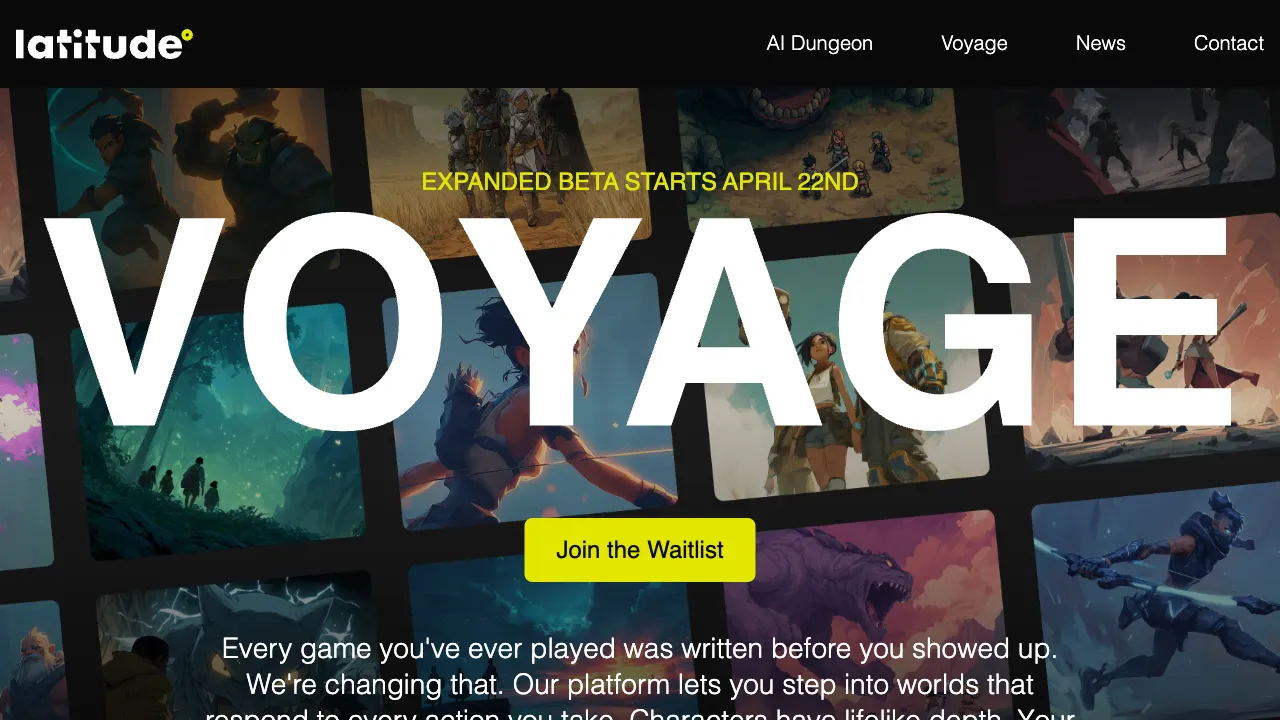
At the end of 2019, three full years before ChatGPT appeared, a web game called AI Dungeon suddenly went viral online. Players excitedly shared screenshots of themselves trying to ride dragons, proposing marriage to villains, or ruling a kingdom with a spoon—and the game actually caught every one of these inputs, providing plausible narrative responses. For most ordinary people, this was their first time conversing with a large language model in their lives, three years before ChatGPT ignited the world.
AI Dungeon initially used GPT-2 and later moved to GPT-3, with the model continuing the story from players’ input. Compared with games built around preset choices and branches, it lets players describe actions in their own words and generates the next part of the story.
What Latitude and AI Dungeon Are
Latitude (latitude.io) is the development company behind AI Dungeon, founded by Nick Walton—AI Dungeon was originally a project he created during a university hackathon. The company has continued to develop products around "AI-driven interactive narrative," with AI Dungeon remaining its flagship title to this day.
AI Dungeon itself is an infinite text adventure game: you play as the protagonist of the story, inputting whatever you want to do in natural language. The AI acts as the game master (similar to a Dungeon Master in tabletop role-playing), generating responses from the world, reactions from NPCs, and plot progression on the spot. There are no fixed scripts, no preset endings, and no "invalid commands"—the direction of the story is entirely determined by you and the AI improvising together.
Core Gameplay and Features
Infinite Interactive Narrative
The core loop of the game is minimalist: AI describes a situation → you input an action/dialogue/narration → AI writes the consequences → repeat. Inputs are divided into three modes:
- Do (Action): "I pry open the treasure chest's lock" → AI describes the result, which might be gold coins or a trap
- Say (Dialogue): "I ask the guard: 'What has been happening in the city lately?'" → AI responds as the guard
- Story (Narration): Directly write the plot as an author to guide the direction of the story
The key point is that the AI will not reject your wild ideas. In traditional RPGs, you can only choose A, B, or C; here, you can choose Z—negotiating with a dragon to become its business partner in its lair, inventing steam engines in a medieval world, or persuading a villain to open a tavern together. The AI takes these inputs seriously and deduces the consequences. This sense of freedom—that "anything could happen"—is the irreplaceable core experience of AI Dungeon.
Multiple Worlds and Scenarios
Built-in starting worlds include fantasy, sci-fi, cyberpunk, horror, modern, and post-apocalyptic settings, as well as a massive library of community-created scenarios (Scenarios) to play. In fully custom mode, you can set up the worldview, characters, and opening situations from scratch, with the AI hosting the story within your framework.
Memory and World Info Systems
The biggest enemy of long-form stories is AI forgetfulness. AI Dungeon provides tools to address this: Memory stores core facts of the story (protagonist identity, important events), while World Info acts like a glossary, recording characters, locations, and settings. When related terms appear, they are automatically injected into the context, helping the AI maintain consistency with the setting.
This system is the watershed moment for experience quality. Players who diligently maintain their settings can play out coherent long-form epics, while those who play without preparation often encounter plot drift after just a few dozen turns.
Creative Writing Tool Attributes
Many users treat AI Dungeon as a creative writing tool rather than a game: using it to simulate world-building, test how characters react in certain situations, overcome writer's block (by having the AI improvise several development directions), or simply enjoying the process of co-creating stories with the AI. The boundary between game and writing tool is inherently blurred here.
Multiplayer Mode
Supports multiple players joining the same story, taking turns acting, with the AI hosting uniformly—essentially an online role-playing session with no script limits.
Comparison with Similar Products
vs Character.AI: Character.AI's core is "chatting with characters"—you are conversing with a character that has a specific persona. AI Dungeon's core is "adventuring in a world"—the AI plays the entire world (narrator + all NPCs + rules). If you want to chat and romance, look to C.AI; if you want to run campaigns and adventure, look to AI Dungeon.
vs NovelAI: NovelAI also supports AI interactive narrative, with finer control over text quality and style, leaning more toward a "serious creative tool." It has looser content restrictions (which is why it received many users who left AI Dungeon after the 2021 content censorship controversy). AI Dungeon has more complete game mechanics (Do/Say modes, scenario community, multiplayer mode). If you lean toward writing novels, choose NovelAI; if you lean toward playing games, choose AI Dungeon.
vs Running Campaigns with ChatGPT/Claude: It is entirely feasible to let general large models act as DMs, and their capabilities are even stronger. However, you need to build and maintain the entire framework yourself (setting injection, memory management, action formatting), and setting loss becomes more severe as conversations get longer. AI Dungeon has productized this scaffolding, ready to play out of the box.
vs Traditional Text Adventures/CRPGs: Carefully crafted traditional games far surpass AI improvisation in plot quality, pacing, and payoff of foreshadowing—stories written by human designers are simply better. However, replayability and freedom are on a completely different dimension. The two satisfy different kinds of fun.
Who Is AI Dungeon For?
Campaign Enthusiasts: When you can't find teammates or a DM, AI Dungeon is a solo campaign that can start anytime, with looser rules and freer imagination.
Creative Writers: Use it as a sparring partner and inspiration pump for improvisational writing, especially suitable for exploring plot deductions like "what if the character did this?"
Curious About AI Interactive Narrative: If you want to experience the current state of "AI storytelling," AI Dungeon is the oldest and most mature entry point.
Role-Playing Enthusiasts: If you want to play any identity and make any choice in a world that completely goes along with you, there are no scripts for murder mysteries here, only your script.
Limitations
Consistency is an eternal pain point: in long stories, the AI still forgets or distorts previous settings. NPC personalities drift, dead characters resurrect, and geographical relationships become chaotic. The memory system can alleviate but not cure this; it is a common ceiling for all current AI narrative products.
Plot quality varies widely—the AI sometimes delivers stunning plot twists, and other times falls into mediocre loops (being trapped in infinite dungeon corridors and repetitive combat descriptions is an experience familiar to veteran players). Accepting "unstable quality" as an inherent trait of improvisation will significantly improve the experience.
Content policies have undergone drastic swings: the 2021 content censorship incident caused massive user loss and a crisis of trust, followed by several policy adjustments. Users sensitive to content freedom are advised to understand the current policies before investing time.
Limited Chinese Experience: The AI is primarily optimized for English. While Chinese input is usable, the generation quality differs significantly from English.
Pricing
The free version allows gameplay using basic AI models with certain limitations. Paid subscriptions come in multiple tiers (monthly), unlocking stronger AI models (significant improvements in plot quality and memory capabilities), longer context windows, and more customization features. Specific tiers are subject to the official website.
The free version is sufficient to experience the essence of the gameplay; if this style clicks with you, the experience upgrade from the premium models in paid tiers is worth it—when AI acts as DM, the smarter the model, the more real the magic becomes.
As the product that let the world first witness the magic of large language models, AI Dungeon's place in the history of AI applications is already written. And for the category of "AI improvisational narrative" it pioneered, the story has only just begun.