

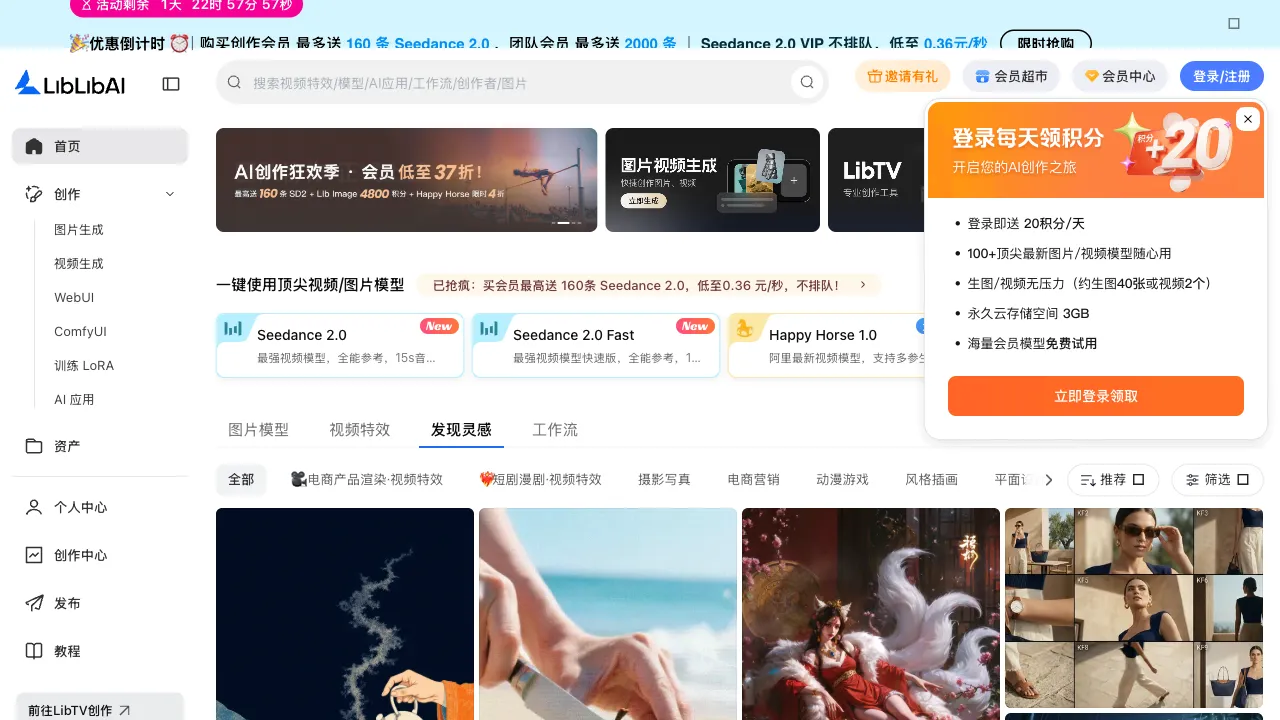
In the field of AI image generation, the upper limits of output quality and stylistic diversity largely depend on one thing: which models you use. The official base models for Stable Diffusion are fully functional, but their outputs are generic. Achieving specific styles—such as cyberpunk concept art, soft Japanese anime aesthetics, or traditional Chinese fine-brush portraits—requires specialized community-contributed models. Civitai is the largest international SD model community, but access from within China is unstable and sometimes completely blocked. Liblib (Liblib AI) fills this gap, serving as one of the core options for domestic SD model communities.
What is Liblib?
Liblib (liblib.art, Liblib AI) is a domestic platform focused on the Stable Diffusion ecosystem, aggregating a vast array of resources uploaded by community creators, including Checkpoint base models, LoRA style fine-tuning files, and Embeddings. Beyond model downloads, the platform also offers online image generation services—allowing users to generate images using community models directly in their web browsers without needing local GPUs or technical configurations.
If Stable Diffusion is compared to a camera, Liblib is like a shop selling various specialty films and filters. The base tools are accessible to everyone, but the quality of the results largely depends on which "film" you use.
Launched in 2023, the platform rapidly accumulated a large user base and model resources, standing alongside TusiArt as one of the two most active domestic SD model communities.
Core Content
Checkpoint Base Models
A Checkpoint is the complete base model file for SD, determining the foundational style direction of generated images. Liblib’s collection of Checkpoint models covers several main categories:
Anime and Manga: This is the most active category on Liblib. Specialized models exist for various anime styles—soft Japanese aesthetics, Chinese classical beauty, pixel game art, comic line art, realistic-anime hybrids, and more. Creators have trained specific models for each style, yielding generation quality far superior to generic models. For anime creators, this is virtually an infinite resource library.
Realistic Portraits: Models featuring Asian female photography styles are popular on Liblib. These include models specifically trained on Asian facial features, producing results that are more realistic and natural than generic models’ depictions of Asian portraits, with more accurate skin texture and facial proportion rendering.
Chinese Traditional Art: Models for ink wash, fine-brush, and blue-green landscape styles benefit from data accumulation unique to domestic platforms, often outperforming general training on overseas platforms.
Illustration and Concept Art: Specialized models for commercial illustration, game concept art, fantasy concept art, and other directions.
Architecture and Interior Design: Specialized models for interior visualization assistance and architectural concept generation, used by interior designers.
LoRA Files
LoRA (Low-Rank Adaptation) is a lightweight fine-tuning module in the SD ecosystem that can overlay specific stylistic effects or character traits onto base models. Liblib’s LoRA resource library is extensive:
Artist Style LoRAs: LoRAs that mimic the style of specific illustrators, which can be overlaid on base models to generate images with that artist’s stylistic characteristics.
Specific Character LoRAs: LoRAs for specific characters from games or anime, enabling stable generation of those characters’ visual traits.
Clothing and Prop LoRAs: LoRAs for specific types of clothing (e.g., Hanfu, military uniforms, school uniforms), props, and accessories.
Effects and Style LoRAs: LoRAs for specific visual effects such as watercolor textures, sketch lines, or cyberpunk lighting.
LoRAs are used by overlaying them onto Checkpoints, and multiple LoRAs can be stacked simultaneously (by adjusting their respective weights). This combination method greatly expands the customization space for generation results.
Community Showcase and Prompt Learning
Each uploaded model includes example images provided by the creator to demonstrate its actual output, along with corresponding prompts (positive and negative) and parameter settings. These are invaluable learning resources.
For SD beginners, browsing Liblib’s model showcases and their associated prompts is the most intuitive way to learn “how good images are made.” A model’s rating and save count also serve as reference indicators for quality—highly rated and saved models typically deliver excellent results and are worth trying first.
Online Image Generation Service
Liblib is not just a model download platform; it also provides an online image generation service based on community models. Its interface closely resembles that of the local SD WebUI (AUTOMATIC1111):
Core Feature Support: It supports text-to-image, image-to-image, and inpainting, covering the main use cases for SD.
ControlNet Control: It supports major ControlNet preprocessors—pose control (OpenPose), line art control (Canny/Lineart), depth control, etc.—allowing precise control over composition and pose in generation results, rather than relying solely on prompts.
Multi-LoRA Stacking: The online service also supports loading multiple LoRAs simultaneously and adjusting their weights, allowing users to experience LoRA combinations without local deployment.
Direct Use of Community Models: Online generation allows direct selection of models from the Liblib community. There is no need to download or install anything; simply switch models as desired.
This online service is significant for users without local GPUs. High-quality community models on Liblib, which originally required downloading (often several GBs) and having a sufficient graphics card, are now accessible to everyone via the web.
Cloud LoRA Training
The platform also supports training personal LoRAs in the cloud, meaning you can train a LoRA file for a specific style or character using your own prepared image assets. This significantly lowers the technical barrier for “having AI draw a specific character” or “mimicking my art style”—previously, this was possible only for tech-savvy users with GPUs. Cloud training opens this capability to ordinary users.
Comparison with Competitors
vs. TusiArt: These two are direct competitors with highly similar positioning—both are domestic SD model communities combined with online generation. Their model libraries have distinct strengths; it is generally recommended to register on both and see which resource aligns better with your stylistic preferences. Many power users utilize both platforms, choosing different ones for different styles.
vs. Civitai (International Original): Civitai is the international standard for SD model communities, offering more comprehensive resources and high-quality models that are often published there first. However, access from China is slow and sometimes completely blocked, and some content may not comply with domestic regulations. Liblib serves as a domestic alternative, offering stable access, moderated content, and seamless usability.
vs. WuJie AI: WuJie AI positions itself more toward beginner-friendliness with a simpler interface, though it also relies on SD models behind the scenes. Liblib targets users with existing SD experience, offering deeper functionality and finer granularity in model selection, making it suitable for those with some understanding of SD technology.
vs. Local Stable Diffusion WebUI: Local SD offers complete freedom—you can use all models from Civitai and Liblib, generate infinitely, have full ControlNet support, adjust all parameters freely, and maintain total privacy without data uploads. The trade-off is the need for sufficient GPU hardware (at least 8GB VRAM, 12GB+ for smoother performance), Python environment configuration, WebUI installation, and a certain technical threshold. Liblib’s online service is a “zero-configuration” alternative, sacrificing some flexibility for instant usability.
Who Should Use Liblib?
SD Advanced Users: Those who already understand basic concepts like Checkpoints, LoRAs, and ControlNet and wish to explore different styles within a rich model library will find Liblib a more convenient resource hub than manually downloading models locally.
Anime Creators: The anime category is Liblib’s strongest content segment, with numerous models and rapid updates. Creators in this field rarely bypass Liblib.
Users Without GPUs: Those with strong SD usage needs but lacking high-performance graphics cards can use the online generation service as a direct solution, accessing a feature set nearly identical to local deployment.
AI Art Learners: Browsing model showcases and their associated prompts is one of the most efficient ways to learn SD prompt writing. Real-world examples provide more intuitive reference than tutorials alone.
Creators Needing LoRA Training: Those who wish to train LoRAs for specific characters or styles but lack a local GPU can use the cloud training feature as a viable alternative.
Limitations
Content moderation is a uniform constraint for domestic platforms; some content publishable on overseas platforms is restricted on Liblib, resulting in less creative freedom compared to Civitai.
The online generation service has limited free credits. Frequent usage requires paid top-ups, and costs accumulate with usage volume. For professional users requiring massive generation, local deployment (with one-time hardware costs and zero marginal costs) may be more economical.
Cloud generation speed is affected by server load; there may be queueing during peak hours, preventing the instant response offered by local GPUs.
Pricing
Registered users receive daily free credits for online image generation. Once credits are exhausted, paid top-ups are required. Model downloads are generally free (though some high-quality models may require credits or payment). Cloud LoRA training consumes computing resources that must be paid for with credits. Specific pricing and credit schemes are subject to the official website.
For domestic SD users, Liblib is an indispensable resource library. Even if used solely as a channel for model discovery and download, without utilizing the online generation features, the high-quality community models alone justify registration and usage.