

The cruelty of the game industry lies in this: failure rarely happens during development; it is often sealed at the moment of project inception. Steam launches tens of thousands of games every year, most of which see dismal sales. Upon review, the common causes of death are not poor code or lackluster art, but misjudgments at the creative level: building a gameplay loop for a saturated market, targeting a player base that doesn’t exist, or betting two years of your life on a concept that could be debunked in three days. For indie developers whose resources are counted in "individuals," one mistake in project inception means losing everything.
Traditional AAA studios hedge against this risk with market research teams; indie developers can only rely on scrolling through forums, checking leaderboards, and trusting their intuition. Ludo AI aims to toolify "market intelligence and creative work before project inception." Its name is derived from the Latin word for "I play" (ludo), yet its positioning targets the most serious part of the game creation phase.
What is Ludo AI?
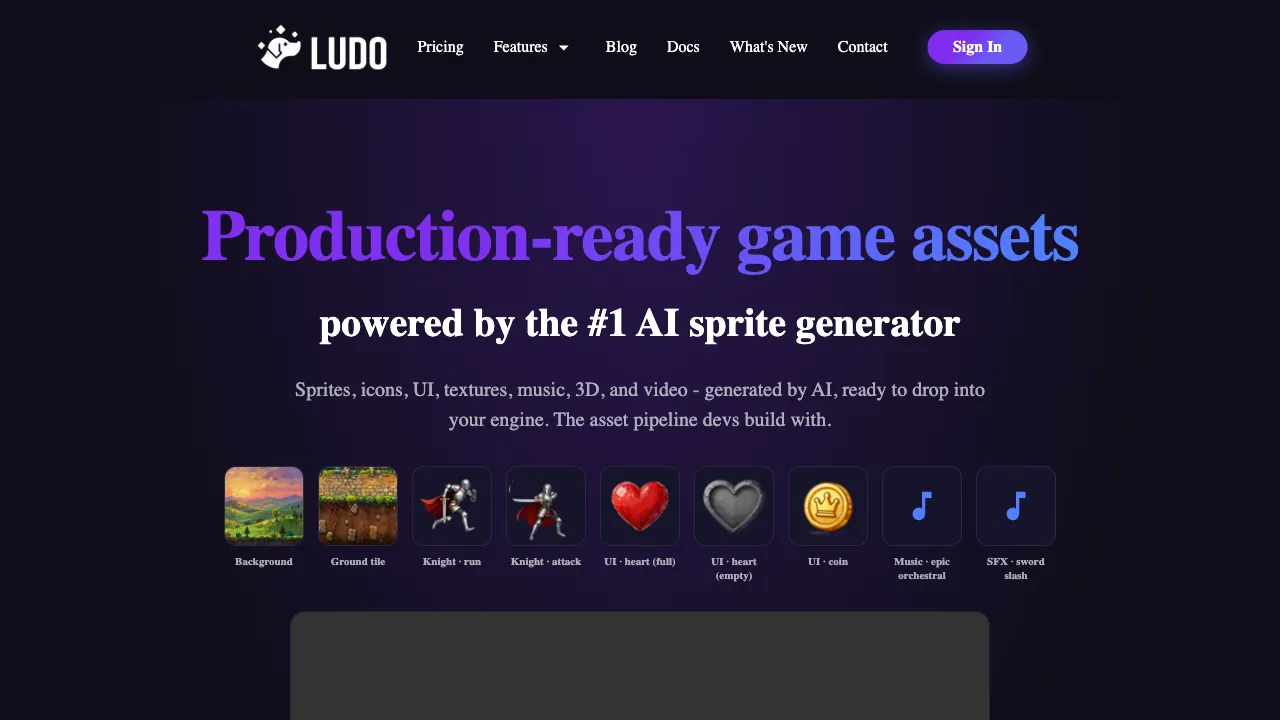
Ludo AI (ludo.ai) is an AI creative and research platform for game developers, offering three core capabilities around the early stages of game development: game market research and trend analysis, game concept generation and iteration, and rapid production of game visual assets.
It deliberately avoids engines and code—Unity/Unreal are responsible for "building the game," while Ludo handles the upstream question: "What game should we build?" This positioning is quite unique among AI tools; most game-focused AI tools cluster around asset generation, with very few focusing on "project inception decision support."
Key Features
Game Database and Market Research
The foundation of Ludo is a continuously updated, large-scale game database that indexes massive amounts of data from games across various platforms (primarily mobile, with some PC coverage), including gameplay tags, themes, commercial performance, and player reviews. Built on this, it offers:
Trend Tracking: Which gameplay mechanics are rising, which themes are becoming overheated, and what combinations new hits are using—using data to answer "where the market wind is blowing." For a trend-driven market like mobile gaming, the timeliness of such intelligence is highly valuable.
Similar Game Search: Input your concept description to find existing games with similar gameplay in the market and their performance. The due diligence you should do before inception—"Has my idea already been done? How well?"—shifts from impression-based searching to systematic retrieval.
Competitor Analysis: Mining player reviews of benchmark games to see what players praise or criticize, directly converting this into a checklist of pitfalls to avoid in your design.
Game Concept Generation and Iteration
Transform vague directions into structured concept documents: input keywords or fragments of ideas, and AI expands them into game concepts containing core gameplay loops, target audiences, key mechanics, and selling point descriptions.
Its proper use is not "letting AI think up ideas for me," but acting as a brainstorming accelerator: generating twenty concept variants in an hour for humans to filter and combine—the ancient rule in creative work that "quantitative change catalyzes qualitative change." AI has lowered the cost of producing "quantity." Using it to pre-generate material before team brainstorming sessions raises the starting point of discussion significantly.
Game Visual Asset Generation
Image generation tuned for game scenes: character concept art, scene atmosphere images, props, icons, and store page assets.
For indie developers, its value anchor is clear: visual placeholders during the prototyping phase. Demos that validate gameplay do not need—and should not burn money on—hiring artists; AI assets are sufficient to support internal reviews and early testing. Once the direction is validated, then invest in real art budgets. Additionally, including a set of AI concept images in project pitches improves communication efficiency far beyond pure text descriptions.
Store Page and Marketing Asset Assistance
Game name suggestions, store description copy, icon schemes—the "facade engineering" phase before launch, where AI provides multiple starting options. In the mobile game market, icons and store pages directly determine conversion rates; the value of testing multiple options in this stage is real.
Comparison with Alternatives
vs ChatGPT for Game Design: Using a general large model to discuss creativity is entirely feasible, but it lacks a structured game market database—it has "read" text about games but doesn't know which casual gameplay category saw rising downloads last month. Ludo’s data foundation is its core differentiator; using large models for creative divergence and Ludo for market validation is a reasonable division of labor.
vs Midjourney: MJ produces stronger pure image quality; Ludo’s generation wins by being embedded in the game workflow (preset asset types, linkage with concept documents). Use MJ for a stunning key visual; use Ludo to quickly fill out a complete set of assets for prototyping.
vs Sensor Tower / data.ai and other market data platforms: The depth of professional mobile market data (downloads, revenue estimates) far exceeds Ludo’s, but the price is enterprise-level (annual fees starting at tens of thousands of dollars), and they do not offer creative assistance. Ludo is like a "lightweight version of market intelligence + creative workshop" combo for indie developers.
vs Unity/Unreal: Different stages, no competition—Ludo’s outputs (concepts, assets, market conclusions) serve as inputs for engine work.
Who Should Use Ludo AI?
Indie Game Developers: The group with the highest cost of trial and error in project inception. Ludo’s market search can debunk bad ideas before development begins—avoiding one wrong project inception is worth far more than the subscription fee.
Mobile Game Team Planners and Publishers: Trend data and competitor review analysis are directly useful for the fast-paced planning and tuning of mobile game projects; this is also the area where Ludo’s data coverage is strongest.
Game Creative Roles (Planners/Producers): Use concept generation as brainstorming fuel and the database as ammunition for arguments, simultaneously improving the speed and persuasiveness of pitch outputs.
Students and Enthusiasts in Game Design: Learning "what kind of games succeed" using real market data is far more effective than practicing in a vacuum.
Limitations
Data is primarily focused on the US/European and global mobile markets, with limited coverage and understanding of the Chinese domestic market (channel servers, game license ecosystem, user acquisition logic). Domestic publishing decisions must be supplemented with local data sources; domestic developers should keep this in mind.
AI can suggest familiar combinations of themes to start an idea. Whether a game feels original still depends on design choices, prototypes and human selection.
Asset generation quality is suitable for prototypes and references, not for final art assets; when used commercially, pay attention to policies regarding AI-generated content on various distribution platforms.
Pricing
Offers a free version to experience basic features; paid subscriptions (tiered, roughly starting from over $10 per month) unlock full research features, more generation quotas, and team collaboration. Refer to the official website for specifics.
For indie developers, whether Ludo is worth subscribing to can be tested with one question: For your last shelved project, would you have skipped development entirely if you had spent two hours doing systematic similar game searches before inception? If the answer is "yes"—then this tool’s two hours are worth integrating into your workflow.