

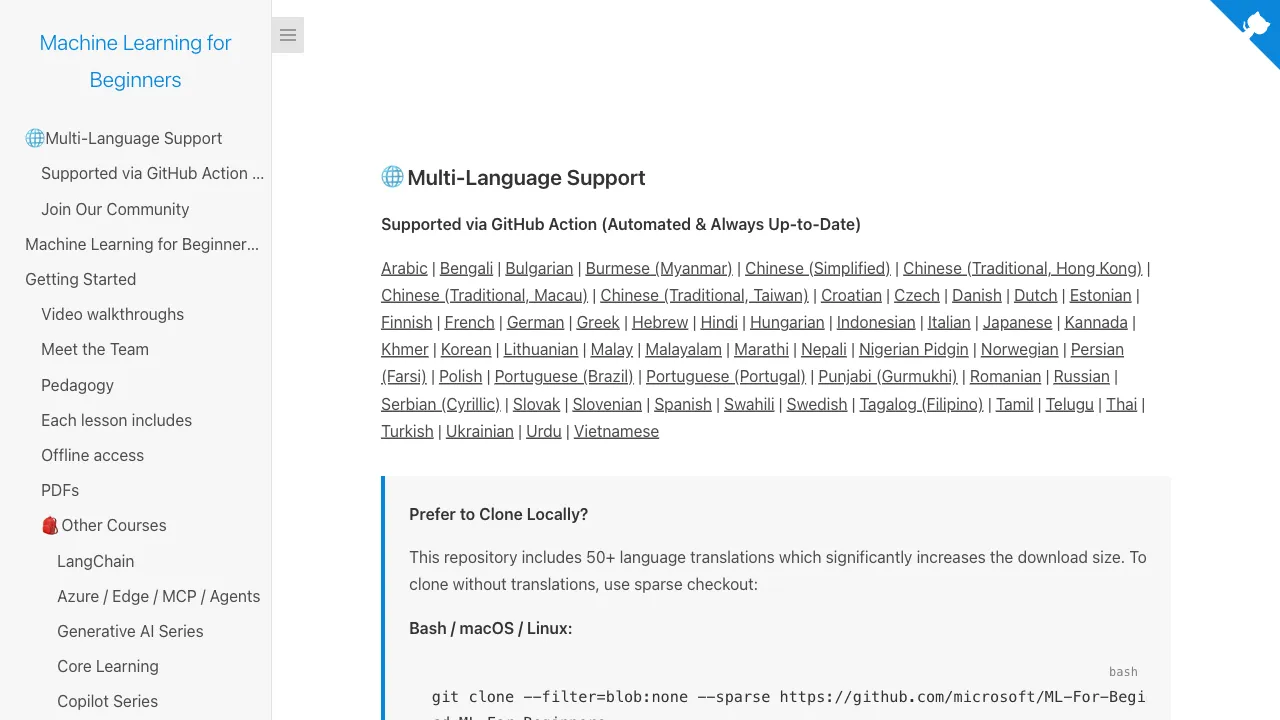
There is a special category of "treasure repositories" on GitHub: those with zero lines of product code yet boasting tens of thousands of stars. Microsoft’s ML-For-Beginners is a star among them, consistently ranking at the top globally for educational repositories. This phenomenon reveals a truth about supply and demand: while introductory machine learning materials seem to be everywhere, resources that simultaneously meet three criteria—free, systematic, and non-intimidating—are rare. The middle path between the two extremes of market textbooks—the "math-heavy theory" approach that drives learners away and the "quick-fix library user" approach—is precisely the scarce commodity: a path that emphasizes understanding principles, hands-on practice, and gradual progression.
The open-source course created by Microsoft’s Cloud Advocates team fills this gap.
What is ML for Beginners?
ML for Beginners (github.com/microsoft/ML-For-Beginners) is an open-source systematic introductory machine learning course released by Microsoft on GitHub: 12 weeks, 26 lessons. It begins with the history and ethics of machine learning, covering classic domains such as regression, classification, clustering, NLP, time series, and reinforcement learning. All lecture notes, code, quizzes, and assignments are open-source; it is free for individual self-study and free for instructors to use in their courses (under the MIT license). It serves as a comprehensive "teaching toolkit," which explains its widespread adoption in universities and training circles globally.
The choice of tech stack is deliberate: Python + scikit-learn. The course intentionally avoids deep learning frameworks, prioritizing a solid foundation in classical machine learning—a pedagogical stance that runs throughout the entire curriculum.
Course Content Landscape
Foundations and Ethics
The course covers the brief history of machine learning, core concepts, and workflows—and includes a topic often ignored by other textbooks but placed prominently at the beginning by Microsoft: Fairness and Ethics. Addressing algorithmic bias and data fairness in the first week establishes the moral compass of this course, reflecting its contemporary relevance.
Core Classical Algorithms
- Regression: Starting with linear regression to master the basics of predicting continuous values.
- Classification: From logistic regression to multi-class classifiers, understanding the principles behind problems like spam detection.
- Clustering: Unsupervised learning, allowing algorithms to discover data structures on their own.
- NLP Intro: From text processing to sentiment analysis, a classic path to linguistic intelligence.
- Time Series: Tools like ARIMA for forecasting in finance and energy sectors.
- Reinforcement Learning: Understanding "trial-and-error learning" through mini-games—the conceptual starting point for technologies like AlphaGo.
Thoughtful Dataset Design
A charming detail of the course: the practice datasets are deliberately global—North American pumpkin prices, Asian recipes, Nigerian music, and global electricity data. This avoids theInertia (inertia) of "Western-centric" textbooks, making learning more engaging. Each lesson includes pre- and post-quizzes and Notebook assignments, forcing learners to bridge the gap between "understanding" and "doing."
Comparison with Other Learning Resources
vs. Andrew Ng’s Machine Learning (Coursera): A legendary introductory course with stronger theoretical depth and systematic structure, delivered via video. ML for Beginners is lighter, entirely free, and driven by text and code. A common effective combination: use this course to quickly build a panoramic view, then take Andrew Ng’s course to deepen theoretical understanding.
vs. fast.ai: fast.ai takes a radical "top-down" approach, running the latest deep learning models in the first lesson, suitable for learners who prefer "experience first, understand later." This course is a steady "bottom-up" approach, covering classics before frontiers, ideal for those who want to know why things work. Neither philosophy is superior; it depends on your learning style.
vs. Google ML Crash Course: Google’s crash course centers on TensorFlow with a fast pace. This course centers on scikit-learn with a more relaxed, systematic approach. They are complementary and can be used together.
vs. Bilibili/Online Video Courses: Videos are intuitive but prone to "watch-and-forget." The quiz and assignment mechanisms in this course force hands-on practice, resulting in significantly higher knowledge retention. When learning programming skills, your hands are always more honest than your eyes.
vs. Learning LLM Applications Directly: Those aiming to build LLM applications often ask, "Do I still need to learn classical ML?" The honest answer: you can skip it for application-layer work, but if you want to go deeper (fine-tuning, evaluation, data engineering), the conceptual foundation of classical ML is inevitable. Learning it early is cheaper than learning it later.
Who Is This Course For?
Career Changers and Students with Python Basics: If you know basic Python and want a systematic introduction to ML, this is one of the most complete options in the free world—the core audience.
Engineers "Making Up for Lost Time" in the AI Era: Developers who haven’t touched ML can build a complete conceptual framework in 12 weeks, allowing them to communicate confidently with algorithm colleagues.
Teachers and Trainers: The open-source teaching toolkit is ready to use, drastically reducing preparation costs—this is why the course has penetrated classrooms globally.
Hesitant Observers Testing the Waters: Unsure if you really want to learn ML? Try the first few weeks for free; it’s far better than buying a thousands-of-dollars course and regretting it later.
Limitations and Learning Advice
The course does not cover deep learning or neural networks. After completing it, you will understand classical ML, but there is still a journey to LLMs and diffusion models; transitioning to fast.ai or a deep learning specialization is the natural next step. The text-and-code format may not suit video-dependent learners; consider pairing it with Bilibili explanation videos.
One key mindset: Don’t just read; run the code. Run every lesson’s Notebook yourself, tweak parameters, and observe changes. In 12 weeks, you will be a different species from those who "learned by collecting." The community has circulated Chinese translations; if English is challenging, search for them to assist your study, but it is recommended to tackle the original version as much as possible—the working language of ML is ultimately English.
Price
Completely free: the curriculum is hosted in full on GitHub, free to browse, clone locally and contribute to. There are no paid tiers and no account system.
The structure is 12 weeks across 26 lessons, with exercises and projects — enough substance to work through as a course with a beginning and an end rather than something to dip into.
Because it lives on GitHub, updates and corrections are publicly visible in the commit history, so you can check how actively it is maintained before committing to it.