

Writing a novel is fundamentally different from creating short-form content. If you mess up a short article, rewriting it is just a matter of a few hundred words. But if you reach the tenth chapter of a long story and realize there’s a contradiction in the second chapter’s lore, you’re left with two choices: go back and fix it, or plow forward with that plot hole. If Character A says they’ve been afraid of dogs since childhood in Chapter 3, but adopts a Golden Retriever in Chapter 8, readers will notice. But if you can’t even remember what you wrote earlier, such contradictions are nearly impossible to prevent.
This is why most people with writing impulses get stuck when attempting long-form works: it’s not a lack of ideas, but rather that the story system is too complex for human memory to manage all the details. The result is either writer’s block or plot holes, and ultimately, many stories are abandoned halfway through.
Novelist AI was designed specifically to address this problem—not just to help you write text, but to help you manage the story itself.
Novelist AI What It Is
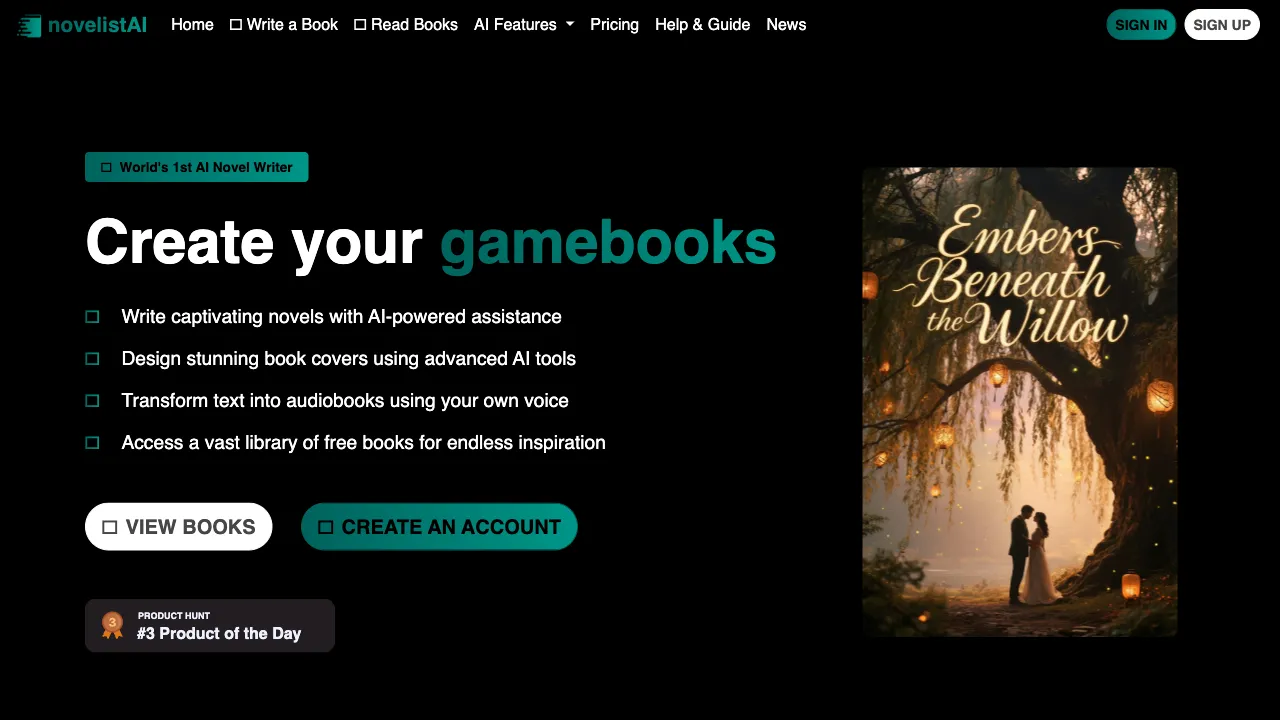
Novelist AI (novelistai.com) is an AI-assisted platform for novel and long-form story creation, integrating AI-generated writing, world-building management, character profiles, and plot planning. Its goal is to make the process of creating long stories more structured and sustainable.
It is not a general conversational AI like ChatGPT, nor is it a simple “write me a story” tool. Novelist AI’s design premise is that long-form creation requires a “collaborative partner” that remembers every detail of your story, allowing you to reference existing content at any time to ensure newly generated material doesn’t contradict the established world-building, characters, or plot.
Target users include: amateur creators with writing impulses, web novel professionals, game narrative designers, and students with creative writing needs.
Core Features
AI Continuation and Generation
The most direct feature: when you hit a wall, let the AI continue. This “continuation” isn’t blind generation; it references everything you’ve written so far, your established character profiles, and your world-building rules to generate logical follow-up content within those constraints.
Usage is flexible: you can let the AI write freely, provide a plot direction (e.g., “the protagonist discovers a key clue next”) for the AI to generate content within that framework, or specify a scene (e.g., “a conversation between two characters in a café”) for the AI to fill in specific dialogue and action.
Writing style references existing content. If you’ve already written several chapters, the AI will learn your narrative rhythm, sentence structure, and word choice habits, generating content that stylistically matches your existing work rather than suddenly shifting to a different narrative tone.
Character Profile Management
This is one of Novelist AI’s most important features distinguishing it from general AI writing tools. It allows you to create independent profiles for each character:
Basic Information: Name, age, physical description (height, hair color, eye color, body type, etc.). This information ensures the AI maintains consistent physical traits when describing characters, preventing scenarios where a character has long black hair in one chapter and short brown hair in the next.
Personality Traits: Core personality characteristics, behavioral habits, catchphrases, and speaking style. The AI references these settings when generating dialogue and behavior, ensuring the character’s portrayal aligns with their personality—introverts won’t suddenly become boastful, and calm individuals will have specific stress responses under pressure.
Backstory: The character’s upbringing, significant events, psychological trauma, or sources of motivation. These backgrounds directly influence why a character makes specific decisions, which the AI references when handling character actions.
Relationships: The network of relationships between characters—who is an ally, who is an opponent, what historical grievances exist, and the current state of their relationship. This provides accurate reference points for scenes involving multiple characters.
World-Building Management
Fantasy and science-fiction stories often have many settings. World-building tools help record rules, places and character relationships to reduce inconsistencies.
Geography and Settings: Descriptions of the world’s map, cities, and key locations. The AI references these settings when dealing with geographical content, ensuring the distance between City A and City B remains consistent.
Rule Systems: Internal operational laws of the world, such as magic rules, technology levels, and social systems. These rules form the basis of story consistency; the AI understands the physical laws and social logic of this world, ensuring generated content doesn’t violate established rules.
Historical Background: The era in which the story takes place, significant historical events, and relationships between different factions. These backgrounds provide logical support for politics, culture, and conflicts within the story.
Items and Props: Settings and abilities of important props, weapons, and magical items, preventing inconsistencies where an item’s capabilities change across chapters.
Plot Planning Assistance
Writer’s block often stems not from not knowing what plot points to write, but from not knowing how to connect them or being uncertain about the story’s overall direction. Novelist AI provides assistance at the plot level:
Outline Generation: Describe the story type and main settings, and the AI generates a usable story outline, including major plot arcs, key turning points, and directions for the beginning and ending. This outline can serve as a reference or be adopted directly with modifications.
Plot Development Suggestions: When the story reaches a certain node, the AI analyzes existing plot points and offers multiple possible directions for development, each with a brief explanation. This doesn’t make decisions for you but provides options to broaden yourapproach (thought process) when stuck.
Conflict Design: Helps design character conflicts, plot twists, and climax nodes at appropriate points in the story to avoid flat pacing.
Writing Style Adjustment
Different types of stories require different writing styles. Novelist AI allows users to specify or adjust the AI’s output style:
- Literary Fiction Style: Focuses on internal monologue, complex sentence structures, and literary language quality.
- Web Novel Style: Fast-paced, dense plot, high proportion of dialogue, and quick gratification points.
- Suspense/Thriller Style: Maintains suspense, tight pacing, and strategic information control.
- Lighthearted Slice-of-Life Style: Gentle and brisk, with humor, suitable for light novel genres.
Comparison with Competitors
vs NovelAI: NovelAI is a more well-known AI-assisted writing platform with a deep user base in the English-speaking creative community, particularly accumulating specialized models and features for Japanese-style light novels and visual novels. Its support for adult content (requiring a subscription) is also a distinctive feature. Novelist AI has a more general positioning with deeper world-building management and character profile systems, making it better suited for users seriously engaged in long-form creation.
vs Sudowrite: Sudowrite is an AI writing assistant recommended by professional writers, featuring unique tools like “Description Enhancement” (to make scene descriptions more vivid) and the “Story Engine.” It excels at improving text quality but targets professional users with higher entry-level pricing. Novelist AI offers a more complete world-building and character management system, making it more beginner-friendly.
vs Direct Writing with ChatGPT: While you can certainly use ChatGPT to help write stories—offering high flexibility and good generation quality—ChatGPT’s chat interface lacks persistent world-building and character management. You must re-establish context in every new conversation, making it impossible to truly remember all settings during long-form creation. Novelist AI’s specialized design addresses this structural flaw of ChatGPT.
vs Domestic Writing Platform AI Features: Chinese web novel platforms like Baidu Literature and Qidian are also integrating AI-assisted features. Novelist AI is an English-centric international product with limited Chinese support; domestic writers will typically find using the AI features on local platforms smoother.
vs Notion AI: Notion AI can assist with writing within Notion documents and has strong general capabilities, but it lacks character and world-building management optimized for story creation. It suits general writing but not complex fictional narrative production.
Who Should Use Novelist AI
Amateur Writers Stuck in Long-Term Writer’s Block: Those with story ideas and initial enthusiasm who always stop at a certain point. When character behavior becomes illogical or plots fail to connect, Novelist AI’s structured tools help build a creative scaffold, enabling you to actually finish the story.
Fantasy/Sci-Fi/Xianxia Story Creators: For genres requiring complex world-building, the AI’s ability to reference world settings during generation significantly reduces contradictions, making the creation of stories set in grand worlds manageable.
Web Novel Professionals: Who need high-frequency updates and fast-paced plot progression. AI assistance can boost output speed, generating usable drafts quickly aligned with the author’s creative direction.
Game Story Designers: Independent game developers or studios needing large volumes of world-building text, NPC dialogue, and quest descriptions. Novelist AI’s systematic approach is well-suited for producing this type of structured content.
Students in Creative Writing Courses: Practicing story creation benefits from AI providing immediate continuation examples and plot suggestions, aiding the learning of writing techniques with more reference material and feedback than solitary practice allows.
Usage Recommendations
Don’t rush to have the AI write your main text. The best workflow is: first, complete your character profiles; second, establish world-building settings; third, plan the plot outline; and only then let the AI assist in generating body paragraphs. The more thorough your preparatory work, the higher the quality and consistency of the AI-generated content, and the closer it will align with your expectations.
Treat AI-generated content as a first draft, not a final version. The AI provides structurally sound, setting-compliant text, but literary texture, emotional depth, and unique narrative voice still require your revision and refinement.
Limitations
AI-assisted writing has a fundamental limitation: while AI excels at generating fluent text, it struggles to produce content that truly moves the heart. The authentic depth of emotion, unique life insights, and details that resonate with readers—these stem from real human experience and cannot be generated out of thin air by AI. Stories written relying on AI tend to be “readable but forgettable,” possessing the shell of an excellent story but lacking the core that makes a story truly great.
The language focus is primarily English; support and optimization for Chinese writing lag behind English. Domestic writers may encounter areas requiring adjustment regarding Chinese linguistic nuance.
For authors pursuing a strong personal writing style, AI continuation can sometimes “dilute” your voice, creating a noticeable textural difference between the generated paragraphs and your own writing, requiring significant manual editing to blend seamlessly.
Pricing
Novelist AI offers a free tier that provides basic functionality with limits on the number of words generated by AI. Paid subscriptions unlock additional AI generation credits, full world-building and character management features, and support for more story projects. For specific details, please refer to the official website.
For users who are serious about writing long-form stories, Novelist AI’s structured creation tools offer genuine value. It helps you tackle not just the problem of “not knowing what to write,” but the systemic challenge of “managing a complex narrative”—which is key to actually finishing a novel.