

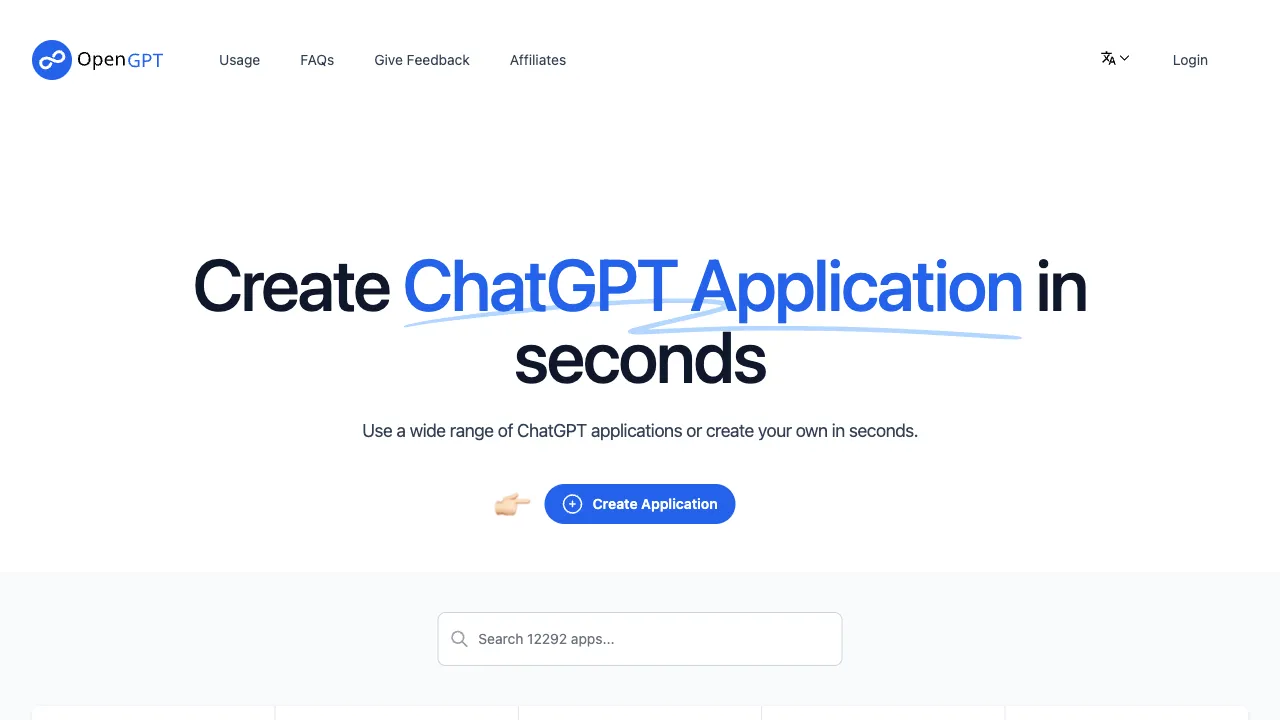
GPT’s capabilities are general-purpose, but that very generality is an obstacle for average users: facing a blank chat window, most people don’t know how to “prompt” it effectively. Writing novels, translating text, or acting as legal counsel each require entirely different prompts, and crafting good prompts is itself a craft. OpenGPT’s solution is to “productize” prompts: encapsulating a tuned system prompt into a ready-to-use mini-app that anyone can open and use immediately without writing their own prompts. It appeared before OpenAI’s official GPTs Store, making it one of the early practitioners of this “turning prompts into apps” approach.
What is OpenGPT?
OpenGPT (open-gpt.app) is a third-party ChatGPT application community, positioned similarly to OpenAI’s official GPTs Store but launched earlier and with greater openness: the platform hosts thousands of user-created ChatGPT applications, each pre-configured with system prompts and use cases for immediate use; it also provides an ultra-minimalist creation interface, allowing anyone to input a system prompt and create their own GPT widget in seconds to share, with zero coding required.
Its essence is an “app store + one-click wrapper for prompts”—lowering the barrier to using and building AI tools.
Types of Applications on the Platform
The coverage is extremely broad, with several typical categories:
Writing Assistance: Article polishing, Xiaohongshu-style copywriting, marketing copy, resumes, and cover letters.
Professional Knowledge: Preliminary legal consultation, medical Q&A, psychological dialogue assistance, financial calculations (for reference only; see notes below).
Education & Learning: Language learning, plain-language explanations of complex concepts, math problem-solving, subject-specific Q&A.
Development & Tech: Code debugging, SQL generation, API documentation assistants, regex generators.
Creative Entertainment: Role-playing stories, travel planning, recipe suggestions, tabletop RPG DM assistants.
Productivity: Meeting minutes organization, email drafts, project planning, data analysis assistance.
Creating Your Own GPT App in Seconds
One of OpenGPT’s core capabilities features an ultra-simple workflow: go to the creation page → input a system prompt (e.g., “You are a Chinese classical poetry research assistant; cite relevant poems and provide background knowledge when answering questions”) → name it and add a description → publish, yielding a shareable app link. Zero coding required; anyone familiar with prompting can get it done in five minutes.
Its most practical value lies in encapsulating repetitive tasks: prompts used repeatedly for fixed-format content review or daily data report generation become far more efficient when encapsulated as an app that you simply open each time, rather than pasting the prompt over and over—this is its real productivity contribution to individuals and small teams.
Comparison with OpenAI’s Official GPTs
OpenAI launched its official GPTs in late 2023, with a positioning highly overlapping with OpenGPT, which poses a direct challenge to OpenGPT:
Advantages of Official GPTs: Built into ChatGPT requiring no extra registration; supports knowledge bases (file uploads); supports tool integration (code execution/web access/DALL·E); mature store discovery mechanism; backed by the latest models.
Characteristics of OpenGPT: Launched earlier, accumulating users and apps; does not depend on a ChatGPT Plus subscription (some features are free); lighter creation process; hosts a large number of community-created Chinese-language applications.
To be honest: as official GPTs improve, OpenGPT’s room for differentiation is narrowing—this is the common pressure facing all third-party platforms that “encapsulate prompts.” Its remaining value mainly serves users who don’t want to pay for a ChatGPT Plus subscription or wish to use ready-made Chinese community applications.
Who Is It For?
Average users who want to directly use ready-made AI tools: Those who don’t want to write prompts and prefer to find corresponding tools in the app library—its core audience.
People performing the same AI tasks repeatedly: Encapsulate frequently used prompts into apps to say goodbye to repetitive input every time.
Creators wanting to share AI tools: Turn your prompt-based tools into shareable applications via a lightweight distribution channel.
Small teams’ internal AI tools: Quickly build several standardized auxiliary tools (code review templates, unified copywriting tools), which is faster than formal development.
Usage Notes
Data Privacy: Content is processed via API calls (typically OpenAI); comply with their respective privacy policies; avoid entering sensitive information.
Variable Application Quality: Since apps are user-created, quality varies widely; prioritize high-rated apps with significant usage counts.
Verify Critical Information: Outputs from medical, legal, or financial applications should not be taken as professional advice; maintain critical thinking—this applies universally to all such platforms.
Pricing
The site offers a limited free trial quota, after which continued use requires a purchased license key. There is also an affiliate program.
No tiers or amounts are published on public pages, so no figures here — check what the site shows you.
Worth being clear about scale: this is a small independent product. The site currently lists 50-odd pre-built apps sorted into productivity tools, copywriting assistants, code assistants, and lifestyle and entertainment. Since OpenAI's official GPT Store launched, "package a prompt as a mini-app" has a more mainstream home — which makes this more useful as a lightweight prompt reference and trial than as a primary tool.