

NVIDIA CEO Jensen Huang publicly stated that he uses Perplexity every day, a remark that introduced the product to many for the first time. However, if you adopt it solely based on celebrity endorsement, it is easy to remain unclear about what exactly makes it good and in which scenarios it is more suitable than Google or ChatGPT. This article aims to clarify this point.
What Is Perplexity?
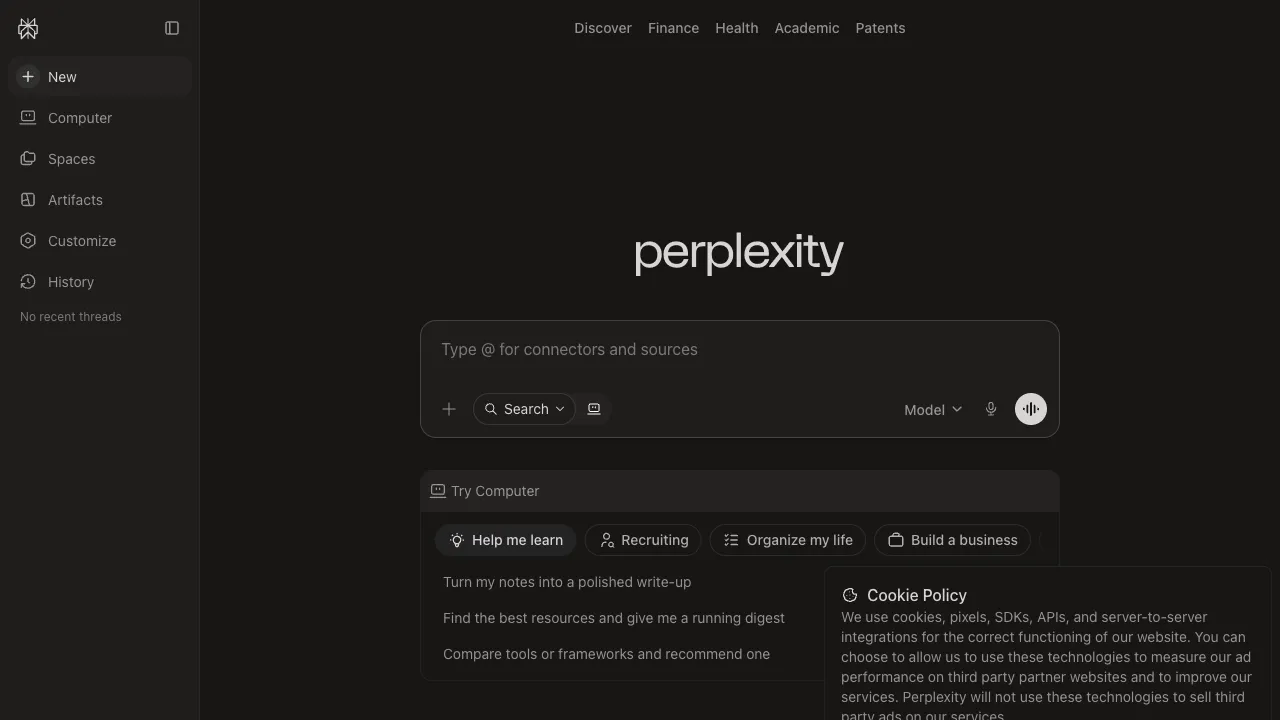
Perplexity is an AI-powered search engine launched in late 2022, founded by a team from top AI institutions such as OpenAI and Meta. Its core product logic is simple: you ask a question, it searches the internet in real time, and then integrates information from multiple sources into a complete answer—with each specific piece of information accompanied by a source citation that you can click to verify the original text.
The difference from traditional search engines lies here: Google gives you a list of links for you to read yourself; Perplexity reads the information and directly provides you with the answer, along with telling you where the answer comes from.
The difference from ChatGPT is also clear: ChatGPT answers questions based on its training data, has a knowledge cutoff date, and does not provide source citations; Perplexity searches in real time, so the information is current, and every detail has a verifiable source.
Core Capabilities
Real-Time Answers with Citations
This is Perplexity’s most core capability. When you ask it a question, it:
- Issues multiple search requests in real time to gather information from different sources
- Reads and integrates the search results
- Generates a clearly structured answer, appending source numbers after each key piece of information
- Lists links to all reference sources below the answer
This workflow is valuable for scenarios requiring reliable information. You do not need to open ten tabs to read them one by one, nor do you need to worry about AI “hallucinating” data—because every piece of information has a source that can be directly verified.
Follow-up questions about search results
Perplexity supports multi-turn conversations, allowing you to follow up on the answers it provides. For example, you might first ask “What are the core differences between these two products?” and, after receiving the answer, ask “What is the pricing logic of the first product?” It will continue searching and answering while maintaining the context from previous turns.
You can add questions, ask for more sources or clarify a detail in the same conversation without restating the topic each time.
Multiple Search Modes
Perplexity offers different search scope settings:
- Web Search (default): Searches the entire internet
- Academic: Searches only academic databases (PubMed, arXiv, etc.), suitable for questions requiring academic sources
- YouTube: Searches video content, displaying relevant videos and summaries
- Reddit: Searches Reddit discussions, suitable for finding real users’ experiences and reviews
- Social Media: Searches latest discussions on platforms like X (Twitter)
This design is quite practical. For instance, if you want to understand the genuine reputation of a product, switching to Reddit mode yields discussions from real users rather than promotional copy from brand websites.
Pages: Generating Research Reports
Perplexity’s Pages feature can organize your exploration process into a formatted document containing titles, sections, and images, similar to a structured article. You can share it or continue editing on it. For scenarios requiring the presentation of research findings externally, this feature saves a significant amount of formatting time.
Deep Research
Pro users can use the Deep Research mode, where Perplexity autonomously plans a research path for a complex question, performs dozens of searches, reads multiple web pages, and ultimately generates a detailed research report. This feature is suitable for important decision-making scenarios requiring comprehensive information—such as choosing investment directions, researching competitors, or understanding a new field.
Where It Outperforms Google
When you need direct answers rather than a list of links: Asking “What are the common side effects of a certain drug?” yields a list of side effects directly from Perplexity, with notes citing the FDA or medical literature, whereas Google gives you a pile of links.
When you need comparative analysis: To compare two products, two solutions, or two companies, Perplexity synthesizes multiple sources to provide a comparison, while Google only gives you links for you to read yourself.
When tracking real-time developments: For the latest progress on a news event or the latest data in a certain market—Perplexity searches in real time, and its answers reflect the current situation.
When verifying a claim: Asking “Is this claim true?” prompts Perplexity to search relevant sources and provide an answer supported by evidence, rather than answering based on impressions from AI training data.
Where It Falls Short of ChatGPT
When needing creative writing or brainstorming: Perplexity’s strength is “finding information,” not “generating content.” Asking it to help you write an article or brainstorm product ideas will yield lower-quality output compared to ChatGPT or Claude.
When needing deep collaboration in long conversations: ChatGPT is better suited for long back-and-forth discussions and multi-round revisions; Perplexity is more oriented toward a Q&A mode.
When processing private documents: Uploading your own documents to ask questions is handled better by Claude or Kimi; document processing is not Perplexity’s core capability.
Pricing
The following reflects the official perplexity.ai/pro page as of September 15, 2026. The page shows only monthly equivalents for annual billing; monthly prices and some add-ons could not be rechecked and are marked "to be confirmed".
- Free: $0, with only a few advanced searches a day on a single default model
- Pro: $17/month billed annually; the monthly price and the student Education Pro price are to be confirmed
- Max: $167/month billed annually, monthly price to be confirmed; unlocking the highest level of model access, Comet's Max Assistant, file and app creation, and Brain — a memory system in research preview — plus unlimited Labs and Perplexity Computer with 10,000 monthly credits
- Enterprise: the pricing page lists an Enterprise plan; per-user prices are to be confirmed
- Comet Plus: an add-on (price to be confirmed) that brings premium publisher content into Comet's AI answers, included with Pro and Max
The Comet browser itself is free. It launched in July 2025 behind the Max plan, opened to everyone on October 2, 2025, and the Android and iOS apps are free too. The free tier covers everyday use; Max is what you need for background automation and agentic features. Current prices live at perplexity.ai/pro (the /pricing URL returns a 404).
Privacy and Usage in China
Perplexity may require a VPN to access within mainland China. Regarding privacy, it records your search history, and the Pro version offers stronger privacy options. If your queries involve sensitive content (such as trade secrets or personal information), you should take this into account.
Summary
Perplexity’s value proposition is straightforward: it helps you find reliable information faster. But it does so well that many users have genuinely changed their daily search habits—when they need to look something up or understand a topic, their first instinct is now to open Perplexity instead of Google.
If you frequently search for information, conduct research, or verify facts, it’s worth giving it a serious try.