

There is a widely circulated rule of thumb in the fast-moving consumer goods (FMCG) industry: consumers spend only a few seconds paying attention to a product while standing in front of a shelf. In those fleeting moments, packaging is the product’s sole voice—it determines whether an item gets picked up or overlooked. This is precisely why large corporations invest heavily in eye-tracking tests, consumer research, and shelf simulations for their packaging. However, the high cost of this scientific approach (a single professional test runs into hundreds of thousands of dollars) keeps small and medium-sized brands at bay; their packaging decisions largely remain in an era of intuition, where the boss simply thinks one version looks better than another.
PLUG AI bridges this gap by doing two things simultaneously: assisting in the generation of packaging design proposals and, more uniquely, evaluating those proposals like a consumer research institute. The latter is its true differentiating identity among various AI design tools: it doesn’t just help you create; it helps you judge whether what you’ve created is right.
What Is PLUG AI?
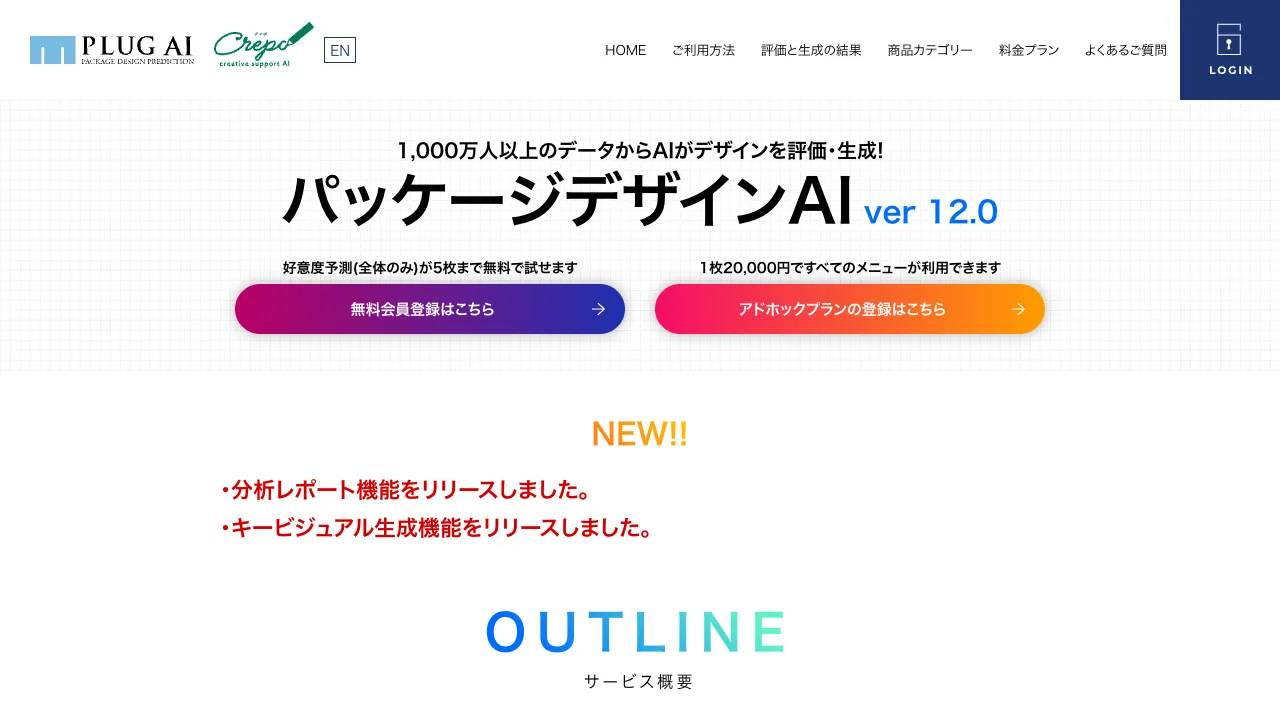
The former Package AI entry now redirects to PLUG's CREPO service. It focuses on packaging-design research and creative evaluation, combining consumer studies with AI-assisted analysis to compare packaging concepts. Current capabilities and service scope should be checked on the CREPO site.
Packaging is a notorious "professional silo" in design (involving dielines, cutting templates, printing specifications, and 3D visual relationships). General-purpose AI design tools generally avoid this space, which creates the survival niche for vertical tools.
Core Features
AI Packaging Proposal Generation
The technical difficulty of packaging generation lies in the fact that it is not a flat image: designs must be drawn on dielines, and they must hold up visually from a 3D perspective after folding—maintaining visual relationships between the front, side, and top panels, as well as pattern continuity at corners. PLUG AI has made specialized adjustments for these packaging-specific constraints:
- Supports mainstream packaging formats (paper boxes, round cans, flexible pouches, bottle labels, etc.)
- 3D Preview: View the 3D formed effect directly, rather than mentally imagining the folding result
- Element layout considers visual continuity after folding
Input brand, category, and style direction to produce multiple proposals—compressing the packaging design cycle from "zero to concept draft" from weeks down to hours. This is the value of the generation side.
AI Packaging Evaluation: Signature Feature
Upload packaging drafts (your own or competitors’), and the AI outputs multi-dimensional analysis:
Shelf Competitiveness: Simulates the packaging standing side-by-side with competitors in a shelf environment, assessing how well this version stands out—"being seen on a colorful shelf" is the primary mission of packaging, something that design drafts can never measure within an office;
Visual Attention Analysis: Where consumers’ eyes land first and whether the visual priority of information aligns with the intended message—an AI version of eye-tracking tests that compresses hundreds of thousands in research budgets into a single upload;
Information Delivery and Category Fit: Whether core selling points are clear and whether the design language conforms to (or strategically deviates from) category conventions.
It is necessary to honestly mark the boundaries: AI evaluation is a prediction based on visual patterns and data training, not a vote from real consumers—its correct usage is as an early filter (screening out obviously weak proposals before investing in prototyping and testing), not a replacement for human research as the final arbiter.
Competitor Analysis and Iteration Assistance
Deconstruction of competitors’ packaging visual strategies and comparison with your own proposals; rapid generation of variants for existing proposals (changing colors, adjusting elements, modifying layouts)—a arsenal for packaging revision decisions.
Comparison with Alternatives
vs. Generation Tools like Midjourney: Can produce stunning packaging concept images, but the output is an "image," not a "design file." It lacks dieline logic, 3D formation, and evaluation—useful for inspiration reference, but missing a huge chunk of the implementation chain. PLUG AI’s vertical depth lies precisely in that missing segment.
vs. Canva Packaging Templates: Lightweight template collages without 3D preview or professional structural support. Sufficient for small-shop sticker-level needs, but inadequate for serious FMCG packaging.
vs. Adobe Illustrator: The execution standard for professional packaging design; final pre-press delivery relies on it. PLUG AI is its upstream concept and decision accelerator, not a replacement—AI provides direction, Illustrator handles execution; the two AIs play to their respective strengths.
vs. Professional Design Agencies + Consumer Testing: Represents the ceiling of effect and rigor, but also the ceiling of budget and timeline. PLUG AI serves the majority who cannot reach that ceiling, as well as clients who want to clarify their direction before commissioning design work.
Who Is PLUG AI For?
New Consumer Brands and SMEs: Groups for whom packaging is critical but budgets are limited—AI generates proposals, AI evaluation aids decision-making, upgrading "boss’s gut feeling" into "evidence-based judgment," hitting their pain point directly.
Product/Marketing Managers at FMCG Brands: In the concept phase of new product development and packaging revisions, quickly producing and screening proposals. Bringing candidates that have passed initial evaluation to meet with design firms changes communication efficiency entirely.
Packaging Designers and Design Firms: An efficiency tool for the concept exploration phase (AI lays out directions, humans refine); the evaluation function adds a layer of "data-driven" persuasiveness to pitches—showing clients attention analysis graphs is far more powerful than saying "I feel this version pops more."
E-commerce Sellers Making Packaging Decisions: Obtain low-cost third-party perspective references for packaging selection during product launches.
Limitations
Ceiling of Creative Uniqueness: AI proposals are based on existing design paradigms; the "innovative packaging language" pursued by high-end brands remains the domain of top-tier designers—AI delivers passing to good grades, while excellence relies on humans.
The Second Half of the Implementation Chain Is Not Its Domain: Professional pre-press steps such as color management, material processes, and dieline production still require professional execution. PLUG AI solves "what to design," not "how to print."
The reference value of evaluation fluctuates with the thickness of category data; AI judgments in niche categories need to be calibrated with human market experience. For important decisions, the combination of AI initial screening + small-scale human testing remains the prudent approach.
Pricing
A paid product, billed via subscription plans or per project; specifics are subject to the official website. Compared to the costs it replaces (quotes from design agencies in the concept phase, budgets for a round of consumer testing), the math for its target audience is straightforward.
PLUG AI represents a clear direction in the evolution of AI design tools: moving from "helping you draw" to "helping you think + helping you verify." If your product is facing packaging decisions—upload your existing proposals (and those of competitors) to view an evaluation report: even if it’s just to find a control group for your intuition, the cost of this "second opinion" is so low that there is no reason to refuse it.