

There is a brutal economic equation to video globalization: producing multilingual versions of a single video traditionally requires a translation team, voice actors, recording studios, and lip-sync post-production. The cost for each language version is nearly equivalent to redoing the entire project. Localizing a 30-minute video into ten languages demands a budget and timeline sufficient to deter most creators and small-to-medium enterprises. Consequently, high-quality content remains trapped at its origin by the wall of language—this is the largest invisible loss in global content circulation. Rask AI targets this exact barrier: using AI to slash the costs of video translation, dubbing, and lip-syncing to levels affordable for ordinary users.
What is Rask AI?
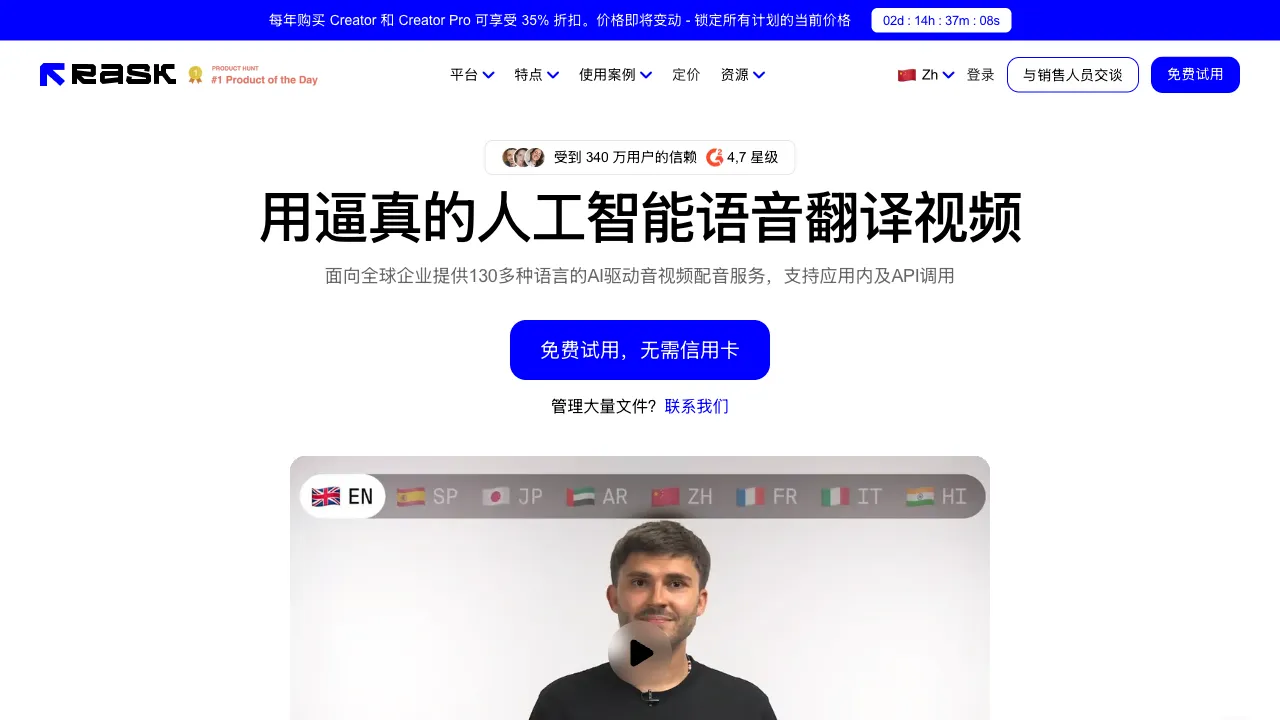
Rask AI (zh.rask.ai) is a platform focused on AI-driven video localization, offering a complete pipeline from speech recognition → translation → AI dubbing → lip-syncing, supporting 130+ languages. It features a Chinese interface, making it user-friendly for domestic creators expanding overseas. Its positioning is clear: it does not generate content from scratch but specializes in "translating existing real-person videos into foreign languages." This focus distinguishes it from digital human tools like HeyGen.
Core Features
AI Video Translation and Dubbing
Upload a video and select the target language; Rask handles the rest automatically: ASR identifies the original speech and converts it to text → translation → AI voice synthesis for the target language dub → alignment with the original video timeline. No human voice actors are needed, and a single video can produce multilingual versions simultaneously—reducing localization from "redoing everything" to "just a few clicks."
Lip-Syncing: The Premium Feature
Its advanced capability, and where its technical value lies, is not just adding dubbing in the background but synchronizing the speaker’s lip movements with the new language audio—viewers see the person in the original video "speaking the foreign language," avoiding the obvious dissonance of post-produced dubbing. This is the ceiling feature for localization quality; Rask is competitive here, though it requires source videos with clear facial visibility and frontal angles.
Voice Cloning Dubbing
Clones the original speaker’s voice to generate foreign-language dubbing, preserving intonation, emotion, and vocal characteristics—the multilingual versions always sound like "the same person speaking," rather than switching to a standard robotic voice. For personal IPs and brands, this feature maintains personality consistency at the vocal level, offering high value.
Subtitle Generation and Editing
Automatically generates bilingual subtitles (original text + translation), with in-platform editing of content and timeline—serving as the entry point for manual review of translation quality and alignment.
Batch Processing
Enables batch localization of multiple videos, catering to educational institutions and enterprises with large video libraries.
Comparison with Similar Tools
vs HeyGen: Both offer video translation and lip-syncing, but their focuses differ—HeyGen is famous for "creating digital humans from scratch" (building a virtual speaker from an image library or cloning), while Rask specializes in the workflow of "translating existing real-person videos." Choose HeyGen to create digital humans; choose Rask to localize existing real-person videos. Both are iterating rapidly, so real-world testing on the same video is the most reliable comparison.
vs Akool: Akool is more comprehensive (including face-swapping and background generation); Rask focuses solely on localization, with its coverage of 130+ languages being a competitive advantage.
vs Synthesia: Synthesia creates AI digital human videos (for corporate training, product explanations) and does not translate existing real-person videos; its positioning is entirely different.
vs Traditional Dubbing Companies: A disruptive blow in cost and speed—tasks that traditionally cost tens of thousands of yuan and take weeks are handled by Rask at a fraction of the cost and hundreds of times faster, making it the only realistic solution for large-scale localization.
vs Pure Subtitle Translation Tools: If you only need subtitles, there are simpler and cheaper tools; Rask’s value lies in "dubbing" rather than "subtitles," targeting those who want dubbing effects.
Who Should Use Rask AI?
Overseas Content Creators: Transforming Chinese YouTube/TikTok content into multilingual versions (English, Spanish, French, etc.) to expand the global audience—the core user group. The voice cloning feature allows "the same you" to speak multiple languages.
Cross-Border Brands and E-commerce: Producing multilingual versions of product and brand videos to reach markets in different regions.
Online Educational Institutions: Making courses accessible to global students; AI translation and dubbing significantly reduce localization costs, and the batch feature aligns perfectly with large video library needs.
Globalized Enterprises: Localizing internal training videos; batch processing is the ideal scenario here.
Podcast and Interview Creators: Translating Chinese audio/video content into foreign languages to reach a broader audience.
Limitations
The emotional nuance and intonation of AI dubbing do not match professional voice actors; there is still a gap for content with extreme demands on dubbing quality, such as high-end commercials and feature films.
Lip-syncing depends on source video quality (clarity, frontal angle, lighting); side profiles or blurry videos will see reduced effectiveness.
Translation quality requires review: handling of professional terminology, colloquialisms, and cultural references may have deviations; native speaker review is recommended before publishing important content.
Dubbing quality varies across 130+ languages: major languages (English, Spanish, French) have better quality than minor ones; do not expect too much from obscure languages.
Pricing
Free quotas allow testing with short videos; paid plans are billed by minute, with advanced features (lip-syncing) available in higher tiers. Check the official website for specifics.
What Rask AI does is essentially dismantle the language wall blocking global content circulation: ensuring a good video is no longer trapped in its original language. For any creator or enterprise with ambitions to go global but lacking localization budgets—it turns "taking one video to the world" from a luxury into a daily necessity.