

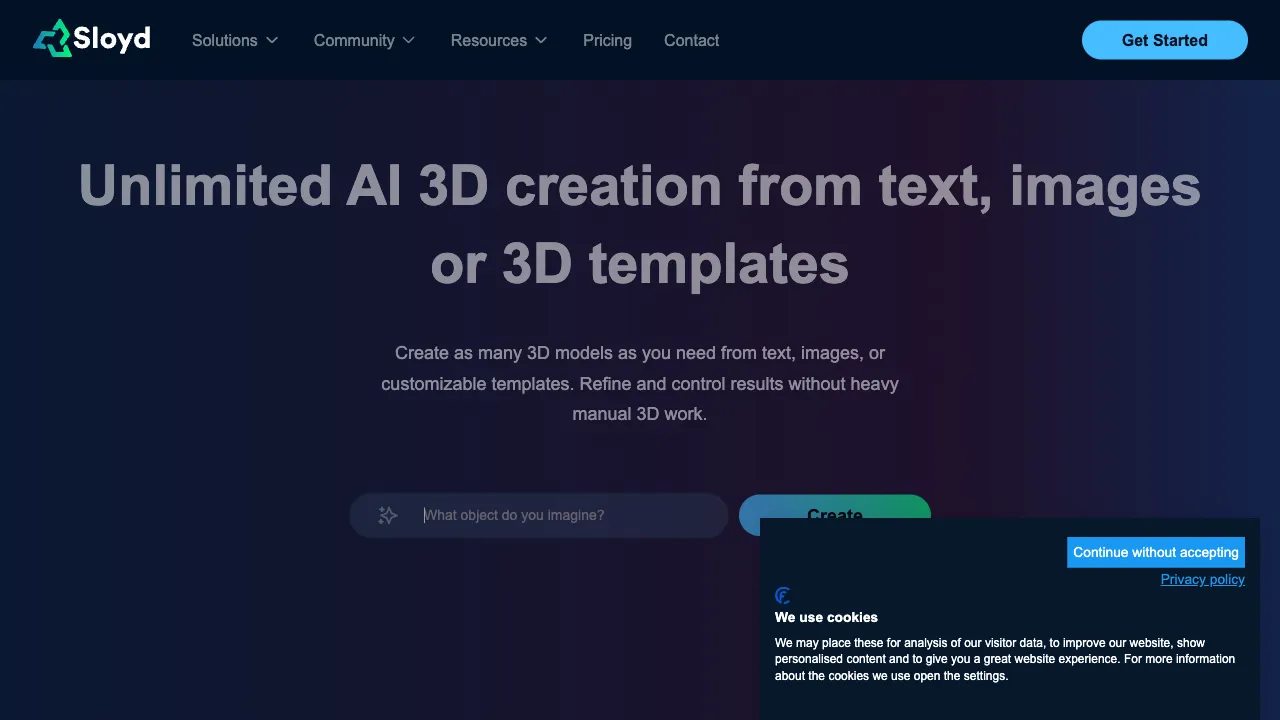
A longstanding workload challenge in 3D game development is the sheer volume of 3D assets required for a game world—weapons, props, buildings, furniture, tools, and more. Each of these items demands time from modelers to create. For indie developers, the time cost of producing these "supporting" assets often exceeds that of implementing core game functionality. Sloyd is an AI-powered 3D asset generation tool that rapidly produces game-ready 3D models through parameterization.
What Is Sloyd
Sloyd is an AI-driven 3D model generator focused on the rapid creation of game assets. Its core capability lies in generating a 3D model ready for direct import into game engines like Unity or Unreal Engine within seconds, using either text descriptions or parameter adjustments.
Unlike general-purpose 3D generation tools, Sloyd’s training data and optimization targets are specifically tailored to game assets. The output models feature polygon counts suitable for games (avoiding performance issues from excessive complexity), include UV unwrapping, support direct texture mapping, and align with the workflows required in game development.
Core Features
Text-to-3D Model Generation
Input a text description, such as "a medieval knight's sword, two-handed, with a golden hilt" or "a wooden crate with iron latches and hinges," and Sloyd generates the corresponding 3D model.
The generated models come with base materials already applied, allowing them to be used directly in scenes or replaced with custom textures.
Parametric Shape Editing
Another core interaction method in Sloyd is parametric adjustment. For specific object types (swords, axes, shields, crates, barrels, etc.), Sloyd provides a set of shape parameters: blade length, width, curvature, guard shape, and more. By adjusting these parameters, you can generate numerous variants that are distinct in form yet consistent in style, all based on the same template.
This is particularly valuable for game development requiring "the same type of object but with slight variations"—not every crate looks identical, yet they all belong to the same visual aesthetic.
Diverse Asset Types
Sloyd supports a wide range of 3D asset types, including:
- Weapons: Swords, spears, axes, bows, shields
- Tools: Hoes, hammers, shovels, pots
- Containers: Crates, barrels, pots, jars
- Architectural Elements: Doors, window frames, steps, fences
- Natural Objects: Rocks, tree trunks, mushrooms
- Game Props: Gems, coins, potion bottles
The library is continuously expanding, with Sloyd regularly adding new asset categories.
Direct Export to Game Engines
Generated models can be exported directly in the following formats:
- GLB: A universal 3D format supported by various tools
- FBX: The standard format for professional 3D software and game engines
- OBJ: A widely compatible 3D format
Both Unity and Unreal Engine can import these formats directly without additional conversion, ensuring a smooth workflow.
API Integration (Procedural Generation)
Sloyd offers an API that allows developers to programmatically call Sloyd to generate 3D assets within their own games. This feature is valuable for procedural generation games (such as Roguelikes or open-world titles) that require infinite content diversity—ensuring that weapons and props in a dungeon are dynamically generated by AI each time a player enters, maintaining variety.
Comparison with Other Tools
vs Meshy AI: Meshy is also an AI 3D model generation tool that supports text-to-3D and image-to-3D conversion, producing models with higher visual fidelity. However, it lacks Sloyd’s specific optimization for game development workflows. Sloyd focuses more on the "immediate usability" of game assets.
vs Blender (Manual Modeling): Models created by professional modelers in Blender have no upper limit in quality and can be meticulously crafted. However, creating a single model takes anywhere from hours to days. Sloyd generates models in seconds; while there is a ceiling on quality, the efficiency is extremely high, making it ideal for producing large volumes of "supporting" assets.
vs Paid Assets on Sketchfab: Purchasing ready-made 3D models from asset stores (Sketchfab, TurboSquid, Unity Asset Store) guarantees quality but comes with higher costs and difficulty in maintaining a unified visual style. Sloyd-generated assets can be customized to match a specific style at a much lower cost.
vs Luma AI and Instant3D: These tools focus on converting 2D images or videos into 3D models (using NeRF technology), offering unique value in reconstructing real-world objects but are less suitable for creating stylized game assets. Sloyd is about "creation from scratch" rather than "reconstruction of reality."
Who Should Use Sloyd
Indie Game Developers: For solo developers or small teams without dedicated 3D modelers, Sloyd can rapidly generate large volumes of "good enough" assets, allowing limited time to be focused on game design and coding.
Game Prototyping Phase: During the concept validation stage, use Sloyd to quickly generate placeholder assets to get game mechanics running before refining asset detail.
Need for Large Asset Variants: For procedural generation games, Roguelikes, or open-world titles that require massive quantities of assets, Sloyd’s parametric generation and API integration can meet these demands.
Non-Modeler Content Creators: For those creating virtual scenes, 3D content for YouTube channels, or virtual exhibitions, Sloyd enables individuals without modeling skills to obtain usable 3D materials.
Pricing
- Starter, free: 30 export credits plus the generator library, themed materials, AI prompt creation and editing. Note that the free tier gates export credits — model downloads — rather than generations; a guest tier also allows one generation a day
- Plus, about $11/month annually or $15 monthly: unlimited AI generation, two concurrent generations, text-to-3D and image-to-3D, with commercial rights; annual billing saves about 25%
- Pro, $50/month: higher concurrency and advanced exports, plus texture capabilities and custom style workflows
- Studio / Enterprise, custom: SDK access, game-engine plug-ins, private generators and priority support
Where the price makes sense: Sloyd's own comparison argues that above roughly 40–50 models a month, the $15 Plus subscription beats per-generation tools — because per-generation pricing charges not just for the model you keep but for every retry, variation and failed prompt.
Two things to check first. The site mentions both unlimited exports and export credits, so confirm the current export-credit rules before upgrading. And read the licence scope: paid plans list commercial use, but redistribution, marketplace resale, commercial 3D printing and AI-training rights each carry separate restrictions — commercial 3D printing is not included by default and needs licence verification.
Confirm current pricing at sloyd.ai/pricing.
Limitations
Limited Asset Types: The currently supported asset types are relatively limited, primarily focusing on props and small environmental pieces. Characters and complex buildings are not yet supported.
Ceiling on Detail Level: AI-generated models cannot match the intricacy of those handcrafted by professional modelers. For projects requiring AAA-quality assets, Sloyd serves as a starting point rather than a final solution.
Challenges with Style Consistency: Generating different asset types using the same Sloyd pipeline may sometimes lack the stylistic unity achieved by a single human modeler. Maintaining consistency requires careful selection of similar parameter settings.
For game developers, particularly indie developers, Sloyd elevates the efficiency of 3D asset production to an entirely different level. It does not replace professional modelers but significantly lowers the barrier and time cost of creating "sufficient" 3D assets.