

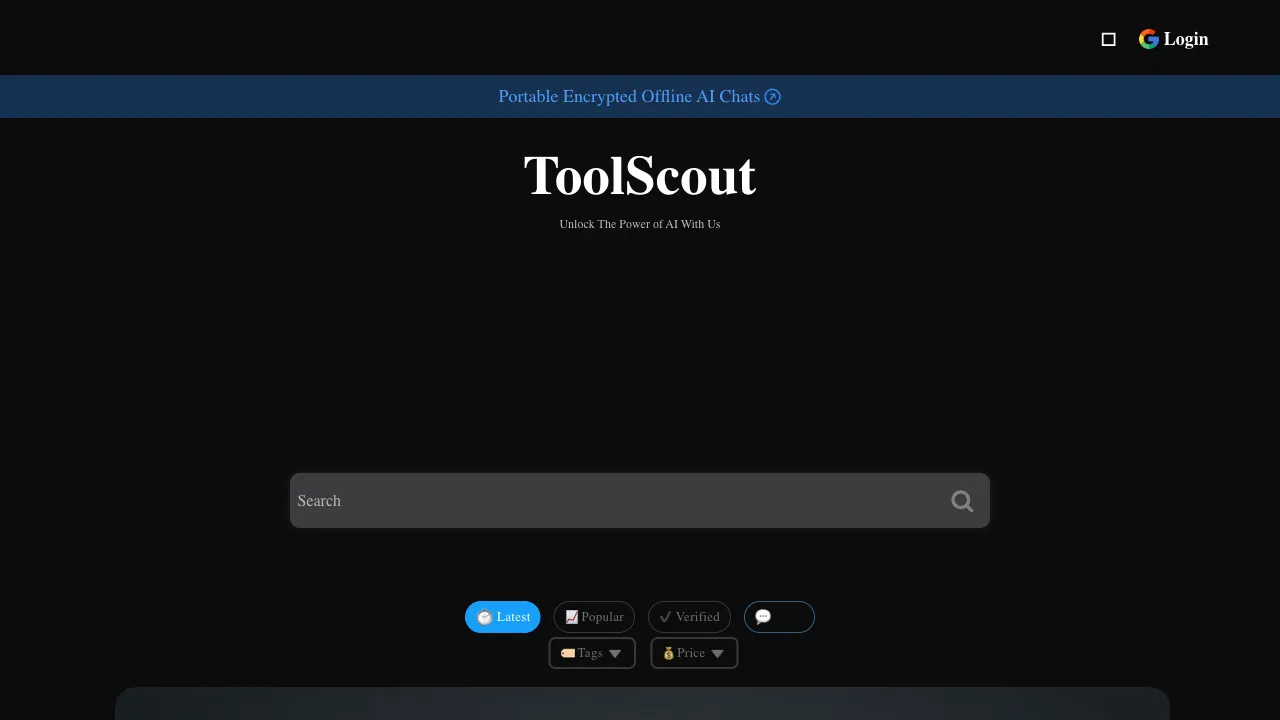
There is a pervasive "rot problem" in the AI tool directory niche: you launch a site with thousands of tools, and six months later, 30% of the links are broken, pricing info is outdated, and you can’t even find the new star tools. The value of a directory decays over time, while maintenance is an unglamorous grind—resulting in many tool navigation sites on the market being "digital fossils." They look content-rich but are obsolete everywhere you try to use them.
Toolscout bets its differentiation on fighting this decay: daily updates. The word "scout" in its name is a product manifesto—it doesn’t want to be the largest archive, but rather the vanguard sentry, ensuring new tools appear in its "New Today" section the moment they go live.
What is Toolscout
Toolscout (toolscout.ai) is an AI tool discovery and navigation platform that catalogs newly launched AI tools daily, categorizing them by use case, tagging pricing models, and including user ratings. Its core selling point is timeliness: for the question "What new AI tools dropped today?", it provides a continuously rolling answer.
Positioned alongside There's An AI For That and Futurepedia in the international AI tool directory space, its differentiation lies in focus—while others compete on total volume, Toolscout competes on update velocity.
Platform Features
Daily New Tools Feed
The "New Today" list on the homepage is the product’s soul: new tools are added daily, creating a feed you can check as part of your routine. For AI tools, timeliness has real value—star products in this space often have only a few weeks from launch to virality. Knowing about a good tool two weeks earlier can mean two weeks of efficiency gains or content ideas.
Comparing it to a newsletter clarifies its form: email digests are curated picks pushed to you by editors, while Toolscout is the full raw feed you actively browse. The former saves effort; the latter offers comprehensiveness. Both have their uses.
Use-Case Categorization
Tools are grouped by purpose: content creation, image design, video/audio, productivity, developer tools, marketing, education, etc. This categorization turns "browsing" into "searching"—users with specific needs can reach a candidate list in just two clicks.
Ratings and Filtering
Standard directory features are all present: user ratings, free/paid tags, keyword search, and multi-condition filtering. When reading ratings on such platforms, keep this in mind: new tools have small sample sizes (inflating scores), while older tools have many reviews but may be obsolete. Look at both the rating count and the date to get useful information.
Comparison with Similar Platforms
vs There's An AI For That (TAAFT): The volume king, organizing tens of thousands of tools by "task." The experience of searching directly for "I want to do X" is unique; updates are also frequent, but noise levels in such a massiveexisting stock are high. Use TAAFT for finding tools with specific functions, and Toolscout for daily new releases. Their positions complement each other.
vs Futurepedia: An established directory with fine-grained categories, tutorial content, and polished overall experience; often considered a benchmark for the niche. Toolscout breaks through on update speed alone. The two are highly similar; in practice, the choice often comes down to "which feed feels smoother to scroll."
vs Product Hunt: PH is a multi-category new product community where AI is just the hottest sector; community discussion and voting are its unique values. However, you have to sift through dozens of daily launches yourself. Toolscout is vertical on AI, offering a higher signal-to-noise ratio for AI followers. Go to PH for product stories and discussions; come here to browse tools.
vs Domestic Directories (AIbase, AI Tools Collection): The divide of language and ecosystem—Toolscout focuses on English-language international tools, many of which have access or payment barriers for Chinese users. Domestic directories cover Chinese tools with availability tags. Use Toolscout for global trends; check domestic sites for tools you can use immediately. Mature users usually bookmark both.
vs Browsing X/Twitter directly: First-hand AI news is indeed on X, but it’s fragmented, noisy, and depends heavily on the quality of your follow list. Directory sites offer structured secondary curation. They are upstream/downstream partners, not substitutes.
Who Should Use Toolscout
Heavy Early Adopters of AI Tools: People who enjoy (or make a living from) discovering new tools. The daily new feed is designed as your morning coffee companion.
Tech Content Creators: Bloggers producing AI tool reviews and roundups. This is a stable mine for topic ideas—browse "New Today," and you’ll likely have this week’s topics sorted out.
Product Managers and Entrepreneurs: Track competitor moves, find inspiration, and observe which directions are seeing dense tool emergence—the new feed itself serves as coarse-grained trend data for the sector.
Enterprise Efficiency Leads: Those scouting AI tools for their teams. Regularly glance at the new feed and category rankings to keep your tool radar on.
Usage Tips
Position it as a "radar," not an encyclopedia: Spend five minutes daily scanning "New Today." Save relevant items to bookmarks, then dig deeper only when you have a real need. This is the optimal use for a timeliness-focused directory. Conversely, for carpet-style research with specific needs, full-volume directories like TAAFT are more suitable.
Maintain basic skepticism toward newly listed tools: A significant proportion of AI tools emerging daily are wrapper products or short-lived experiments. Inclusion in a directory does not equal a quality endorsement. If you see something appealing, check independent reviews and community discussions first before investing your time and data.
Be aware that its English-centric nature means a non-trivial portion of tools may not be directly usable in China. Using it alongside domestic navigation sites is the sensible approach for Chinese users.
Pricing
Browsing is free; no registration required. The standard business model for such platforms involves paid promotion slots and submission fees for tool providers. Just keep a neutral mindset regarding promoted placements while browsing.
In an industry where dozens of new tools are born daily, "knowing early" itself is a small but real competitive edge. Toolscout turns this into a feed you can check as part of your daily routine. If your work or interests require this kind of sensitivity, it deserves a bookmark spot. If you prefer sticking to stable, established tools, there’s no need to feel anxious about missing out—and that’s perfectly valid too.