

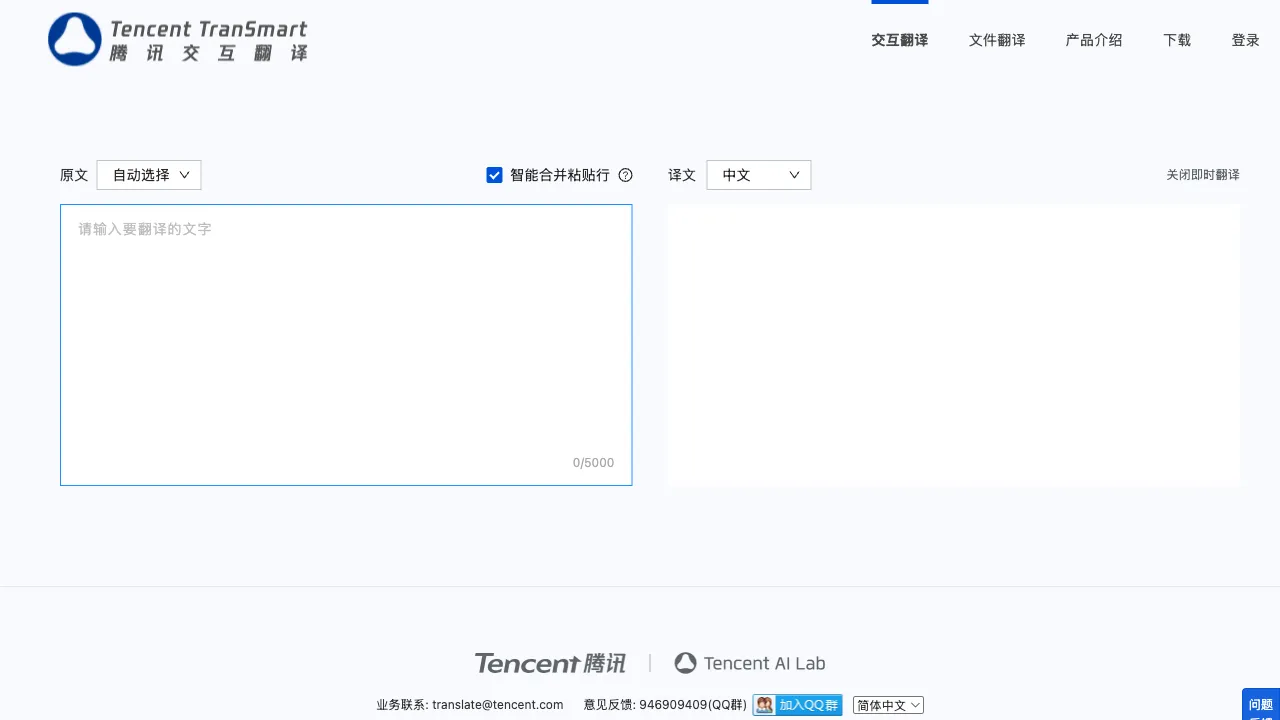
The world of translation tools is actually divided into two layers. Most people have only seen the superficial layer: Google, DeepL, and various consumer-grade translators—input text, get a translation, copy it, and leave. But professional translators operate in another world: CAT (Computer-Assisted Translation) software like Trados and MemoQ, which feature translation memories, terminology databases, and human-machine collaboration workflows. These tools are powerful but expensive and have steep learning curves. Between these two layers lies a massive gap: those with professional translation needs who cannot afford or do not wish to learn CAT software—office workers who frequently translate documents, freelance translators, and researchers handling academic literature. TranSmart is Tencent AI Lab’s product aimed precisely at this void: more professional than consumer translation tools, yet simpler than professional CAT software.
What is TranSmart?
TranSmart (transmart.qq.com) is an AI-assisted translation product developed by Tencent AI Lab. Its core philosophy is Interactive Machine Translation (IMT)—rather than simply handing you a static translation, it turns the process into a collaborative editing workflow of "machine suggestions + human correction." It offers professional features such as document translation and terminology management, targeting professional users and translators with specific translation needs. Tencent AI Lab’s academic background (it is also the creator of well-known projects like GFPGAN) provides TranSmart with a solid technical foundation.
Core Features
Interactive Translation: The Signature Feature
TranSmart’s most distinctive design—and the soul that sets it apart from ordinary translation tools—is its workflow: input source text → machine provides a first draft → you correct unsatisfactory parts → the system perceives your edits and adjusts subsequent suggestions in real time.
The beauty of this human-machine collaboration is that translators do not have to start from scratch (the machine lays the groundwork) nor are they forced to accept the machine’s output entirely (they can intervene and correct at any time). Moreover, your corrections "teach" the system to adjust later text—efficiency far exceeds pure manual work, and quality far exceeds pure machine translation. This is the core philosophy of professional CAT tools, which TranSmart has rendered into a lightweight, easy-to-use form.
Document Translation and Format Preservation
Translate entire Word/PDF/PPT files while preserving layout, eliminating the need for manual reformatting—a practical necessity for long-document translation.
Terminology Management
Custom dictionaries: translate proper nouns, company names, and product names according to specified translations to ensure consistency. Terminology consistency is the lifeline of quality for legal, medical, and technical documents; this feature directly addresses professional scenarios.
Translation Memory
Records translated segments; when new documents encounter identical or similar source text, they are automatically reused—ensuring consistent translation methods for the same content and reducing repetitive labor. This is a hallmark capability of CAT software, which TranSmart has democratized.
Language Pairs
Chinese-English is the core (highest usage frequency), covering mutual translation among major languages including Japanese, French, German, and Spanish.
Comparison with Similar Tools
vs DeepL: DeepL has the highest industry quality for European language translations, but Chinese is a weak point and it lacks an interactive workflow; TranSmart has stronger Chinese capabilities and a workflow better suited to professional translation tasks. For precise European language translation, choose DeepL; for professional Chinese translation, choose TranSmart.
vs Tencent Transmart (Translation Jun): Same parent company but different tiers—Transmart is aimed at the general public for daily use (app, photo translation), while TranSmart targets professionals (interactive editing, terminology databases, document translation). Tencent uses two products to cover both the superficial and deep layers of translation needs.
vs Professional CAT (Trados/MemoQ): The industry standard for full-time translators and translation agencies, with extremely professional features (memory banks, terminology databases, QA, project management all in one), but high cost and steep learning curve. TranSmart is their lightweight version—for occasional professional translation needs, TranSmart is sufficient; full-time translation workflows still require professional CAT. This positioning is TranSmart’s clearest value proposition.
vs Google/Baidu/Sogou Translation: Consumer tools are great for quick queries but lack professional workflows and terminology management support; they are adequate for short-text translation, but the value of TranSmart only becomes apparent in professional scenarios involving long documents and terminology requirements.
Who Should Use TranSmart?
Office workers who frequently translate documents: Professionals in legal, financial, and technical fields often handle English documents; document translation plus terminology management significantly boosts efficiency and ensures controllable quality—the core audience.
Freelance translators and writers: Those who cannot afford or do not want to learn professional CAT software will find TranSmart provides a sufficiently robust translation workflow, with interactive editing delivering tangible efficiency gains.
Enterprises with fixed terminology requirements: Scenarios where brand names, product names, and technical terms require unified translations; terminology management directly solves this issue.
Researchers and students: Translating foreign literature drafts plus manual polishing is much faster than manual translation from scratch.
Limitations
Quality for non-Chinese language pairs (e.g., English-Japanese, English-German) does not match experts like DeepL; it is not a strong suit. The interactive translation workflow has a certain learning curve and requires adaptation to realize its efficiency advantages—for simple short-text translation, it offers no obvious advantage over Google or Baidu. Its professional value is only realized in long-document and terminology scenarios, so its positioning must be clear.
Pricing
It is usable directly in the browser, and no paid tiers for individuals are published on public pages, so no figures are given here — trust what transmart.qq.com shows.
Its positioning is interactive translation: rather than producing one output and stopping, it combines machine translation with human revision so the translator intervenes during the process. That differs from general translation tools that hand back a finished result, and sits closer to how professional translators actually work.