

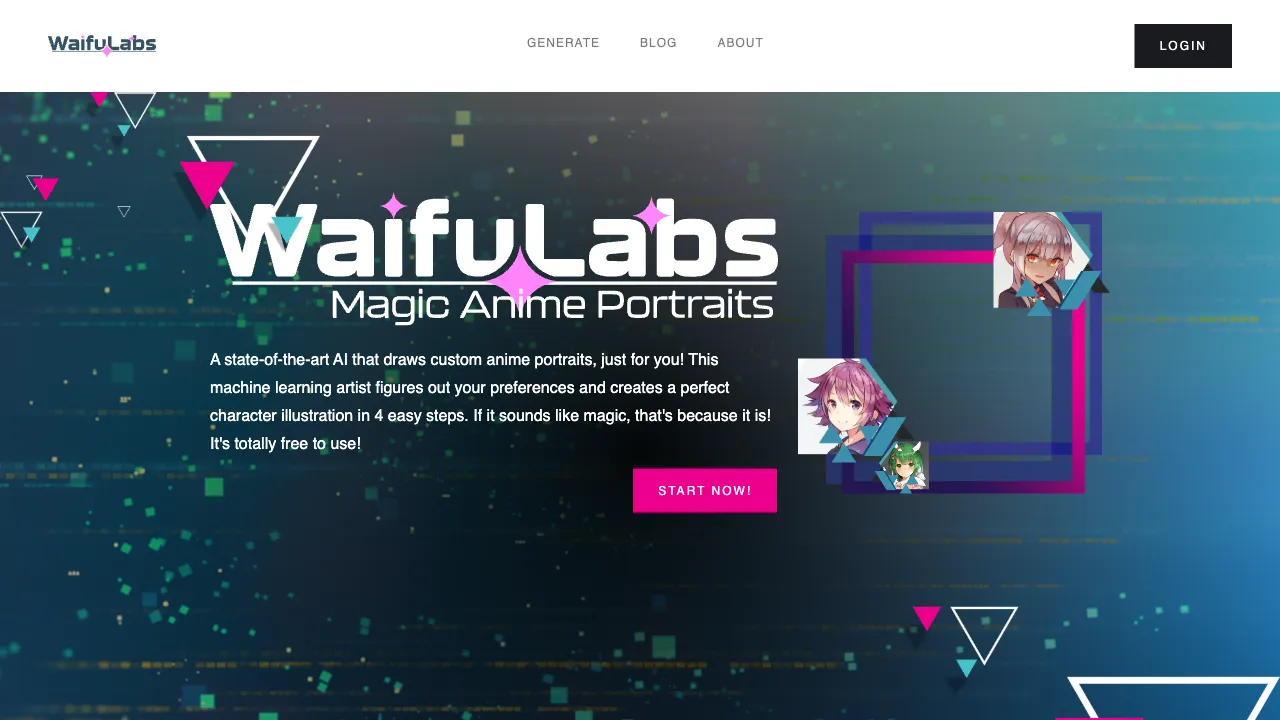
In 2019, when "AI painting" was still a sci-fi concept for the vast majority of people, a website quietly gained popularity within the ACG (Anime, Comic, and Games) community: open the page, and sixteen anime-style female avatars in various styles appear before you. You select your favorites, it generates more in similar styles, you choose again, it generates again—after a few rounds, a character appears on the screen as if custom-made for your aesthetic. No prompts, no parameters, no waiting queues; the entire process feels like playing an "aesthetic Russian nesting doll."
This is WaifuLabs. It went viral nearly three years before Midjourney and was the first AI image generation product many people encountered—in that era, the fact that "AI could draw anime characters of this quality" was itself a spectacle worth screenshotting and sharing.
What is WaifuLabs?
WaifuLabs (waifulabs.com) is an AI tool specialized in generating anime-style female character avatars, developed by game studio Sizigi Studios. Based on GAN (Generative Adversarial Network) technology, it was specifically trained on a massive dataset of anime illustrations. "Waifu" is a playful term used in the ACG community for a "beloved 2D character"—the product name straightforwardly declares its mission: to help everyone generate their own waifu.
Its greatest design legacy is its interaction method: replacing description with selection. In today’s world where prompts dominate AI painting, this approach reveals a unique kind of human-centric design.
Core Experience
Evolutionary Selection Generation
The entire process is a gradual convergence of aesthetics:
Round 1: Displays 16 characters with widely distributed styles—varying art styles, hair colors, and temperaments. Select the one that resonates most with you.
Round 2: The AI uses your selection as an anchor to generate 16 variants in a similar style; you continue to choose.
Subsequent Rounds: Each round moves further in the direction of your preferences, with the differences between choices becoming increasingly subtle—converging from "which art style" to "which gaze."
Finalization: Once satisfied with the final result, proceed to detail adjustments and download.
This design addresses a fundamental issue: most people have only a vague sense of what they want and cannot articulate precise descriptions like "cel-shaded style, low-saturation color palette, wide-set eyes," but everyone knows which of two images they prefer when shown them. WaifuLabs replaces the biggest barrier in AI painting—"expressing needs"—with a zero-barrier "choice between two."
Feature Fine-Tuning
During the selection process and before finalization, you can adjust specific features: hair color, hairstyle, eye color, expression, and overall tone. The "evolution" handles the broad direction, while fine-tuning covers the last mile.
Final Product Download
The final character can be downloaded for personal use as an avatar, wallpaper, etc. It once offered paid merchandise services (printing generated characters on physical goods like body pillows), a commercialization approach characteristic of ACG culture.
How to View WaifuLabs in Today’s AI Painting Landscape
To be honest: viewed through the lens of 2026, WaifuLabs’ generation quality, resolution, and stylistic diversity have been comprehensively surpassed by next-generation tools. However, its positioning remains valid—it won on experience rather than parameters.
vs. NovelAI / Anime-Specialized SD Models: These represent the professional tier of current anime generation, with quality ceilings far exceeding WaifuLabs, supporting full-body shots, scenes, and precise tag control; the cost is learning a tag-based prompt system, and NovelAI requires a subscription. Those seriously engaged in anime creation should go there; for those who just want a unique avatar in three minutes, WaifuLabs is still faster.
vs. Midjourney (niji mode): niji’s anime generation quality is top-tier with strong stylistic expression; however, the four barriers of Discord, English prompts, subscription fees, and network requirementslayer-by-layer discouragement (dissuade layer by layer) casual users.
vs. Domestic Anime Generation Tools (e.g., Liblib): Domestic platforms are Chinese-friendly with rich model ecosystems, serving as the practical mainstay for domestic anime creators; WaifuLabs’ differentiation is left with only its interactive experience.
vs. Artbreeder: Both are GAN-era products with "selection/mixing" interactions. Artbreeder supports image gene mixing and has a more eclectic style; WaifuLabs focuses on anime avatars, being purer in a single direction. The two are different implementations of the same design philosophy.
vs. Photo-to-Anime Filters (e.g., Lensa): Filters turn your face into an anime style, while WaifuLabs creates non-existent characters from scratch—one is "an anime version of me," the other is "my anime character"; the needs are completely different.
Who Should Still Use WaifuLabs?
Users needing unique anime avatars: If you want an avatar for forums, games, or social platforms that is "unique across the entire web" and fits your aesthetic, a few minutes of selection can produce it; it remains one of the easiest experiences for this need to date.
Prompt-averse users: Those interested in AI painting but dissuaded by prompts will find that WaifuLabs proves you can guide AI without writing a single word—it is itself the best introductory experience.
AI product design researchers: As a classic case study of "preference-driven generation" interaction paradigms, its reference value in the history of AI product design exceeds its current tool value. The idea of converging user preferences through multiple rounds of binary choice still echoes in today’s recommendation systems and generative products.
ACG enthusiasts for nostalgia and entertainment: The experience itself has a game-like feel; the "gacha-style" selection process is more fun than many serious tools.
Limitations
It only generates avatars/half-body images of female anime characters—it does not draw male characters, full-body shots, or scenes. The category boundary is very narrow, which is a natural constraint of specialized GAN models.
The art style is generally unified, with variations concentrated at the character feature level; it cannot provide stylistic leaps like ink wash, impasto, or American comics.
Product updates are slow; the GAN technology route itself has been replaced by diffusion models (Diffusion), so one should not expect qualitative iterations.
Resolution and detail precision are low by current standards, making it unsuitable for commercial-grade asset needs.
Pricing
The site states plainly that it is totally free to use — no payment is required to generate a character portrait.
Generated characters can be imported into the team's own game, Arrowmancer, which requires a separate signup and does not affect free use of this tool.
The interaction is four steps of guided choices: it narrows toward your preferences at each step and produces a finished character illustration — not a single prompt and a roll of the dice.