

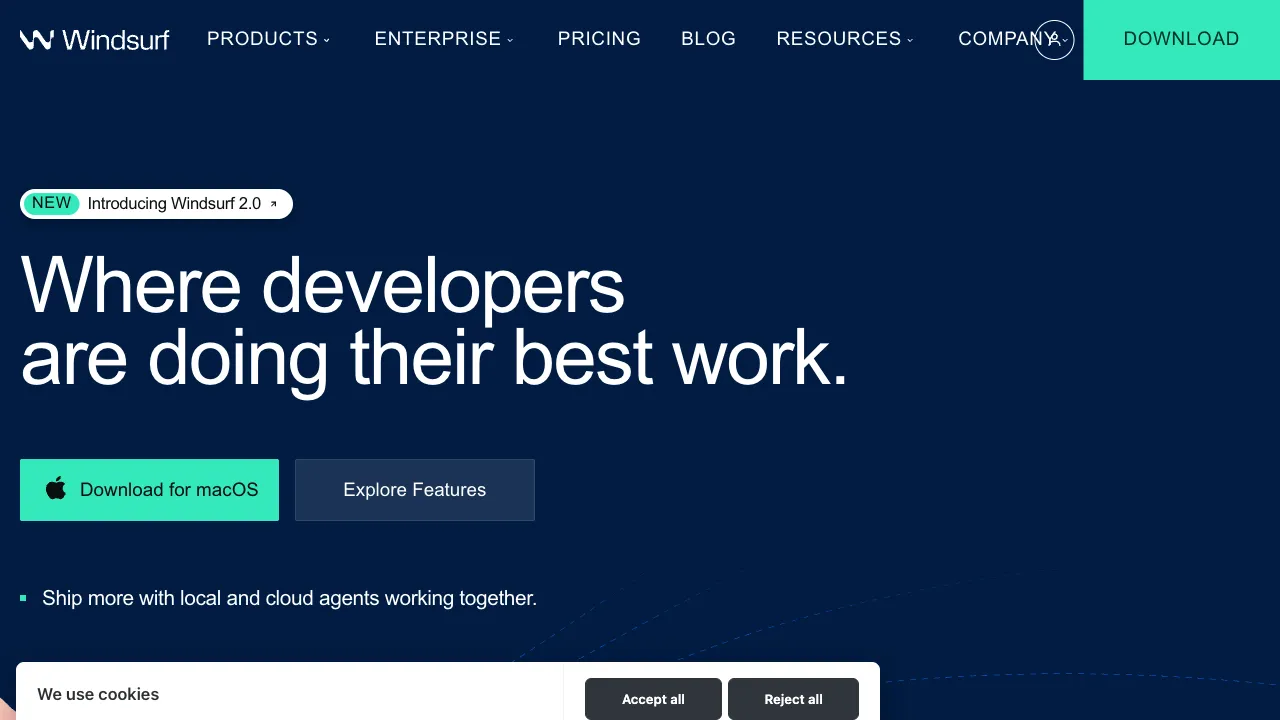
This product changed names twice in a year. The timeline first, or nothing below will parse:
- November 2024: Codeium ships the Windsurf editor, built on the VS Code core, built around a multi-step agent called Cascade, aimed squarely at Cursor.
- April 25, 2025: the company Codeium renames itself Windsurf; the old Codeium completion extension becomes Windsurf Plugins.
- Late 2025: Cognition, the team behind Devin, acquires it.
- June 2, 2026: Cognition renames the Windsurf editor to Devin Desktop and ships it as an over-the-air update — accounts, plans, extensions and keybindings all preserved, no reinstall. windsurf.com now redirects to devin.ai/desktop.
So what you install today is Devin Desktop. Plenty of people still call it Windsurf out of habit, the JetBrains plugin is still Windsurf for JetBrains, and some menus have not caught up either.
What it is now
Cognition frames it as "a full IDE with an agent manager built in" rather than an editor with AI bolted on. The editor still runs on the VS Code core, so the interface and shortcuts carry over and migration costs little.
The real change is the Agent Client Protocol (ACP) — an open, Apache 2.0 protocol that defines the editor as the host and each agent as a guest. Codex, Claude Agent, Gemini CLI, OpenCode and Junie all run as first-class citizens in the same window, and guests are hot-swappable. That is the strategic core of the rename: rather than betting its own agent will win, the product bets on being the shell that holds all of them.
New alongside it: a Kanban-style Command Center for laying tasks out in columns, Spaces for grouping tasks by project, Codemaps for visualising repository structure, and Devin Local, a locally-run agent written in Rust.
Cascade is gone
If the tutorial you are reading still explains Cascade's Write and Chat modes, it predates July 1, 2026. Cascade reached end-of-life that day, and Devin Local replaced it as the default local agent.
The migration is not free: Devin Local shipped without Cascade's persisted memories, complex workflows and deployment hooks, so teams that leaned on those had to rearrange. The upside is that ACP gives you an exit — you can attach Codex or Claude Agent instead of waiting for one vendor to fill the gap.
Models
The in-house line is the SWE series. SWE-1.5 arrived in October 2025 and became the default model for Pro and Teams users during 2026, succeeded by SWE-1.6, which continues as the free proprietary coding model.
How they spend quota differs, and that difference is what sets your burn rate: the in-house SWE models consume quota at a fixed rate per message, while third-party models such as Claude Sonnet 4.6 and GPT-5.4 consume it in proportion to the tokens they process. Put another way, the $5 Pro increase in March 2026 essentially bought a proprietary model that reduces your dependence on expensive third-party tokens.
Compared with Cursor
Still the pairing people ask about:
In common: both are built on the VS Code core, both have an AI sidebar, both do multi-file editing and Tab completion.
Where Devin Desktop (formerly Windsurf) differs:
- ACP lets you swap agents inside one editor rather than opening a second window for Codex or Gemini CLI
- Tab autocomplete is unlimited on every plan, Free included
- Quotas refresh daily and weekly, so you cannot burn the month's allowance in week two and stall
- Devin Cloud's cloud agent now starts on the $20 Pro plan, where it was previously positioned for enterprises
Where Cursor differs:
- Larger user base and community, so more tutorials and discussion
- Stable branding — no rename to follow
- Longer-refined indexing for large codebases
Who it is for
Developers running several agents. If you already move between Codex, Claude Agent and Gemini CLI, ACP is the direct payoff — one editor holds all of them. If you use exactly one, the gain from switching is thin.
People fluent in VS Code keybindings. The editor core is unchanged, so migration is close to painless.
Work that must stay on the machine. Devin Local runs locally, which is one more option for sensitive projects.
Budget-conscious solo developers. Unlimited Tab autocomplete is there on the free plan; run it for a fortnight before deciding on Pro.
Practical advice
Check that the agent you want speaks ACP. It is the main reason to pick this editor now — do not migrate for a protocol you will not use.
Rebuild old Cascade workflows deliberately. Persisted memories and deployment hooks do not carry over; audit which of your processes break before you start.
Mix models to stretch the quota. Use the in-house SWE-1.6 for routine edits, where each message costs a fixed amount, and switch to a third-party model for the hard problems. That is considerably cheaper than leaving an expensive model attached all day.
Break large tasks up. As with every agent, "do A, then report back" beats "do A, B, C and D at once."
Pricing
The March 19, 2026 overhaul retired the credit system in favour of daily and weekly quotas that refresh automatically:
- Free $0: a limited daily quota
- Pro $20/mo: up from $15, includes the proprietary coding model and cloud sessions for background development
- Max $200/mo: the highest quotas
- Teams $40/user/mo: centralized billing
- Enterprise: custom
Annual billing saves roughly 17%. Tab autocomplete is unlimited on every plan.
Quotas behave differently from credits: they refresh daily and weekly with no monthly pool to exhaust, so usage is rate-limited rather than balance-limited. If you hit the daily cap you wait for the next refresh or buy overages at API rates — a design Cognition describes as preventing "sprinting and droughting."
Check the official pricing page for current numbers.