

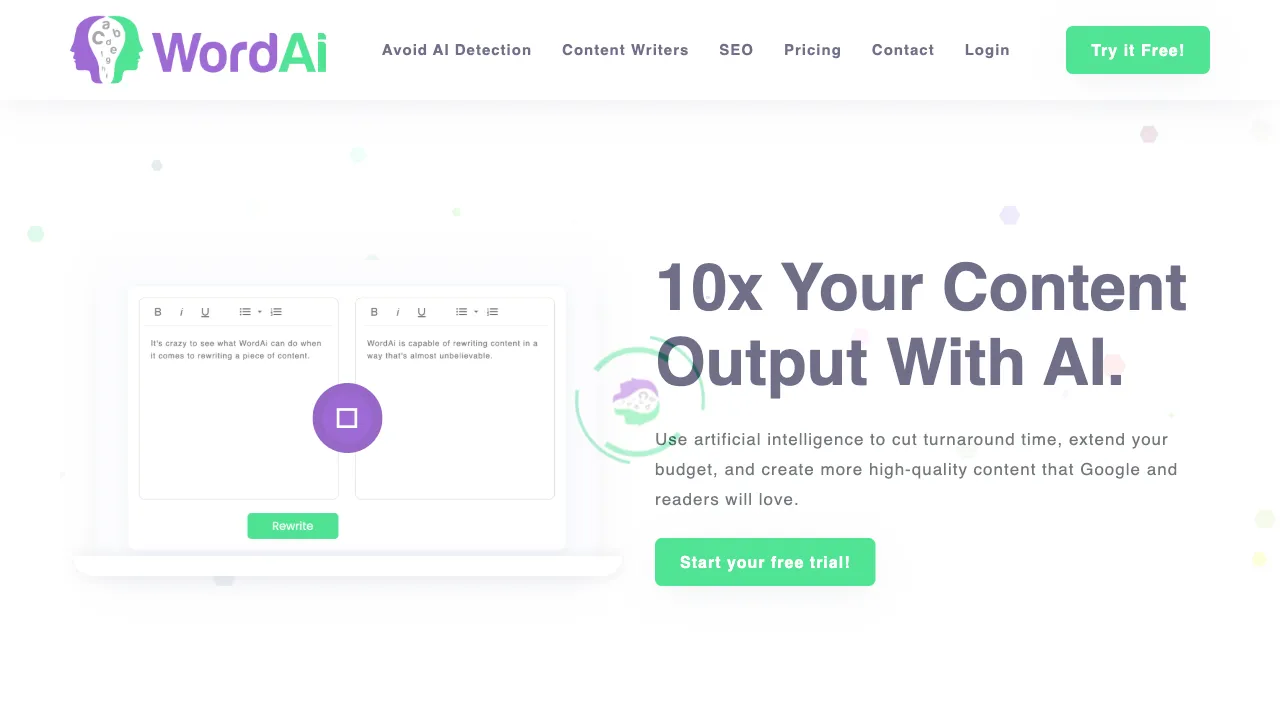
The SEO industry has a "prehistoric" era preceding the large language model age: Article Spinning. The logic of that time was simple and crude—search engines valued "originality," so tools mechanically replaced synonyms to batch-generate dozens of "different" versions to saturate long-tail keywords. Early spinning tools produced results that were pitiful ("happy dog" became "joyful canine"), yet WordAi established its reputation in that sea of low-quality output by promising rewrites that "sounded like human speech." It has been around since 2011, a full era before ChatGPT. Although its underlying technology has long since switched to large models, its positioning remains consistent: a professional rewriting engine for scaled content production.
Understanding WordAi requires understanding its division of labor compared to general AI: While ChatGPT and similar tools can write anything, WordAi does only one thing—massively and high-quality re-expressing existing content.
What is WordAi?
WordAi (wordai.com) is an AI article rewriting tool. Its core capability is restating input articles into versions with identical semantics but completely refreshed wording and structure. This is not a synonym-substitution trick; it is "true rewriting" involving sentence-level reconstruction and paragraph-level reorganization, producing output with readability close to human writing. Around this core, it offers batch processing, multi-version generation, and API integration, targeting industries where "content is production capacity," such as SEO teams, affiliate marketers, and content agencies.
Core Features
High-Quality Article Rewriting
Paste an article, get a rewritten version. The depth of rewriting is adjustable: a conservative mode preserves the original structure while refreshing the wording, while an aggressive mode significantly reconstructs sentence structures and paragraphs—choose your firepower based on use case. Empowered by large models, the quality of its rewrites represents a species-level difference compared to early spinning tools: natural grammar, coherent logic, and smooth reading experience. Most outputs require only light human polishing before use.
Multi-Version Generation
One original article spawns multiple distinct rewritten versions, with significant differences in wording and structure between them. Legitimate uses for this feature include multi-channel distribution (using one version each for blogs, emails, and social media) and A/B testing materials for ad copy.
Batch Processing and API
The dividing line between professional tools and toys: upload and rewrite dozens or hundreds of articles in batch, and integrate via API into automated content pipelines. The production-line needs of content agencies are capabilities that general conversational AI web interfaces cannot provide; this is precisely why WordAi still has a place in the large model era.
Quality Filtering
Built-in quality assessment automatically filters out obviously poor rewrite results, reducing the burden of manual quality inspection. In batch scenarios, the value of this gatekeeping scales linearly with output volume.
Use Cases
Multi-channel content distribution: The same content requires a unique version for blogs, Newsletters, and social platforms. Batch rewriting automates the manual labor of "one draft, multiple posts"—the most undisputed legitimate use case.
Native-language polishing of machine-translated content: Machine translation always carries a "translationese" tone. Running it through a rewriter naturalizes the language, serving as a practical step in localization workflows.
Refreshing old content: Refreshing wording and upgrading expression for existing site articles is a low-cost method for keeping content fresh.
SEO content variants: Generating content variants around a theme for different long-tail keywords. This is the oldest and most caution-required use case; see below.
Comparison with Similar Tools
vs QuillBot: The king of rewriting in the mass market, offering a generous free tier aimed at students and individual single-article use. WordAi’s batch processing, API, and quality pipelines are aimed at agency production capacity. Use QuillBot to rewrite one article personally; use WordAi for a team rewriting a hundred articles. The distinction is clear.
vs Spin Rewriter: A contemporary spinning rival with highly overlapping features and similar quality tiers. Choosing between these old rivals basically comes down to personal preference for rewriting style and current pricing.
vs Direct Rewriting with ChatGPT/Claude: Single-article rewriting quality from general large models is not inferior, and often superior, to WordAi’s, and it is free. WordAi’s moat remains workflow—batch processing, API access, and productized quality filtering. To be honest, technical teams skilled in scripting can easily build their own alternatives using APIs. What WordAi sells is the convenience of "not having to build your own."
vs Jasper and other content generation platforms: Those are all-in-one tools for generating content from scratch, with higher prices and broader scopes. WordAi is a specialty shop for rewriting alone; each serves different needs.
The Boundaries That Must Be Stated: SEO Red Lines
This section is more important than the feature introduction. The practice of flooding search engines with rewritten content is being systematically eradicated: Google’s Helpful Content update explicitly targets "content created for search engines rather than users." Its identification and devaluation of AI-mass-produced low-quality content are becoming increasingly harsh. Content farms that rose on spinning have been dying off in droves in recent years—this is not a risk warning, but an industry fact that has already occurred.
The correct positioning for rewriting tools today: an efficiency accessory for content operations (distribution variants, refreshing, polishing), not traffic magic (pseudo-originality site flooding). The former becomes easier the more you use it; the latter brings you closer to being delisted by search engines. Furthermore, it rewrites wording but adds no new information or insight—the true value of content has never lain in its phrasing.
Its performance in Chinese rewriting is weaker than in English, determined by its English DNA. Chinese content teams should test it firsthand before deciding.
Pricing
The site has a dedicated pricing page and a free trial entry point, but no tiers or amounts appear on publicly readable pages, so no figures are given here. Trust the pricing page at wordai.com.
What is verifiable on the product side: it uses machine learning models for whole-sentence restructuring, covering complete sentence rewrites, enriched phrasing, improved clarity and sentence splitting — it reads the meaning of each sentence and rewrites from scratch, optimising for uniqueness and readability while preserving the sense. "Avoid AI Detection" sits first in the site navigation, which is its current headline pitch.