

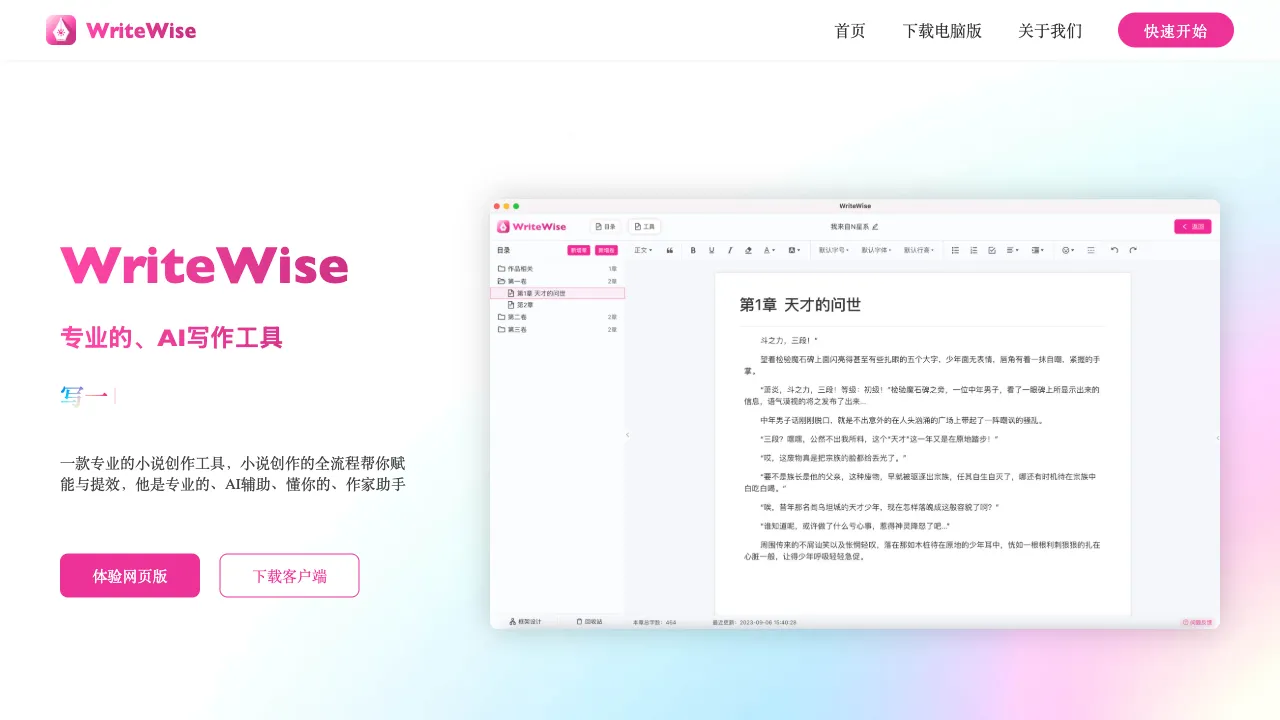
Writing web novels is an extremely draining endeavor. A typical work spans millions of words, requiring authors to produce thousands of words daily while maintaining plot coherence, character consistency, and world-building logic. Many authors hit a wall after writing hundreds of thousands of words—not because they lack the desire to write, but because their minds go blank, unable to figure out what comes next. WriteWise is an AI-assisted novel creation platform launched by Ximalaya, designed specifically for web novel creators’ workflows to address these blocks and efficiency issues.
What Is WriteWise?
WriteWise is an AI-powered web novel creation tool under the Ximalaya umbrella. Leveraging Ximalaya’s deep accumulation in online literature and audio content, it provides AI-assisted writing services tailored for web novel authors.
Ximalaya’s entry into the AI web novel creation space stems from unique advantages: the platform has already amassed vast amounts of online literary content, accumulating deep data on writing styles, plot patterns, and reader preferences across various genres (xuanhuan/fantasy, xianxia/cultivation, urban romance, suspense, etc.). This gives WriteWise a degree of professionalism in understanding and generating Chinese web novels, rather than relying on generic writing tools to handle content with strong genre-specific characteristics.
Core Features
AI Continuation and Smart Completion
This is the most direct feature. When you get stuck halfway through or need extensivelaying the groundwork (setup) for a plotline, you can have the AI continue writing. WriteWise generates contextually appropriate continuations based on the preceding text’s style, character settings, and plot trajectory.
The quality of the continuation depends on the quality of the context provided. If your previous writing is clear—explicitly detailing character personalities, scene atmosphere, and ongoing conflicts—the AI’s output usually connects well. Using it as a starting point—letting the AI draft a section for you to revise—is far better than staring at a blank page.
Outline Assistance and Chapter Planning
Many writers’ pain points lie not in an inability to write, but in not knowing how to plan. Juggling multiple storylines, complex character relationships, and forgetting foreshadowing planted earlier are common issues. WriteWise’s outlining feature helps organize your story structure:
- Generate chapter node plans based on the main plot setting
- Analyze structural issues in your current outline
- Suggest pacing for plot progression (arranging ups and downs, positioning climaxes)
- Check the completeness of character arcs
For authors with some ideas but no complete conception, this feature helps transform vague thoughts into an executable outline framework.
Character and World-Building Management
The biggest fear in long-form novels is "character derailment"—where a character acts completely opposite to their established personality earlier in the story because the plot demands it. Readers will notice and criticize this inconsistency. WriteWise’s character setting management feature records and tracks each major character’s:
- Basic information (name, appearance, background)
- Personality traits (core adjectives, behavioral patterns)
- Abilities (cultivation level, special powers)
- Relationships (connections with other characters)
- Key experiences (critical event nodes)
During creation, the AI checks for consistency against existing settings when you write a character’s actions, preventing contradictions.
Scene and Detail Description Assistance
Web novel writing involveslarge quantity "scene descriptions"—combat sequences, cultivation scenes, romance, scenery… These require significant word count but are often the most time-consuming to write and prone to repetition. WriteWise’s scene description feature generates paragraphs in the corresponding style based on your specified scene type, emotional tone, and character state.
For combat scenes, it can produce rhythmic exchanges with specific skill descriptions; for romance scenes, it controls the pacing of emotional progression without feeling abrupt. Of course, AI-generated descriptions usually need adjustment to fit the surrounding context, but they save the pain of starting from scratch.
Style Analysis and Imitation
You can input samples of your own writing or styles you admire. WriteWise analyzes the stylistic features and strives to maintain consistency when generating content. For authors aiming to develop a stable personal style, this feature makes AI-generated content feel less jarring.
Who Is It For?
Full-time Web Novel Authors: For those producing 3,000–8,000 words daily, WriteWise’s primary value is increasing output speed. Hand over formulaic but word-count-heavy content like "travel descriptions," "combat setups," or "daily life scenes" to the AI, allowing you to focus on core plots and character development.
Part-time Writers: With limited time outside of work, WriteWise helps maintain writing momentum during fragmented periods. You don’t need to "get into the zone" from scratch each time; the AI’s continuation directions can quickly help you pick up your thread.
Beginners: For those new to long-form writing who don’t know how to structure a story, the outlining feature provides a framework reference; for those unsure how to write textured scene descriptions, the scene assistance feature offers learning references.
Genre-Specific Authors: Stories with strong genre rules—xuanhuan, xianxia, time travel, rebirth—benefit from WriteWise’s specialized training in these tropes, giving it a deeper understanding than generic AI tools.
Comparison with Other Writing Tools
vs. General AI (ChatGPT, Claude): General AIs can also help continue novels, but you must feed them massive amounts of background info each time (character settings, recaps, world-building). Their understanding of Chinese web novel genre rules is limited. WriteWise stores this background info within the project and auto-injects it during creation, resulting in a smoother workflow.
vs. Qidian AI Assistant: Yuewen Group’s Qidian also has AI creation features, offering platform integration advantages for authors publishing on Qidian. WriteWise, however, is part of the Ximalaya ecosystem, offering unique value in audio content conversion—since Ximalaya is an audio platform, content created with WriteWise can theoretically integrate more easily into their audiobook production workflow.
vs. Mita Writing Cat: Writing Cat is more general, leaning toward workplace writing and content marketing, lacking the specialized support for web novel genres that WriteWise offers.
Usage Recommendations
Build Character and World-Building Docs Before Writing: Organize your main characters’ settings clearly and input basic world rules (cultivation system, world background, era setting). This significantly improves the quality of AI assistance.
Outline First, Then Write Chapters: Use the outlining feature to clarify the main plot, subplots, and character arcs first. Establish a framework before writing chapter by chapter to avoid discovering logical inconsistencies halfway through.
Use AI Content as Material, Don’t Publish Directly: Platform readers have preferences for web novel prose; AI-generated text can sometimes read "unnaturally." Review it yourself, adapt it to your style, and then publish.
Leverage Continuation to Break Writer’s Block: When stuck, input the last 500–1,000 words you wrote and ask the AI to generate three to five continuation directions. Even if you dislike all of them, reading them often sparks your own ideas.
Web novel creation requires stable, high-volume output. WriteWise’s AI assistance has practical value in reducing "dry spells" and improving daily productivity. For authors serious about web novel creation, it is worth incorporating into their daily toolkit.