
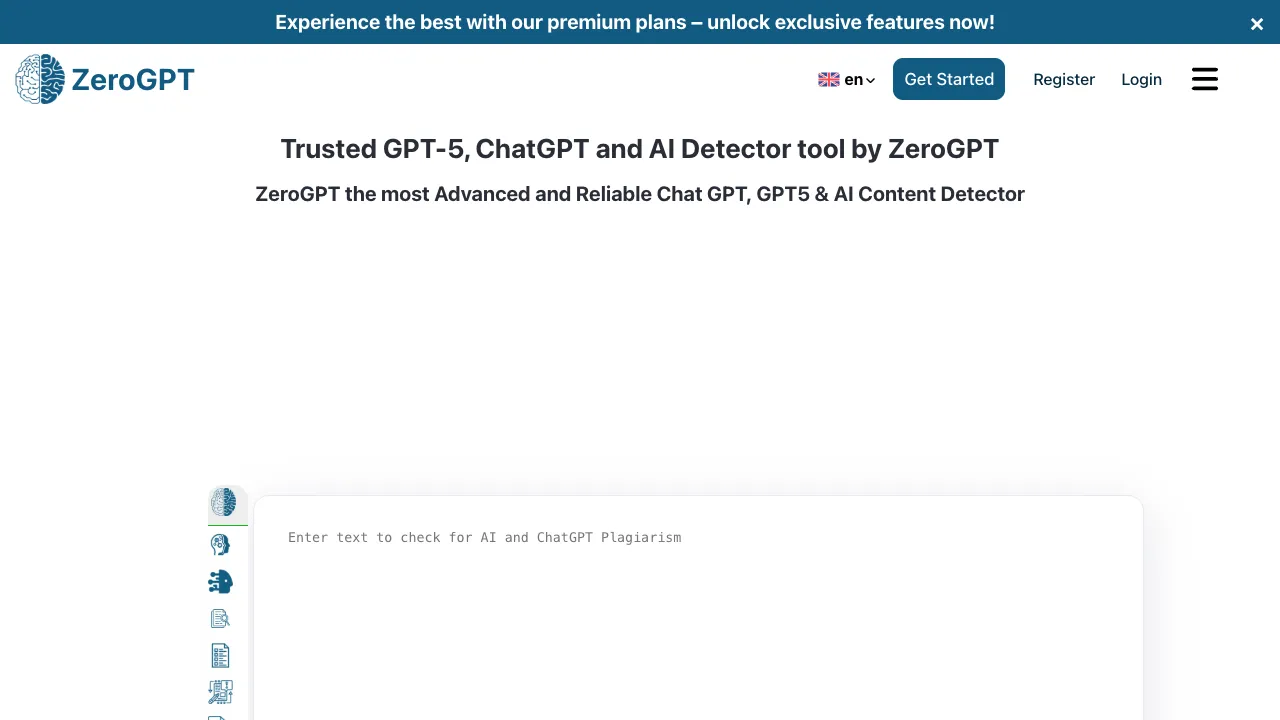
As ChatGPT spread, "was this written by AI?" became a routine question in education, hiring and content moderation. ZeroGPT is an AI text detector that estimates how likely a passage is to be AI-generated, bundled with a set of writing tools.
What ZeroGPT Is
ZeroGPT's core is AI content detection:
- AI detection: paste text and get a probability that it was AI-generated, with sentences it suspects were written by AI highlighted.
- Multiple languages: detection works in several languages, not just English.
- Writing tools: it also offers rewriting ("humanizer"), grammar checking, plagiarism checking, word counts and summaries — a small toolkit around writing and text processing.
Who Uses It
- Teachers and schools: an initial screen for AI-written assignments.
- Editors and content platforms: reviewing submissions and checking originality.
- Recruiters and HR: checking application materials and written tests.
An Important Caveat: A Result Is Not a Verdict
This is essential for any AI detector: no AI detection tool today is 100% accurate. They make probabilistic judgments from statistical features of text, with two kinds of risk:
- False positives: plain, well-structured human writing — especially by non-native speakers — can be flagged as AI.
- False negatives: AI text that has been rewritten or polished can slip through.
Several independent tests in 2026 measured accuracy of roughly 67% to 85%, well below the vendor's claimed 98%+. Reported false-positive rates ranged from 14% to 26%, with non-native English writing misclassified as AI most often (62.5% in one test); technical and academic writing is also prone to false positives, because its regular sentence structure and predictable wording look statistically similar to AI text. Note that many of these evaluations were published by "AI humanizer" products and aren't neutral, but multiple sources point the same way.
So treat a detection result as a signal to look further, not as proof. For serious conclusions about academic integrity or hiring, combine it with other evidence and human judgment rather than deciding on a percentage.
Getting More Reliable Results
- Give it enough text. A sentence or two has too few statistical features for a meaningful result; check full paragraphs or the whole piece.
- Look at the highlighted sentences, not just the score. Whether flagged sentences cluster in one part (such as the introduction and conclusion) tells you more than one overall percentage.
- Cross-check with another detector. Different tools use different methods; only when they agree is it worth investigating further, and when they disagree the text is simply hard to judge.
- Consider how it was written. Drafts, revision history and a document's version history say more about how a text came to be than any detection score.
If Your Writing Is Flagged as AI
When you're misjudged, the strongest evidence is the writing process itself: keep your drafts and outlines, write in a tool with version history (such as an online document), and be ready to explain your reasoning and sources in person. If you're the reviewer, give people that chance to explain rather than concluding from a detection percentage alone.
A Privacy Reminder
Detection means pasting text into a third-party website. Think twice before pasting unpublished papers, internal company documents or material containing personal information.
Tips
Use ZeroGPT as a tool that says "this looks suspicious and deserves a closer look," not as the final word. Its rewriting, plagiarism and grammar tools are genuinely useful for everyday writing as a lightweight text toolkit.
How It Compares
- If you just want to polish or rephrase your own writing: a rewriting tool such as QuillBot is a better fit.
- For formal plagiarism and AI checks at a school or institution, the system the institution designates is what counts; personal online detection results shouldn't be treated as formal evidence.
Pricing
Basic detection and tools come with a free allowance (limited by word count or number of checks); longer texts, batch detection and advanced features require a paid subscription.