
The traditional way to use a search engine is: you enter keywords, it returns a list of links, and you click through them one by one. This model was revolutionary in the early days of the internet, but today, with information exploding, an increasing number of search results are ads, SEO spam, and low-quality plagiarized content. AI search aims to change this pattern: instead of giving you a list of links, it provides direct answers, synthesizing information scattered across multiple web pages into a complete response, along with sources for verification. Tiangong AI Search is one of the representative products in China pursuing this direction.
What Is Tiangong AI Search?
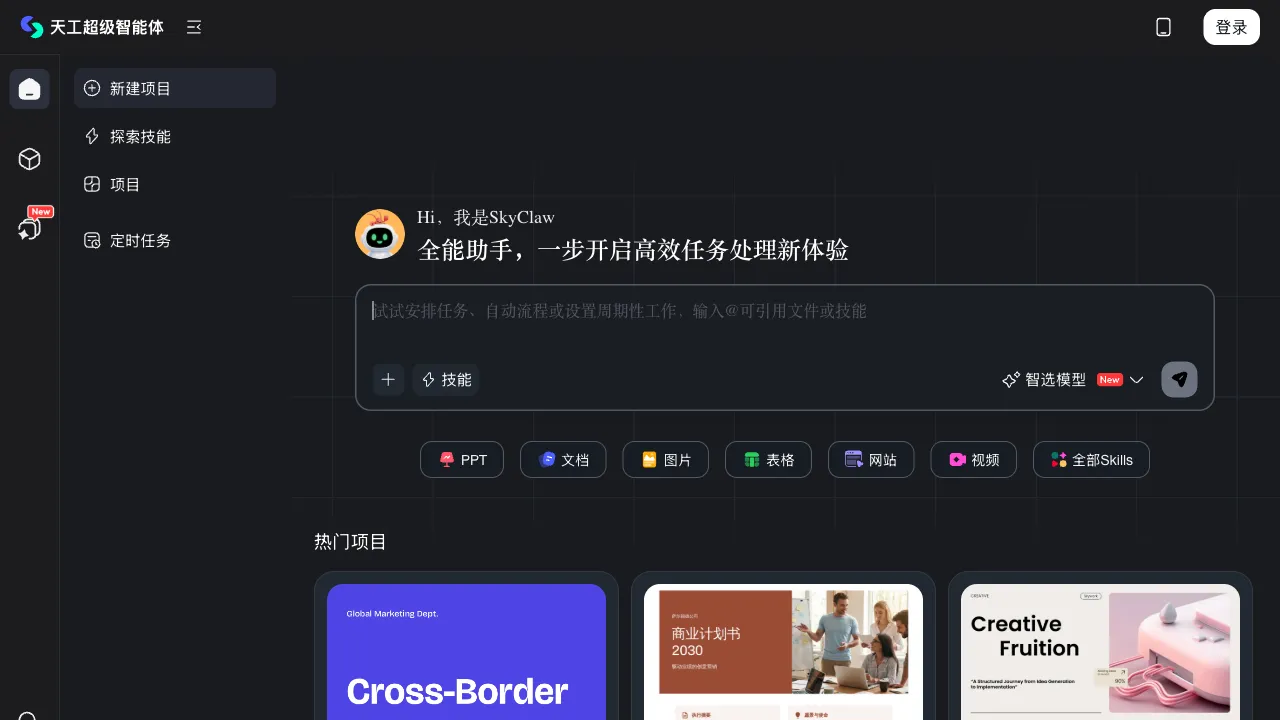
Tiangong is an AI product brand launched by Kunlun Tech, and Tiangong AI Search is one of its core features. The product is positioned as an AI-native search engine—combining real-time web search with the comprehension capabilities of large language models to provide comprehensive AI answers to user queries, while citing information sources.
Kunlun Tech is a veteran domestic internet company with multiple product lines. The Tiangong large model represents Kunlun Tech’s key investment in the AI sector, and Tiangong AI Search is an application product for general users built on top of the Tiangong large model.
Core Features
AI Search Q&A
This is Tiangong’s most core feature: you ask a question, the AI searches the web for relevant information, and then synthesizes multiple sources to provide an integrated answer, rather than returning a list of links.
Typical scenarios:
- "What new AI products have been released recently?" → The AI searches for the latest news and summarizes it into an overview.
- "Which is better, XX phone or YY phone?" → The AI searches reviews and user feedback to provide a comprehensive comparative analysis.
- "How do I apply for a certain policy subsidy?" → The AI searches official policy documents and interpretations, organizing them into step-by-step instructions.
The response includes citation markers; clicking the source links allows you to jump to the original text for verification, preventing the AI from generating inaccurate information out of thin air.
Conversational Search
Tiangong supports multi-turn conversational search, so you don’t need to re-enter the full question each time. For example:
Ask: "What is Apple’s latest iPhone model?" After the AI answers, you can continue asking: "What improvements does it have over the previous generation?" "Where can I buy it cheapest in China?"
This conversational flow is more natural than the traditional search’s “search again” mode and is particularly suitable for scenarios requiring a deep dive into a topic.
Real-Time Information Retrieval
Tiangong’s search is connected to the internet in real time, allowing it to retrieve dynamic information such as the latest news, stock prices, weather, and sports results. This is something AI large models cannot do on their own (as models have a training data cutoff date); AI search bridges this gap by combining real-time retrieval.
Document and Content Analysis
Tiangong also supports uploading documents for AI analysis. Combined with its search capabilities, it can “search and analyze simultaneously”—for example, uploading a competitor report while asking the AI to search for the latest market data for comparative analysis.
Writing Assistance
Tiangong’s functions extend beyond search; it also has AI writing capabilities. After gathering information via search, you can directly generate articles, reports, or summaries based on the search results, connecting information retrieval and content production into a single workflow.
Comparison with Other Tools
vs Metaso AI Search: Metaso’s answers typically have higher information density, with detailed source lists and knowledge graphs; Tiangong offers a more comprehensive conversational experience and overall product completeness, serving as more than just a search tool.
vs Baidu AI Search: Baidu’s advantage lies in the depth of its Chinese content coverage; no one matches its indexing of domestic websites. Tiangong’s AI integration and conversational experience are more native, whereas Baidu’s AI search is largely an overlay of AI on traditional search results.
vs Perplexity (International): Perplexity is the international benchmark in the AI search field, with excellent answer quality and source citation; it requires a VPN to access, and its handling of Chinese content is inferior to domestic products. Tiangong is a domestically accessible, Chinese-optimized alternative.
vs Tongyi Qianwen Search: Alibaba’s Tongyi Qianwen also has web search capabilities. The two are comparable in ability, so the choice largely depends on user habits.
vs Traditional Search (Baidu, Google): Traditional search’s advantages are comprehensive information coverage, diverse sources, and corresponding tools for various needs (maps, images, etc.). AI search’s advantage is providing integrated answers directly, saving time spent on ads and content filtering. However, for information requiring independent judgment of source reliability, it is still recommended to return to traditional search.
Who Is Tiangong AI Search For?
Users who need to quickly understand an unfamiliar topic: Not for in-depth research, but just to gain a basic understanding of a topic; AI search is much more efficient than reading articles one by one.
Users tired of ads dominating search results: Tiangong’s AI answers do not mix in commercial promotions and provide information directly.
Scenarios requiring the latest information: Stock market trends, news events, and policy updates benefit from real-time web search to ensure information is current.
Users who prefer conversational information retrieval: Those who dislike re-entering keywords for every search will find Tiangong’s multi-turn dialogue makes information gathering feel more like chatting with an expert.
Research and investigation work: For quickly collecting multi-angle information on a topic, Tiangong can integrate content scattered across multiple sources into a single overview.
Usage Considerations
The quality of AI search answers depends on the quality of the content found during the search. If there is little or poor-quality information available online for a specific topic, the AI-generated response will also be limited.
For highly professional questions (medical, legal, financial), AI search answers can serve as a reference for initial understanding but cannot replace professional judgment; further verification is necessary before making important decisions.
When encountering controversial topics, the AI tends to provide neutral, synthesized statements. If you need to explore multiple angles in depth, it is recommended to click the source links in the AI response to read the original articles.
Pricing
Tiangong AI Search is currently free to use; simply register to start using it. Kunlun Tech’s commercialization strategy is to first expand its user base with a free tier, potentially introducing paid premium features later.
Tiangong AI Search is one of the important products in China’s AI search sector. For users accustomed to using search engines but who desire more integrated and direct answers, it is worth trying as an alternative search tool.