
Short-video viewers may not realize how much of the "voices" they hear daily aren’t human at all: thesteady (steady) baritone in film recaps, the soothing female voice narrating emotional stories, or the enthusiastic tone in product recommendations—much of this is AI-generated. The logic behind voiceovers in the short-video industry has been completely restructured: recording your own requires equipment, a suitable environment, good vocal condition, and the willingness to endure your own voice; hiring a human voice actor is expensive and involves long revision cycles; whereas with AI voiceovers, you can regenerate the audio by changing just one character, with delivery in ten seconds. In this transformation, MoYin Workshop (Moyin Gongfang) is one of the most recognized names among domestic creators—"MoYin Tone" has even become a shorthand for a certain style of recap video, illustrating its widespread cultural penetration.
What Is MoYin Workshop?
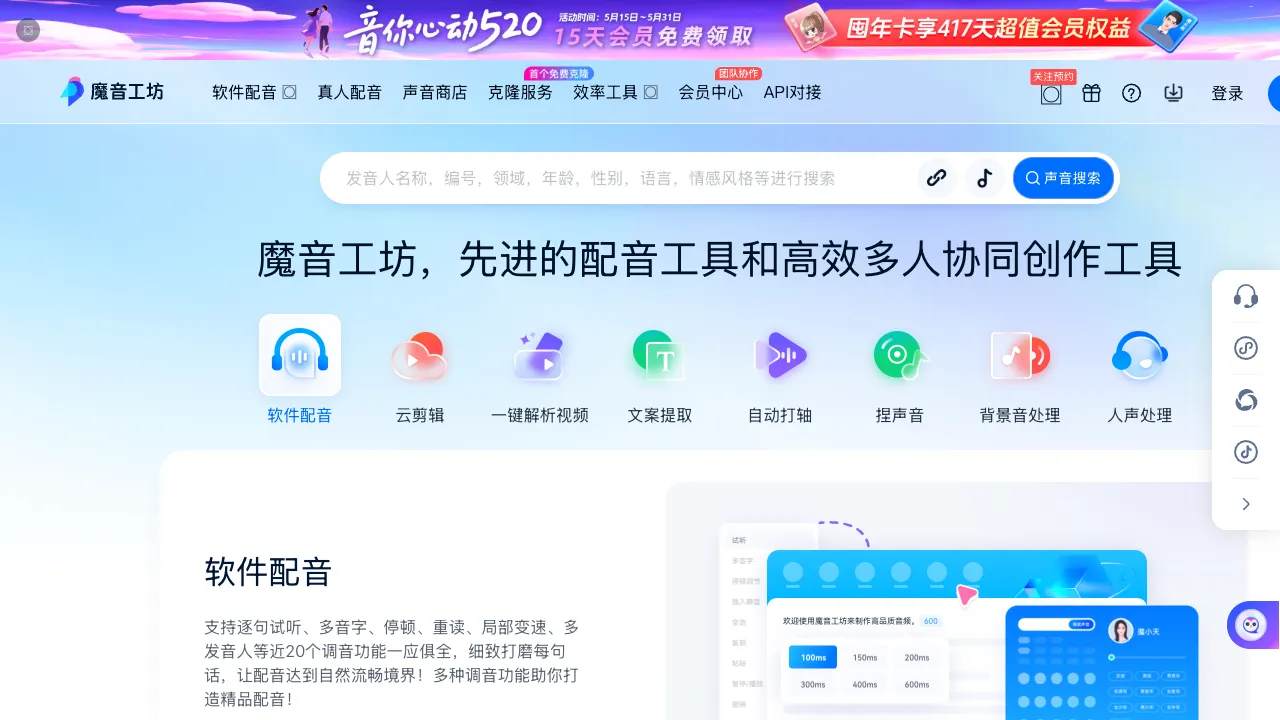
MoYin Workshop (moyin.com) is an AI voiceover platform under Chumen Wenwen (a veteran company in the speech AI field that later listed on the Hong Kong Stock Exchange): input text, select a voice tone, and output audio. Its core asset is a Chinese voice library with both quantity and stylistic quality, along with fine-grained controls tailored for voiceover scenarios (polyphonic characters, pause-and-connect timing, local speed adjustments) and seamless integration into short-video workflows. It has become a de facto industry tool among creators on Douyin, WeChat Channels, and Bilibili who produce recap and storytelling content.
Key Features
Multi-Style Voice Library: The Core Asset
Hundreds of voice tones are categorized by scenario: crisp and clear tones for news broadcasting, magnetic bass voices for film recaps (several "legendary recap tones" widely praised in creator circles originate here), gentle female voices for emotional radio shows, energetic tones for sales pitches, dialects and distinctive voices, and more.
The depth of the voice library matters concretely to creators: tone defines persona—the vocal identity of an account is part of its content asset. Choosing a tone that matches your style and using it consistently is like establishing a sonic logo for your channel. The larger the library, the higher the probability of finding "your voice."
Fine-Grained Voiceover Control: The Source of Professionalism
What sets MoYin Workshop apart from basic TTS tools is its control granularity:
Polyphonic Character Correction: For tricky cases like "return(hái/huán)money" (repay money), you can manually select the correct pronunciation, turning the biggest pitfall in Chinese voiceovers into a solved problem;
Pauses and Rhythm: Manually insert pauses and control breathing points—the "breathiness" of voiceover lies precisely in these pauses, marking the boundary between robotic reading and human-like speech;
Local Adjustments: Emphasize specific words or accelerate certain sentences, enabling performance-level control at the sentence level;
Sound Effects and Music: Overlay background music and sound effects to produce not just dry audio, but near-final tracks.
This level of control allows dedicated users to tune AI voiceovers to have a "broadcasting feel," creating a clearly audible gap from the plastic-sounding tones of one-click synthesis.
Voice Cloning
Record a small sample of your own voice to clone it—producing content in bulk with "your AI voice" without needing to enter a studio for every recording. This is a productivity solution for personal IP creators, but with a clear red line: you can only clone your own voice or voices you have authorized. The platform has verification mechanisms; impersonating someone else’s voice is infringement and potentially illegal.
Workflow Support
Segmented synthesis for long texts, synchronization of subtitles and timelines, and export formats for multiple platforms—these handy details around the specific scenario of "video voiceover" gradually reduce the friction costs for daily-updating creators.
Comparison with Similar Tools
vs Jianying (CapCut) Voiceover: The built-in voiceover in this national editing tool is free, convenient, and decent in quality—for light users who already edit within Jianying, the built-in feature is often sufficient. MoYin Workshop’s advantage lies in the depth of its voice library and control granularity: for creators with "persona-level" requirements for voice or needing fine-tuned performance, professional tools offer a higher ceiling.
vs iFlytek Voiceover: iFlytek has deep technical roots in speech synthesis, with top-tier audio quality domestically; the two compete directly in the professional voiceover market, each with its own fanbase for tone styles—synthesize the same script on both platforms and let your ears decide.
vs TTSMAKER: A free, no-threshold TTS tool, ideal for light users seeking free options; its richness of tones and depth of control are in a different league, serving a different positioning.
vs ElevenLabs: A star in international AI voice, with stunning emotional expressiveness in English and leading cloning technology; Chinese is its home field disadvantage—the naturalness of Chinese voiceovers and handling of polyphonic characters are areas where MoYin Workshop,deep cultivation (deeply cultivating) the Chinese market, is more stable. There’s no need to go far for Chinese content.
vs Human Voice Actors: For nuanced emotional layers and improvisational performance judgment, humans remain the ceiling—hire real people for commercial films and brand TVCs; AI captures the massive middle market of daily-updating content: fast, cheap, and instantly editable. These three factors are lifeblood for productivity-focused creators.
Who Should Use MoYin Workshop?
Recap/Storytelling Short-Video Creators: Film recaps, bizarre stories, historical science popularization—the core user base for MoYin Workshop; its signature recap tones were born for your content types.
Daily-Updating Content Matrix Operators: Batch production across multiple accounts; AI voiceover’s productivity and consistency are essential for assembly-line operations.
Audiobook Content Creators: Synthesized voiceovers for audiobooks, radio dramas, and podcasts, supported by multi-character tone libraries for multi-persona performances.
Enterprises and Institutions: Standardized voiceovers for promotional videos, training materials, and product explanations, eliminating the procurement process of hiring voice actors each time.
Personal Creators Who Don’t Want to Use Their Own Voice: For creators lacking confidence in their own voice or unable to record it, AI voiceover directly removes this barrier.
Usage Recommendations
Choosing a tone is the top priority: take a sample of your actual script and synthesize it with each candidate tone for comparison—the match between tone and content style is more important than the tone’s inherent "pleasantness"; once chosen, use it consistently to build vocal recognition.
Don’t skimp on fine-tuning: review polyphonic characters, add pauses to key sentences, adjust emphasis on important words—ten minutes of fine-tuning can elevate quality by a notch; this is the dividing line between ordinary users and "those who know how to use it."
Pay attention to commercial licensing terms: different plans have different scopes for commercial use (platform distribution, advertising purposes); confirm details before publishing.
Pricing
Free tier available for experience (with character limits); paid plans are subscription-based or charged per character pack; advanced tones and cloning features are in the paid tiers; refer to the official website for specifics. For daily-updating creators, comparing the monthly fee against the "recording time cost per video" is almost a no-brainer.
The track MoYin Workshop operates in essentially turns "voice" into a selectable asset like fonts—pick one, tune it, and apply it. If your content production line is still stuck at the "voiceover" stage, take a script and test its voice library: chances are, you’ll hear the future sonic identity of your channel in one of those voices.