
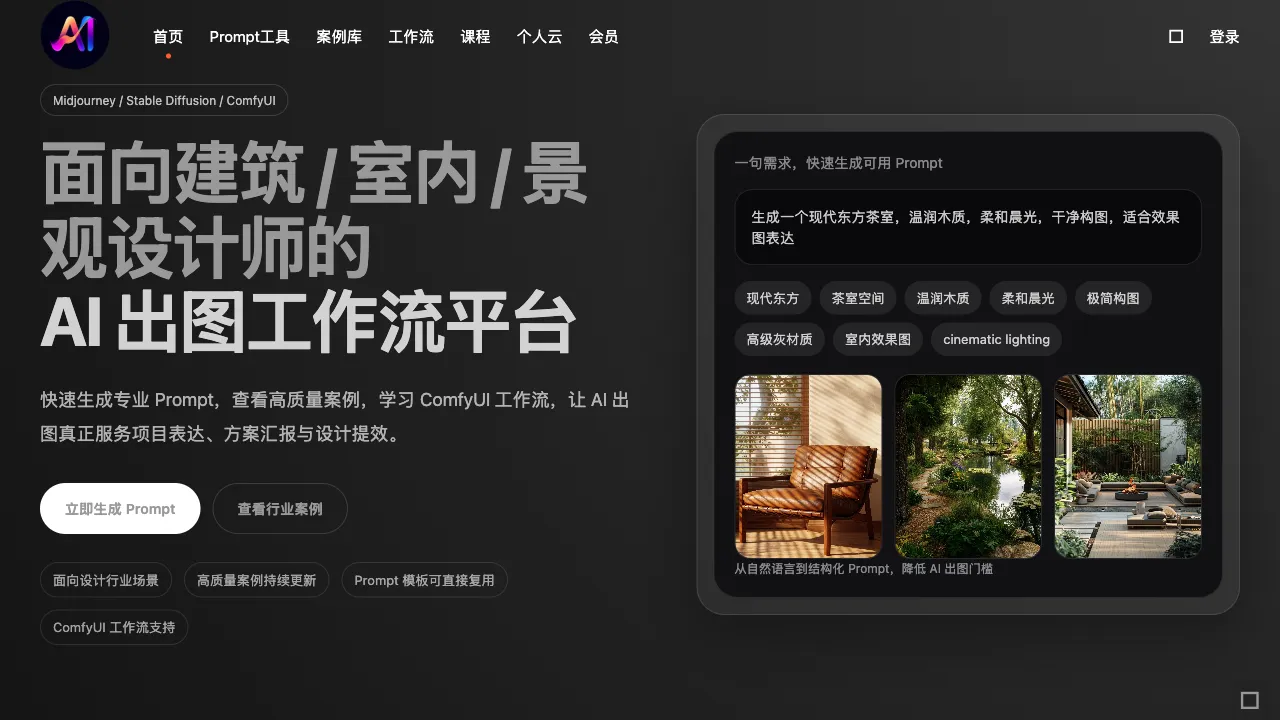
The product has changed shape. This site now centres on a desktop client called AI Design Space (the site currently shows v1.0.4, around 102MB) rather than the browse-oriented gallery and prompt-sharing site it began as. The description below reflects the current product.
Users learning AI art will quickly encounter an awkward reality: the best resources are almost entirely in English. Platforms like PromptHero, Lexica, and Civitai feature prompts written in English; popular styles reflect Western aesthetics. If you're searching for high-quality prompts featuring "meticulous bird-and-flower painting" or "ink wash landscape," you might flip through those platforms endlessly without finding anything relevant. The learning needs of Chinese AI creators have long been stuck in a state of watching others thrive from behind a language and cultural barrier.
AI Gallery (aigallery.top) is one local attempt to bridge this gap: it's an AI art showcase and prompt-sharing community for Chinese users, with a Chinese interface, content contextualized for China, and aesthetic preferences that cater to Eastern subjects—in short, the base camp for learning prompts by looking at images in Chinese.
What Is AI Gallery?
AI Gallery is a Chinese-language platform dedicated to AI art. Its core loop follows the classic model: users upload AI-generated artworks along with their complete prompts; other users browse these works, view the prompts, and learn how to reuse them—essentially an implementation of "find words by looking at images" tailored for the Chinese context. The content covers outputs from mainstream tools like Midjourney and Stable Diffusion and remains tool-agnostic.
In one sentence: while platforms like PromptHero serve the English-speaking world, AI Gallery serves Chinese creators who want to learn AI art in their native language.
Key Features
Artwork Gallery and Categorized Browsing
The community's artworks are displayed in a masonry-style gallery, categorized by style and tool: photorealistic portraits, anime/manga styles, landscape scenes, concept art—and most importantly, its flagship section featuring Chinese-styled content (ink wash paintings, guochao trends, Hanfu attire, traditional patterns, Eastern fantasy). These subjects are often treated as niche on English platforms but form the main course here; for creators of Chinese-style works, this serves as a highly relevant reference library.
Prompt Publicity: The Core Learning Feature
Clicking on any artwork reveals its complete "recipe": the positive prompt, negative prompt, tools used, and parameters. This transparent display is precisely where AI art communities derive their educational value—rather than reading ten tutorial articles, directly observing how a specific good image was created before replicating it is widely recognized as the fastest path to growth.
The added value of Chinese platforms lies in access to extensive real-world examples mixing Chinese and English prompts—the authentic writing style of Chinese users (Chinese descriptions for atmosphere + English controls for stylistic parameters). This experience with "hybrid prompts" cannot be learned on English-language platforms.
Artwork Sharing & Community Interaction
Registration allows you to upload artworks and prompts; likes, favorites, and collections form the basic community loop. When sharing within a Chinese-speaking community, users receive feedback from peers who share their cultural context—for creators of traditional-Chinese-style content, this "insider knowledge" surpasses that found on international platforms.
The Value Proposition of Chinese AI Art Communities
The reason these platforms exist essentially addresses three blind spots in the English ecosystem:
Language Barrier: Learning prompts requires careful, repeated reading; friction from non-native English proficiency is a genuine obstacle for many users.
Aesthetic Bias: Popular styles on English platforms center around Western aesthetics, with low density of references to Eastern artistry.
Chinese Contextual Content: Prompt experience involving Chinese characters, mythology, and traditional cultural themes can almost exclusively be cultivated within Chinese-speaking communities.
AI galleries fill these three gaps—not by replacing international platforms, but by covering the segments they overlook.
Comparison with Similar Platforms
vs PromptHero/Lexica: International platforms dominate in content volume, update speed, and community scale; consult them for general subjects and cutting-edge techniques. AI galleries carve out their niche within the vertical depth of Chinese language and traditional-Chinese-style (Guofeng) art. The relationship is complementary: study technique on international sites, then return to Chinese communities for Guofeng references.
vs Civitai: A universe of Stable Diffusion models focused primarily on model resources (LoRA/Checkpoint) rather than artwork display; AI galleries are lighter in weight and focus solely on "learning prompts by looking at images."
vs LiblibAI/TuShi: Domestic SD platforms come with built-in communities tied to online generation, creating a heavier ecosystem. In contrast, AI gallery tools remain neutral and lightweight, serving as pure reference libraries without burden.
vs Xiaohongshu/Weibo AI Art Content: Social media content is scattered; prompt sharing happens sporadically and lacks structure. Dedicated communities offer categorized search and complete parameter displays—learning efficiency operates on a completely different scale.
Who Is This For?
Chinese-speaking beginners to AI art: Starting from zero with a native-language interface and learning terminology through visuals offers the lowest-friction entry path—build your prompt-handling skills here first before expanding your horizons on international platforms.
Creators of traditional Chinese style content: Prompt references for ink wash, guochao (China-chic), and other directions rooted in traditional culture make this community a high-density resource; it is absolutely the home turf compared to all international alternatives.
Enthusiasts unaccustomed to English-language platforms: Language barriers are real; local communities ensure these users aren't excluded from learning resources.
Creators willing to share: The Chinese AI art community is still in its growth phase, so early contributors can build visibility and influence more easily than on saturated international platforms.
Usage Tips
Treat "replication" as a fundamental skill: When you find an image you like, copy its prompt parameters exactly to regenerate it, then modify each variable one by one to observe the changes—this brute-force method of controlling variables is actually the fastest way to improve your skills.
Use international and Chinese platforms complementarily: International platforms still hold the advantage in terms of reference density for universal styles and cutting-edge techniques; treat AI Gallery as a "specialist hub for traditional Chinese style + entry point for beginners," leveraging the strengths of both sides without relying on just one.
Pay attention to prompt timeliness: As AI tools iterate rapidly, prompts from older works may produce drifting results under new model versions—always rely on your own testing.
Content quality and activity levels in community platforms fluctuate with operations; always judge based on a site's current state—the sustainability of such independent communities precisely depends on user participation to co-build them.
Pricing
The site's navigation includes a membership entry, but no tiers or prices are listed on public pages — you have to sign in to see them, so no figures are given here.
The client is free to download (the site currently shows v1.0.4, around 102MB), and the prompt tools, case library, workflows and courses are openly accessible. Generation itself calls AI models, so allowances and membership benefits are whatever the signed-in pages show.
Check the pricing after signing in at aigallery.top.