

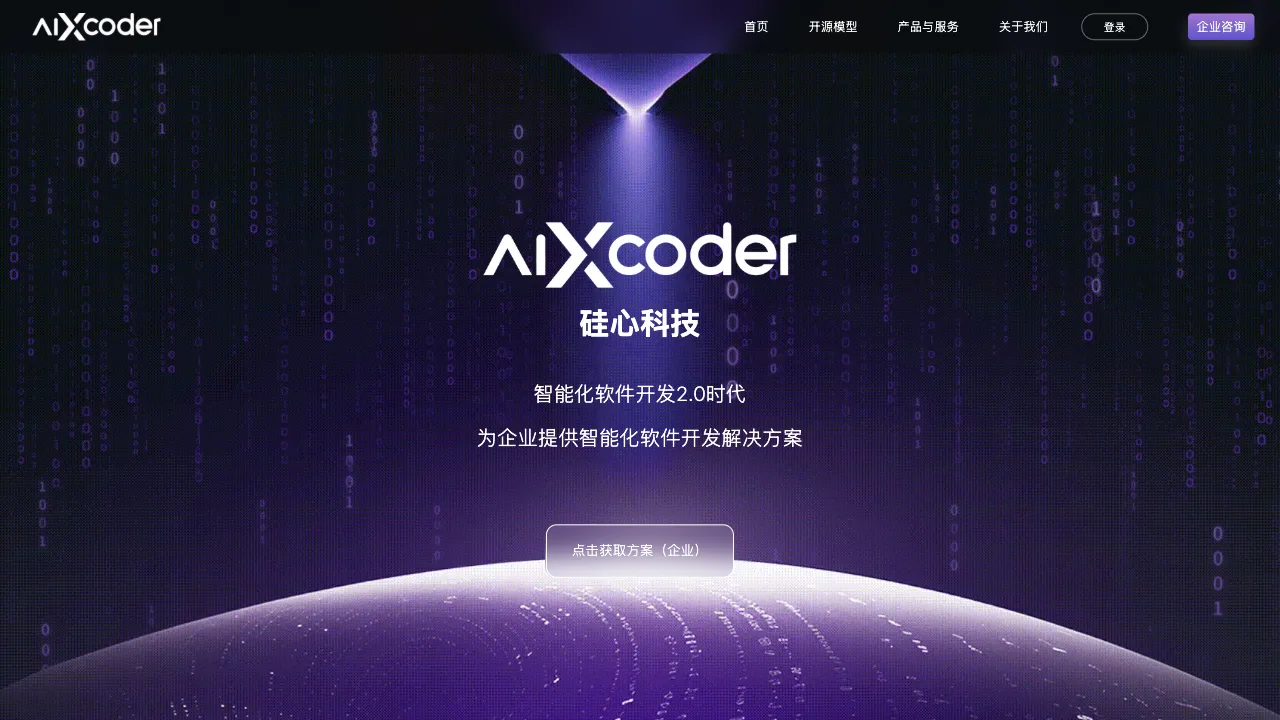
Before GitHub Copilot swept the global market for AI-powered programming tools, domestic teams in China were already developing similar solutions. aiXcoder is an AI coding assistant jointly developed by Peking University's Institute of Computer Science and related research groups. It stands as one of the earliest professional AI code completion tools in China, holding a pioneering position in the development history of homegrown AI programming utilities.
What is aiXcoder?
aiXcoder is an intelligent AI programming assistant whose primary function is to provide automatic code completion within your IDE. It supports installation as plugins for mainstream programming environments such as IntelliJ IDEA, VS Code, Eclipse, PyCharm, and others, delivering deep learning-based capabilities for generating and completing code.
The earliest version was released around 2018, when AI-driven code completion was still a relatively novel technology; at that time, aiXcoder had already cultivated an early user base within the Chinese developer community. Since then, it has undergone successive updates, including releases based on large language models such as aiXcoder-7B.
Core Features
Automatic Code Completion
This is aiXcoder's core functionality. As you write code, it analyzes your coding context in real time to predict and suggest the next lines of code that might be written—ranging from simple variable name completions to full function implementations.
Like other AI-powered code completion tools, its suggestions are based on an understanding of code semantics rather than mere text matching; it can comprehend function call relationships, type information, and API usage patterns.
On-Premises Private Deployment
This is a key differentiator for aiXcoder compared to cloud-based services like GitHub Copilot. aiXcoder offers an enterprise-grade private deployment solution, allowing models and services to be hosted on the company's own servers so that code never leaves the corporate intranet.
For enterprises with strict data confidentiality requirements—such as those in finance, government, defense, or critical infrastructure—this capability is unavailable via GitHub Copilot and represents one of aiXcoder’s primary competitive advantages in China’s enterprise market.
Multi-Language Support
aiXcoder supports mainstream programming languages including Java, Python, JavaScript, TypeScript, Go, C/C++, PHP, covering the common technology stacks used in enterprise development.
The aiXcoder 7B Large Model Version
In the era of large language models (LLMs), aiXcoder has launched its aiXcoder 7B version based on a model with 7 billion parameters. This release delivers significant improvements in code generation capabilities, benchmarking against contemporary open-source code models such as CodeLlama.
The aiXcoder 7B model is open source; developers can download it from platforms like Hugging Face for research purposes or to build their own services, attracting technical users interested in open-source coding models.
Use Cases
Corporate Internal Development Environments: Enterprises with stringent data security requirements can leverage aiXcoder’s private deployment to enjoy AI-powered code completion within the intranet without any code leaving the network perimeter.
Java and Python Developers: These two languages receive the deepest support from aiXcoder; enterprise applications built using them tend to achieve relatively high accuracy in code completions.
Developers Preferring Domestic Tools: For various reasons—including faster access speeds, regulatory compliance, or a preference for domestic software—developers who wish to use Chinese AI tools will find aiXcoder suitable.
Comparison with Other Tools
vs GitHub Copilot: Supported by Microsoft/GitHub and powered by OpenAI's code models, Copilot offers higher-quality completions, a larger user base, and richer community resources. However, because Copilot sends your code data to GitHub servers, it raises concerns for scenarios requiring strict confidentiality. aiXcoder addresses this issue with its private deployment option.
vs Tongyi Lingma (Alibaba): Tongyi Lingma is Alibaba's AI coding assistant, built on the Qwen model and has seen rapid growth in recent years. Its market share among domestic AI programming tools is rising quickly, posing significant competitive pressure to aiXcoder.
vs Wenxin Kuaima (Baidu): Baidu's AI coding assistant that also supports domestic AI programming scenarios, leveraging Baidu's large language models.
vs Cursor/Windsurf: These are AI-powered IDEs with capabilities far exceeding simple code completion plugins; however, they require switching editors and do not support private deployment.
Limitations
Gap compared to global leaders: Compared to GitHub Copilot, there is a perceptible gap in code completion quality, language coverage, and depth of context understanding. This reflects the broader model capability competition common across all AI large models today.
Increasing competitive pressure: Domestic competitors backed by major tech giants—such as Tongyi Lingma, Wenxin Kuaima, and Baidu Comate—are rapidly catching up. As a relatively independent team, aiXcoder faces resource disadvantages in this landscape.
Limited community scale: Compared to GitHub Copilot's global user base, the aiXcoder user community and supporting resources (tutorials, discussions, Q&A) are significantly smaller.
Inconsistent update cadence: In today's rapidly evolving AI large model era, tool update speed is a key competitive factor; performance in this area has been uneven.
Scenarios Worth Evaluating
If you're looking for an AI code completion tool, the scenarios where aiXcoder deserves serious consideration are:
- Enterprises with strict intranet security requirements: Private deployment is a hard requirement here, making aiXcoder one of the important candidates.
- Government or state-owned enterprise projects seeking domestically controlled tools: Compliance and localization may be more critical than feature parity in these cases.
For individual developers or enterprises without special compliance needs, make your decision after thorough comparison with other options—do not choose simply because it's a domestic tool, nor ignore it solely due to lower brand recognition.
Practical Recommendations
Try the free version first: aiXcoder offers a free tier for trial use. Deploy it in your primary projects for a period to assess whether completion quality meets your needs before considering paid plans.
Benchmark against GitHub Copilot: If your code security requirements allow, test both tools on identical tasks and directly compare completion quality and user experience before making a choice.
Conduct thorough evaluation before enterprise procurement: Decisions around private deployment have broad implications; we recommend performing technical validation (POC) beforehand to confirm that performance aligns with expectations within your tech stack and workflow.
aiXcoder stands as a witness to the development history of domestic AI programming tools, with its private deployment capability representing a genuine advantage in specific scenarios. As large language models continue to evolve rapidly, aiXcoder's future trajectory and competitive outcomes against both domestic and international rivals warrant continued observation.