

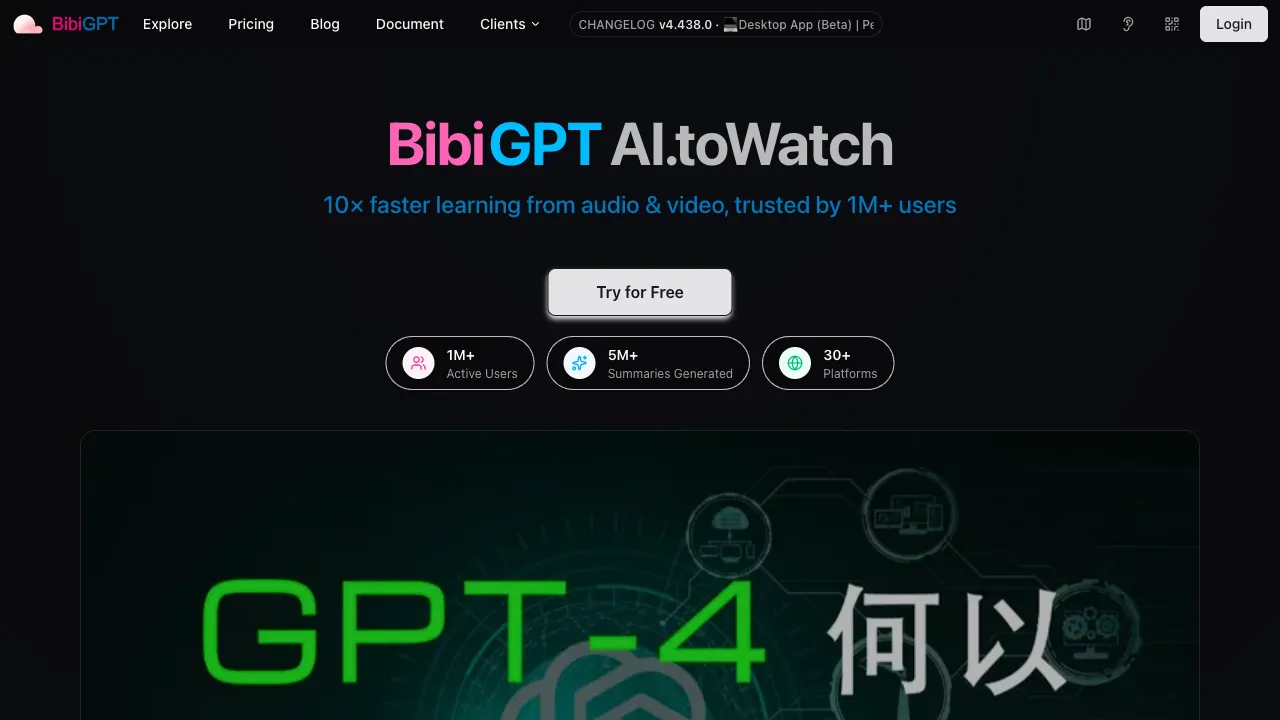
The official address has changed. The early b.jimmylv.cn now returns a 502; the product's entry point is bibigpt.co, and the link on this page has been updated to match.
Early in 2023, when the ChatGPT API first opened its doors to developers, a wave of "overnight sensation" independent developer projects emerged on the Chinese internet. BibiGPT stands out as one of the most representative examples: Developer Jimmy Lv (Lv Liqing) built a web tool that instantly summarizes Bilibili video links with AI. After being open-sourced and launched online, it quickly went viral within technical communities, racking up stars on GitHub—because it addressed a universal pain point: Bilibili videos keep getting longer while your time remains limited. A one-and-a-half-hour "in-depth analysis" might contain only ten minutes of actionable insights; meanwhile, the "Watch Later" folders in collections pile up like graveyards. Every heavy Bilibili user understands this feeling of being overwhelmed.
BibiGPT's solution is simple yet powerful: Before watching a video, spend thirty seconds reading its AI summary to determine if it's worth your time and where the key points lie—get the answers first before investing your attention.
What Is BibiGPT?
BibiGPT (b.jimmylv.cn) is an AI-powered tool for summarizing audio and video content: Paste a video link, automatically retrieve subtitles (or transcribe audio), and let AI generate structured summaries—including core arguments, bullet-point lists of key takeaways, timestamped chapter navigation—and support Q&A based on the video's full transcript. The name reflects its positioning: Bibi (short for Bilibili) + GPT. Its native integration with Bilibili is what sets it apart from other English-centric tools in this space; at the same time, it also covers multi-platform sources like YouTube, podcasts, and local audio/video files.
Starting as a viral open-source demo, BibiGPT has evolved into a mature product undergoing continuous iteration—a rare example among independent developer projects that has "survived beyond the hype."
Core Features
One-Click Video Summarization
Paste a link to receive three key outputs:
- Core Summary: A few paragraphs explaining what the video is about and its main conclusions.
- Key Point List: Bullet-pointed takeaways with information density far exceeding that of the original video.
- Timestamped Outline: Chapters segmented by content, each marked with timestamps—essentially a "table of contents" for the video; click to jump directly to any section.
The essence of practical usage lies in "pre-watch decision-making": Read the summary in thirty seconds → Decide whether to watch closely, skim selectively, or skip entirely → Spend your full viewing time only on content worth it. For subscribers following dozens of UP hosts (creators), this acts as a quality control filter for information streams.
AI Content Q&A
A deep-dive tool beyond mere summarization: "How exactly do I implement the third method mentioned in the video?" or "What evidence did the creator use to refute that particular argument?"—AI answers based on complete transcripts, transforming videos from linear content flows into searchable knowledge bases. No more dragging progress bars backward like an archaeologist hunting for specific details buried within a one-hour clip.
Cross-Language Summarization
Generate Chinese summaries of English-language videos—high-quality English content on YouTube becomes accessible by breaking down language barriers through this layer of translation plus summarization, effectively serving as a "foreign-content digestor" for Chinese learners.
Multi-Platform & Note Accumulation
A unified entry point for Bilibili, YouTube, podcasts, and local files; generated summaries can be saved and accumulated over time—gradually building your own "video study note library." This elevates passive consumption to an active knowledge-building process far beyond simply watching and forgetting.
Comparison with Similar Tools
vs NoteGPT/Glarity: Glarity shows YouTube summaries in a browser sidebar, NoteGPT emphasizes note management, and BibiGPT focuses on Bilibili content. Choose around your usual video sources and how you organize notes.
- vs Official Bilibili AI Summarization: Platform-native features come at zero cost but offer limited coverage in terms of supported videos, summary depth, and Q&A capabilities; BibiGPT provides a "complete" experience serving as an upgrade option for power users with heavy needs.
- vs Tongyi Tingwu (Alibaba): Alibaba's transcription-and-summarization platform excels in enterprise scenarios involving meeting recordings and document processing; BibiGPT shines instead in its lightweight, instant-use nature ("paste link to use") and tight alignment with content consumption contexts—positioning itself distinctly.
- vs Manually Feeding Subtitles into ChatGPT: The DIY route is feasible and free but involves friction: extracting subtitles, segmenting them manually, pasting chunks repeatedly, and organizing outputs becomes unsustainable under frequent usage patterns; BibiGPT productizes this entire workflow—as always: manual labor for low-frequency tasks, paid tools for high-frequency ones.
Who Should Use BibiGPT?
- Heavy Bilibili Users: Learners whose "Watch Later" folders are overflowing—pre-summary filtering transforms these graveyard collections into actionable to-do lists; they represent the core beneficiary group.
- Knowledge Video Learners: Consumers of technical tutorials, courses, and in-depth interviews—the combination of summaries plus timestamped jumps doubles learning time efficiency.
- Content Researchers & Creators: Track multiple videos on a specific topic to rapidly build comprehensive understanding via batch summarization; creators can also deconstruct competitors' structural patterns using the tool.
- Chinese Consumers of English Content: Cross-language digestion of high-quality YouTube material—generate Chinese summaries first, then selectively deep-dive into selected segments for optimal balance between efficiency and depth.
Usage Reminders
Summary quality depends heavily on subtitle accuracy: Videos lacking subtitles or those with poor machine-translated captions will yield discounted results; always verify critical information against the original video at corresponding timestamps since AI paraphrasing inevitably introduces some distortion.
For practical demonstration-type content (e.g., hands-on crafts, cooking tutorials, software walkthroughs), visual cues cannot be fully captured in text summaries—such videos should be watched directly; recognize where tools reach their limits.
Summaries are maps, not journeys: For material requiring deep understanding, reading a summary cannot replace full viewing and thoughtful engagement—treat it as a filter or review index rather than a substitute for learning itself.
Pricing
Signing up grants 120 free minutes, enough to run a few videos and judge the output.
Three paid tiers: Plus, Pro and a partner membership. The first two bill monthly or annually; the partner membership is a one-time payment valid indefinitely. The site displays prices in both USD and CNY.
No amounts are listed here: the CNY figures are live exchange-rate conversions and promotions run frequently — check the pricing page at bibigpt.co. Annual billing is usually considerably cheaper than monthly.
Refunds can be requested within 7 days of purchase.