

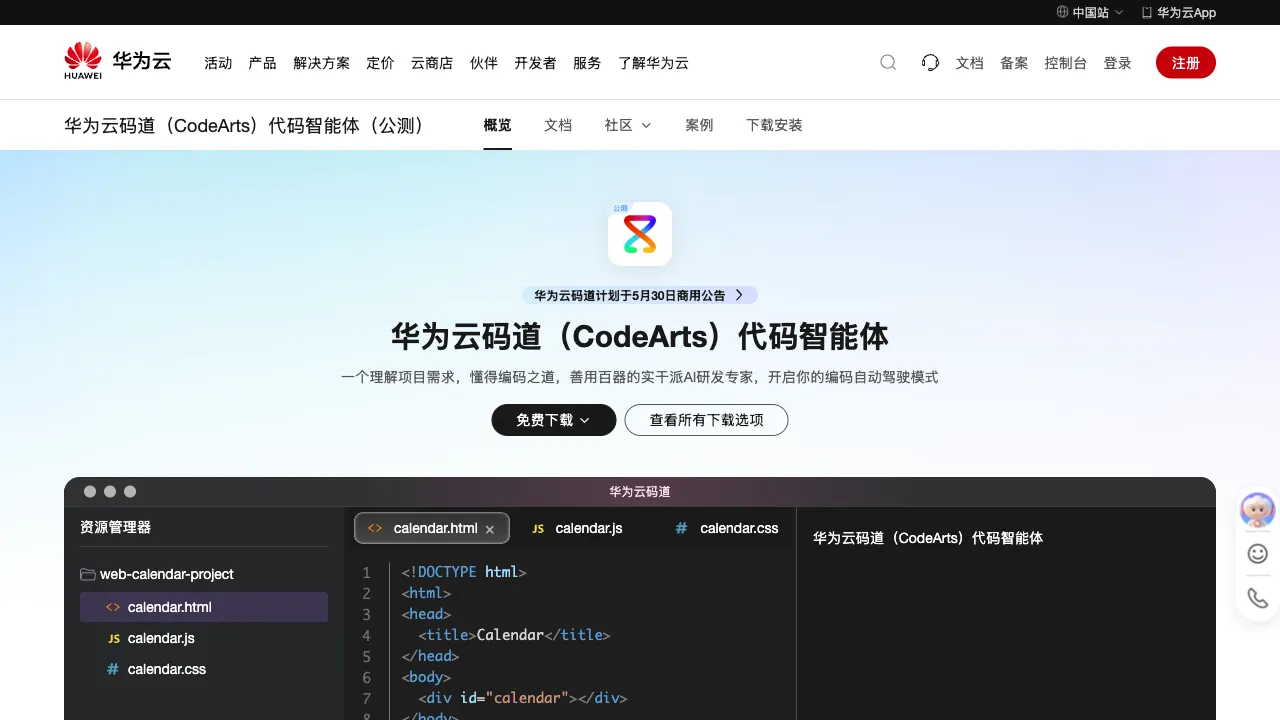
Huawei’s AI strategy is spread across multiple product lines. CodeArts Snap is an AI coding assistant within the CodeArts developer platform under Huawei Cloud, designed for developers using Huawei Cloud services. It provides capabilities such as code generation, completion, explanation, unit test generation, and code review. For development teams already working within the Huawei Cloud ecosystem, CodeArts Snap offers a natively integrated AI coding tool option.
What is CodeArts Snap?
CodeArts Snap is an AI coding assistant built into the Huawei Cloud CodeArts platform, powered by the code capabilities of Huawei’s Pangu Large Model (Pangu Code). CodeArts itself is Huawei Cloud’s one-stop software development platform, covering the entire development lifecycle including requirements management, code repositories, CI/CD pipelines, and testing. Snap serves as the AI capability layer within this ecosystem, providing developers with AI assistance while writing code.
It can be used as a plugin in VSCode and JetBrains IDEs (such as IntelliJ IDEA and PyCharm), or directly within CodeArts’ online IDE.
Core Features
Code Completion
Provides line-level and function-level code completion, predicting the next content in real time as developers type. This feature is commonly known as "AI code prediction." Similar to predictive text on mobile keyboards, it focuses specifically on code context and logic.
Effective code completion goes beyond simple syntax correction; it understands the intent and context of the code to predict the logical next steps. Snap’s completion relies on understanding code context, achieving high accuracy when predicting familiar code patterns such as loops, conditional statements, and common API calls.
Code Generation
Generates code from comments or natural language descriptions:
- Write a comment describing a function’s purpose, and the AI generates the implementation
- Describe requirements in a chat dialog, and the AI generates the corresponding code snippet
- Generate calling code based on interface documentation
Supported languages cover mainstream programming languages, including Java, Python, JavaScript, TypeScript, Go, C/C++, and C#.
Code Explanation
Select a block of code and ask the AI to explain its functionality and logic in natural language. This feature is valuable for:
- Taking over legacy code and needing to quickly understand existing behavior
- Learning new codebases and understanding unfamiliar implementations
- Quickly assessing the intent of a code snippet during Code Review
Unit Test Generation
Automatically generates unit test cases based on existing code functions. Generating tests is often considered one of the most tedious aspects of development; AI-generated test cases can significantly reduce this workload, and the coverage of test scenarios is typically more comprehensive than manual writing.
Code Review Assistance
Before code submission, the AI scans the code and identifies potential issues and suggestions for improvement:
- Potential bugs (null pointer exceptions, array index out of bounds, unreleased resources)
- Code style issues (non-standard naming, overly long functions)
- Security vulnerabilities (SQL injection risks, hardcoded passwords)
- Performance issues (unnecessary loops, inefficient data structures)
This represents a key value of AI coding assistants in quality assurance: adding an AI check before code integration can help identify certain issues prior to formal Code Review.
Code Conversion
Translates code between different programming languages, such as converting Python code to Java, or upgrading legacy syntax to newer versions. This feature is valuable for technology stack migrations or multi-language projects.
Comparison with Other Tools
vs GitHub Copilot: Copilot is the international standard in AI coding assistants, featuring mature functionality, high-quality completion, and widespread IDE integration. However, access to GitHub Copilot services within China can be unstable. For teams working within the Huawei Cloud ecosystem, CodeArts Snap offers a more stable alternative.
vs Tongyi Lingma (Alibaba): Alibaba’s AI coding assistant, also targeting domestic developers with similar functional positioning. Tongyi Lingma offers more free usage quotas and integrates more naturally within the Alibaba Cloud ecosystem. Huawei Cloud users are better suited to Snap, while Alibaba Cloud users should choose Tongyi Lingma.
vs Wenxin Kuaima (Baidu): Baidu’s AI coding assistant with comparable capabilities. The choice largely depends on which cloud provider’s ecosystem you are using.
vs Cursor (AI Code Editor): Cursor is a code editor redesigned around AI, with deeper integration of AI capabilities. CodeArts Snap operates as a plugin, eliminating the need to switch editors and having less impact on existing workflows.
vs Locally Deployed Code Models (e.g., CodeLlama): Capable teams can deploy open-source code models themselves. CodeArts Snap is a SaaS service that requires no infrastructure maintenance.
Who Should Use CodeArts Snap?
Development Teams in the Huawei Cloud Ecosystem: For teams hosting code on CodeArts and using Huawei Cloud services, Snap integrates natively and naturally, requiring no additional accounts or configuration.
Enterprise Development Teams Requiring Data Residency: AI coding tools interact with source code, and many enterprises have strict requirements regarding code security. Huawei Cloud’s domestic compliance makes Snap more reliable in this regard compared to GitHub Copilot.
Teams Needing Unit Test Generation: Low test coverage is a common pain point for many teams; AI-generated test cases can quickly improve coverage.
Beginners and Developers Transitioning Technologies: The code explanation feature helps understand unfamiliar code, while code generation assists in quickly getting started with new languages and frameworks.
Limitations
Compared to international mainstream AI coding tools like GitHub Copilot, there is still a gap in completion quality and model capabilities, particularly when handling complex logic or non-mainstream programming languages.
Support for scenarios outside the Huawei Cloud ecosystem is limited. Developers not working within the Huawei Cloud system have many other options available.
Pricing
CodeArts Snap is available within the CodeArts platform and includes a limited free tier; usage beyond this allowance is billed based on consumption. For specific details, refer to the Huawei Cloud official website. Enterprise users can contact Huawei Cloud sales to learn about team plan pricing.
For development teams already operating within the Huawei Cloud ecosystem, CodeArts Snap is an AI-powered coding assistant worth integrating into your development workflow.