
In the domestic AI coding assistant arena, it is currently a battlefield dominated by tech giants: ByteDance’s MarsCode, Alibaba’s Tongyi Lingma, and Baidu’s Wenxin Kuama are locked in fierce competition. But if we rewind to 2022, one of the earliest Chinese contenders to plant its flag on this track came from academia: CodeGeeX, a joint effort by Tsinghua University’s KEG Lab and Zhipu AI. It didn’t just release a plugin; it open-sourced its billion-parameter code LLM backbone, published research papers, and disclosed training details. This “product + paper + open source” trifecta, characteristic of academic rigor, stands out distinctly in a tool market crowded with commercial offerings.
This origin defines two core attributes: it is completely free for individual developers, and it holds genuine technical credibility within the open-source community.
What is CodeGeeX?
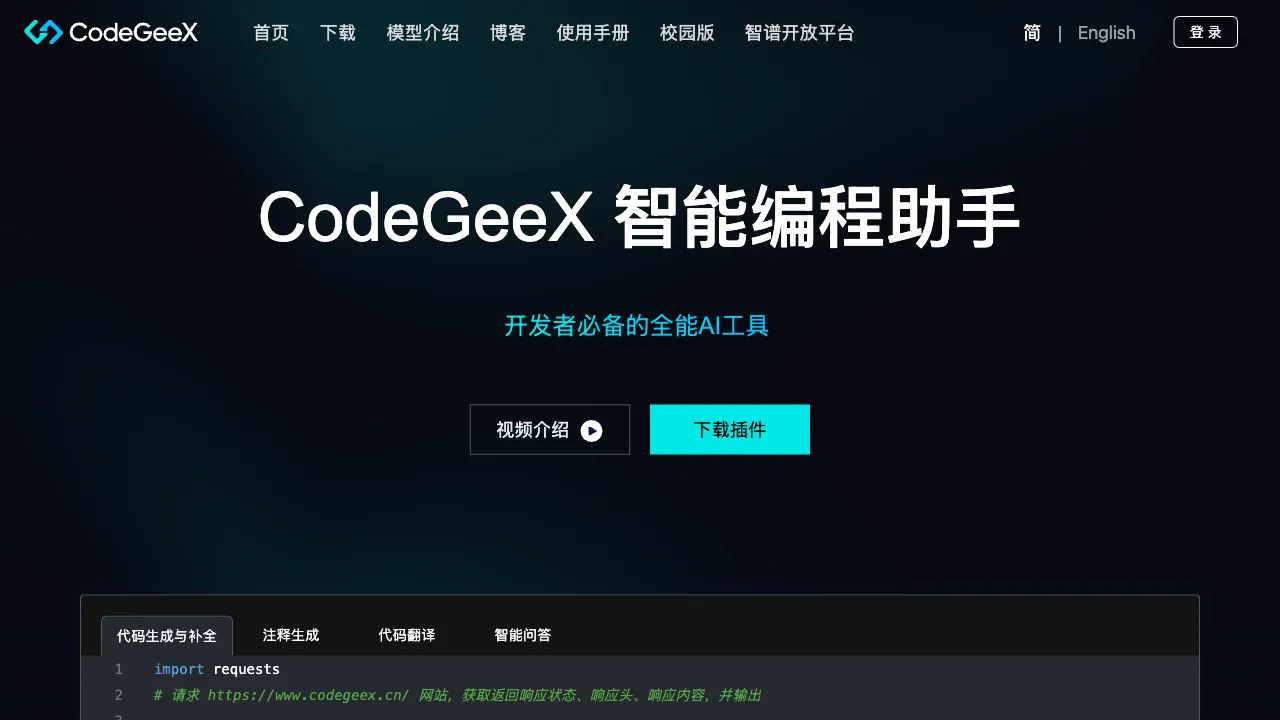
CodeGeeX (codegeex.cn) is an AI coding assistant under Zhipu AI (a Tsinghua-affiliated LLM company and creator of the GLM series), delivered as an IDE plugin. It covers mainstream environments including VS Code, the JetBrains suite (IDEA, PyCharm, etc.), and HBuilderX. The underlying model has evolved from the initial 13-billion-parameter open-source CodeGeeX to a new generation based on the GLM architecture, with capabilities continuously upgrading alongside Zhipu’s LLM advancements.
It supports over a hundred languages, including Python, JavaScript/TypeScript, Java, C++, Go, and Rust. Its core capabilities include code completion, conversational Q&A, code explanation, comment generation, code translation, and unit test generation.
Key Features
Code Auto-Completion
A standard ghost-text experience: gray suggestions appear in real-time as you code, accepted with the Tab key. It covers single-line continuations, full function generation, and comment-to-code conversion. Completion quality for mainstream languages (Python/JS/Java) is stable and usable. Generating code from Chinese comments is a strong suit shared by domestic models—writing a line of Chinese comments to generate the corresponding implementation offers smoother semantic understanding than many overseas tools.
Conversational Coding Assistant (Ask CodeGeeX)
A sidebar chat in your IDE with code context: ask “what does this do?” about selected code, paste an error message to find the cause, or describe a requirement to implement it. This eliminates the friction of switching back and forth between the browser and the editor to query AI.
Code Translation
One of its signature features: converting code between programming languages—such as turning a Python function into Java or C++ logic into Go. This feature stems from its academic research focus (cross-language code generation was a key point in the CodeGeeX paper) and is executed with more seriousness than most similar tools. It is useful for cross-language porting or rewriting implementations based on other languages; however, outputs from complex conversions still require manual verification, and using them directly as production-ready code is risky.
Code Explanation and Comment Generation
Generates explanations for legacy code and batch-adds docstrings and comments to functions—a tool for clearing “documentation debt” and a reliable ally when taking over old projects.
Unit Test Generation
Generates corresponding test cases for selected functions, significantly reducing the cost of going from zero to some test coverage.
Comparison with Similar Tools
vs GitHub Copilot: Copilot’s completion quality and ecosystem integration remain the benchmark. However, the $10/month price tag and overseas server access are two hurdles for domestic users. CodeGeeX is free with domestic service; its completion is sufficient for routine scenarios, though it lags in complex context understanding. For budget-sensitive or compliance-sensitive scenarios, the choice is clear.
vs Tongyi Lingma / MarsCode / Wenxin Kuama: The “Big Three” of domestic free tools compete directly with CodeGeeX. Tech giants have advantages in resource investment and iteration speed. CodeGeeX’s differentiation lies in its open-source heritage and the model foundation of Zhipu GLM. Since they are all free, installing each for a week and voting by adoption rate is the most pragmatic approach.
vs Codeium: A representative of the international free camp, offering broad language coverage and polished experience. CodeGeeX holds advantages in Chinese scenarios and domestic network stability. Your preference for English vs. Chinese workflows will determine your choice.
vs Tabnine: An old-school player whose selling point is enterprise-grade privacy (local deployment). CodeGeeX also offers enterprise private deployment solutions, and its open-source model makes the self-hosting route more transparent for technical teams.
Uniqueness in Open Source: The initial CodeGeeX model was open-sourced under Apache 2.0, allowing researchers to access weights for academic and custom purposes—an almost unique trait among commercial coding assistants. Its high activity in academic citations and secondary development distinguishes it from purely commercial products.
Who Should Use CodeGeeX?
Students and Individual Developers: Zero cost, no barriers, and Chinese-friendly; it is one of the top choices for entering AI-assisted programming. Its Tsinghua affiliation also brings natural trust within university circles.
Teams Sensitive to Code Export: Domestic service + private deployment capability + open-source auditability make compliance reviews much easier than with overseas tools—a practical option for government, enterprise, and financial projects.
Developers Needing Code Translation: Cross-language porting is a strong suit; if you have such needs, it’s worth installing specifically for this purpose.
Researchers and Model Enthusiasts: The open-source code LLM weights are a scarce resource for academic experiments and domain fine-tuning, something no other competitor can offer.
Java/Domestic Tech Stack Practitioners: Training data coverage of commonly used domestic tech stacks results in a satisfying completion experience for Spring-family code.
Usage Reminders
Always review AI-completed code with your own brain—the three classic pitfalls of AI-generated code are edge cases, security vulnerabilities, and outdated APIs. All tools share these risks equally.
Code from the free cloud version is uploaded to servers for inference; confirm your team’s policy before using it on company projects. For strict requirements, opt for the enterprise private deployment version.
Pricing
The personal version is completely free with no limits on core features—not a “free trial” bait-and-switch, but genuinely free. This generosity places it in the top tier among similar products. Enterprise versions (private deployment, management features) are priced separately via business negotiation.
A thread worth remembering in CodeGeeX’s story is that it proves an open-source model incubated by an academic institution can grow into a tool used daily by millions of developers. If you haven’t tried any AI coding assistant yet, it’s a great zero-cost option to start with; if you’re already using another, its code translation and open-source attributes are worth keeping a spot for in your toolkit.