

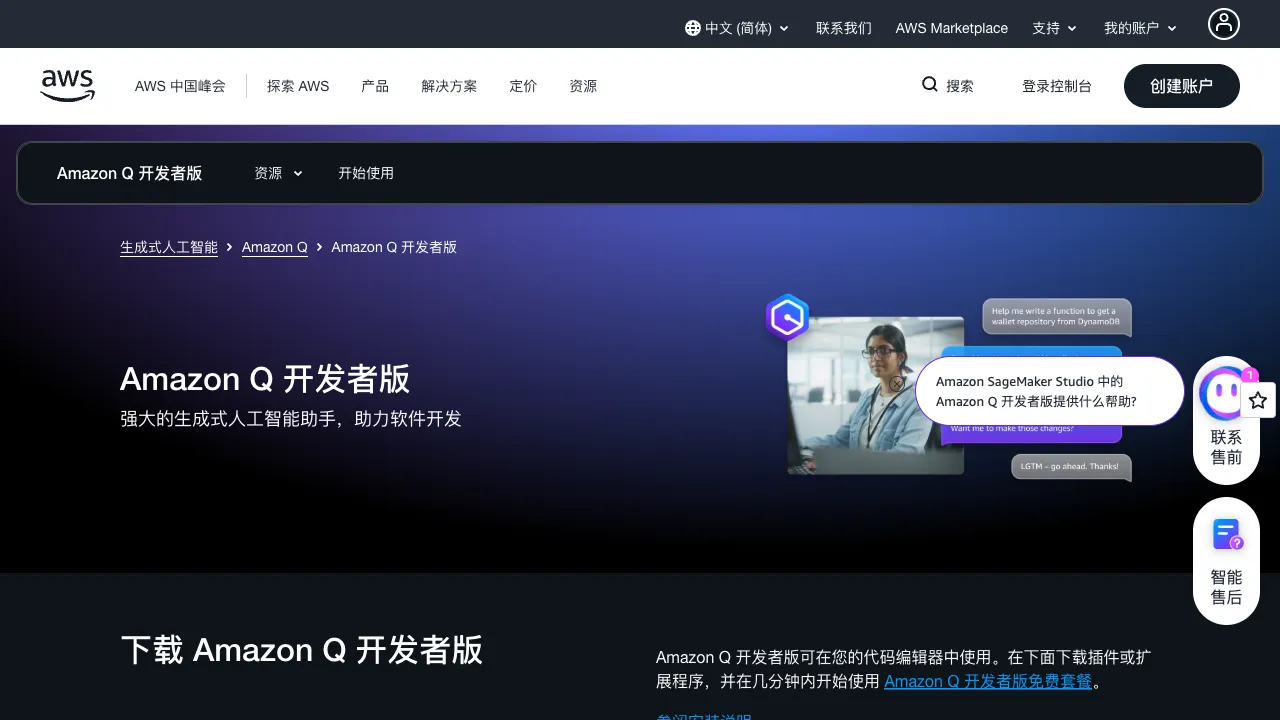
AWS developers face a unique "documentation tax": forgetting boto3 API signatures, looking up IAM policy JSON formats, and constantly flipping through documentation for Lambda event structures. With over 200 AWS services, no one can memorize the usage of every SDK, making "write a line, check the docs" the norm in cloud development. Amazon’s response to this tax is CodeWhisperer: a dedicated AI coding assistant for its own cloud, powered by a model trained on vast amounts of internal AWS code and best practices, specifically designed to solve "how do I write AWS code?" Let’s clarify the name first: the product has been merged into the Amazon Q Developer brand. Amazon integrated and upgraded its line of AI developer tools; CodeWhisperer is its predecessor and foundation, though the community still commonly uses the old name.
Two successive changes (checked 2026-09-06): aws.amazon.com/codewhisperer now points at Amazon Q Developer — the CodeWhisperer brand has been replaced, and the capability expanded from completion to agentic work. The more important part is what comes next: AWS has confirmed that Amazon Q Developer is itself being retired, with new signups blocked from May 15, 2026 and existing subscriptions ending April 30, 2027, and the official successor is Kiro, its spec-driven IDE. Opus 4.6 and later models are available only on Kiro.
In other words, this page describes the earliest generation of that product line; for tool selection, look at Kiro instead.
What is CodeWhisperer?
CodeWhisperer/Q Developer is AWS’s AI programming assistant, available as an IDE plugin (VS Code, JetBrains, Cloud9, JupyterLab). It offers real-time code completion, comment-to-code generation, built-in security scanning, and open-source code reference detection. It supports mainstream languages such as Python, Java, JS/TS, Go, and C# (with the deepest optimization for Python and Java). In 2023, the personal version was announced as completely free, directly challenging Copilot’s $10/month price tag and establishing it as a key player in the free tier.
Core Features
Real-time Code Completion
A standard ghost text experience: provides line-to-function-level suggestions based on context (variables, comments, existing logic), accepted via Tab. The completion quality for general scenarios is merely "usable"—but general scenarios have never been its main battlefield.
AWS-Specific Generation: The Core Differentiator
Its domain of dominance lies in all code touching AWS:
- boto3/SDK Calls: S3 uploads/downloads, DynamoDB queries, SQS send/receive—the accuracy of API signatures and parameter formats is significantly higher than that of general assistants. The promise of "no need to check docs" is primarily fulfilled here.
- IAM Policies: The format of permission JSONs and least-privilege practices provide an AI guardrail for a high-frequency minefield in cloud security.
- Lambda: Standard patterns for handler templates and event parsing.
- IaC: Infrastructure code generation for CloudFormation/CDK.
The internal Amazon code and best practices in the training data are exclusive corpora that general models cannot access—the inherent advantage of cloud providers building AI assistants for their own ecosystems is fully reflected in these details.
Built-in Security Scanning
The second differentiating card: detects security vulnerabilities in code (injection, XSS, insecure encryption, and other OWASP-related issues), annotates them within the IDE, and provides fix suggestions. It shifts "security audit after writing" to "check while writing," and includes a certain quota even in the free personal version—a scarce configuration among free coding assistants.
Open-Source Reference Detection
Detects similarity between generated code and open-source libraries, annotating segments that may involve licenses and their sources. This is a tool-based response to AI code copyright anxiety, a practical configuration for enterprise compliance scenarios, and demonstrates its sincerity toward serious engineering teams.
Comparison with Similar Tools
vs GitHub Copilot: The benchmark for comprehensive completion quality and ecosystem breadth at $10/month; CodeWhisperer’s cards are free + AWS depth + security scanning. The reasons to choose it for heavy AWS developers are sufficient, but for non-AWS scenarios, Copilot or other free alternatives are more balanced—fit your cloud stack accordingly.
vs Codeium/Tongyi Lingma and other free-tier players: All belong to the zero-cost option; general quality varies among them. CodeWhisperer’s unique chip in the free tier is AWS-specific features and security scanning, establishing the logic for it being the first choice for cloud developers seeking free options.
vs Cursor: The capability dimension of AI-native editors (multi-file, Agent) is a notch above plugins; Q Developer is also evolving toward Agent capabilities (automatically upgrading Java versions, autonomously completing tasks are its new selling points), and the catch-up efforts by cloud providers are worth tracking.
vs Google’s Gemini Code Assist: The counterpart for GCP, with mirrored logic—"use whose cloud, follow whose AI assistant." The choice of a cloud provider’s dedicated assistant is essentially a choice of cloud.
Who Should Use CodeWhisperer/Q Developer?
AWS Developers: The core audience needs no argument—daily SDK calls, IAM, Lambda, and IaC; its specialized understanding saves documentation time every day. Getting it for free makes refusal unreasonable.
Budget-conscious Individual Developers: A legitimate option in the free tier; sufficient for general scenarios, with the bonus of free security scanning.
Teams Focused on Code Security and Compliance: The combination of built-in scanning + reference detection is rare among AI assistants; teams with a serious engineering culture should evaluate it.
Python/Java Tech Stack: The two languages with the deepest support, offering the best experience.
Limitations
No obvious advantages in general scenarios outside AWS; the gap in completion quality compared to the first tier objectively exists—choosing it means choosing its ecosystem depth; seek optimal general solutions elsewhere.
The capability ceiling of the plugin form is lower than that of AI-native editors; during the product’s integration into Q Developer, changes to feature entry points and documentation are frequent; refer to current AWS official information.
A standard reminder regarding privacy compliance for cloud-based code inference: enterprises should confirm policies before use (AWS promises not to use enterprise data for training in its enterprise version, while personal version settings are adjustable).
Pricing
CodeWhisperer is now part of Amazon Q Developer: the Free tier includes 50 agentic requests and 1,000 lines of code transformation per month, and Pro costs $19 per user per month. Pro also adds higher limits, an admin dashboard and IP indemnity. AWS has announced that support for the Q Developer IDE plugins ends on April 30, 2027, with Kiro as the suggested successor. Check the AWS website for specifics.
The story of CodeWhisperer is a standard script of the cloud era: cloud providers will not cede the entry point for developer experience to third parties—AI assistants are the new entry points. If your code is full of boto3 and CloudFormation, install it and try writing an S3 operation: that smoothness of "it actually knows how to fill in the parameters" is the entire difference between a dedicated assistant and a general one.