
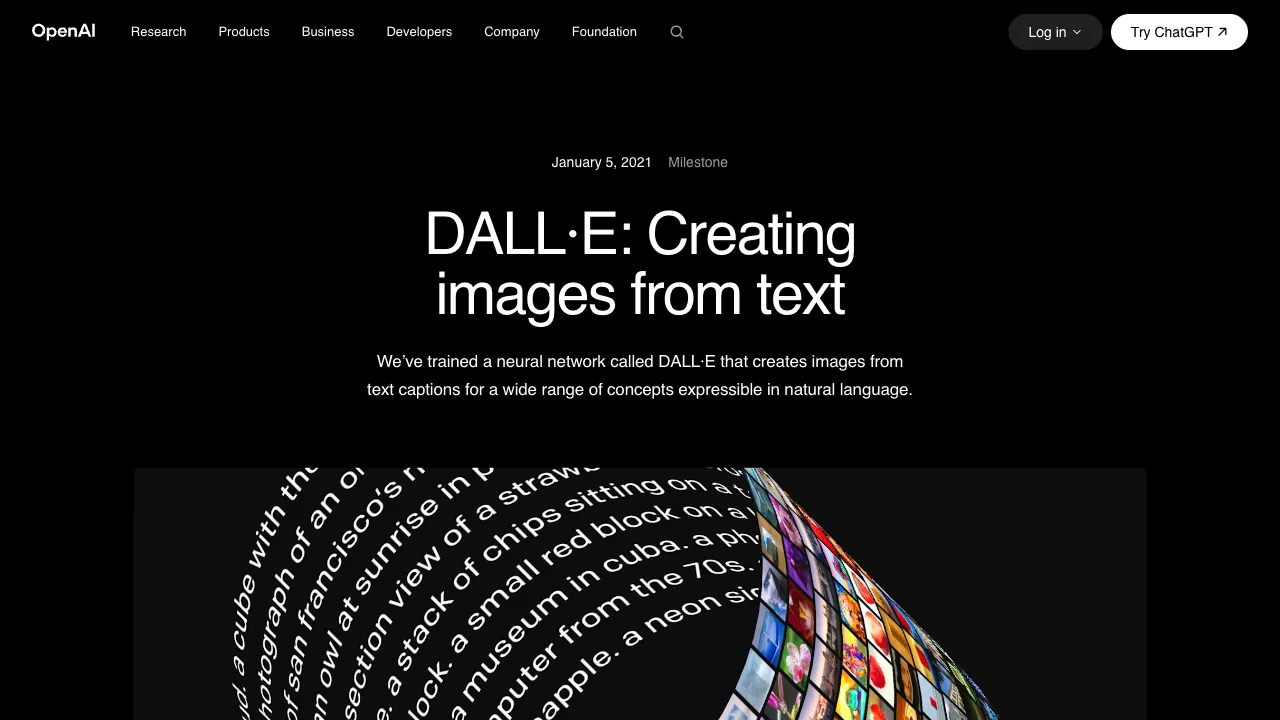
In January 2021, OpenAI released a set of images: an armchair shaped like an avocado, a radish walking its dog in a ballet skirt—all generated out of thin air by AI based on a single text description. These images, which look mediocre by today’s standards, caused a stir at the time comparable to that later sparked by ChatGPT: “Text directly into image” had finally transformed from a concept in a research paper into something visible to the naked eye. This model was named DALL·E—a portmanteau of surrealist painter Dalí and Pixar’s robot WALL·E, a hybrid of art and machine, fittingly so.
In a sense, the entire era of text-to-image generation began with that avocado chair.
What is DALL·E?
DALL·E is OpenAI’s series of AI image generation models, evolving through three generations: DALL·E (2021, the pioneer), DALL·E 2 (2022, a leap in quality), and DALL·E 3 (2023, reaching the peak of semantic understanding). Today, it is no longer a standalone product—DALL·E 3 has been fully integrated into ChatGPT; when you say “draw a…” in a conversation, that’s what powers it behind the scenes. With the launch of native image generation in the newer GPT-4o, OpenAI’s image capabilities have evolved further, but the name DALL·E is already etched into the history of AI art.
Three Generations: A Brief History of Text-to-Image
DALL·E (2021): Proving It Works
With 12 billion parameters, it was GPT-3’s image-generating cousin. By today’s standards, the generation quality was quite rough, but it answered that fundamental question: Can neural networks understand “combinations of textual concepts” and draw them? The avocado chair said: Yes.
DALL·E 2 (2022): Quality Revolution and the Golden Age
Powered by diffusion models, resolution and realism saw a significant leap forward. Its pioneering Inpainting feature—selecting a corner of an image and rewriting its content with a text description—defined a standard feature for all subsequent tools. In the first half of 2022, gaining early access to DALL·E 2 was social currency in the tech world.
But later that year, Midjourney rose to prominence and Stable Diffusion was open-sourced; text-to-image instantly shifted from a solo performance to a three-way battle—DALL·E 2 opened the era but failed to monopolize it.
DALL·E 3 (2023): Winning on a Different Dimension
Facing Midjourney’s aesthetic dominance, OpenAI’s response was to play to its strengths and avoid its weaknesses: rather than competing on artistic feel, it competed on understanding. DALL·E 3’s precision in handling long, complex descriptions was leagues ahead—“An old man with round glasses sits on a red chair on the left, holding a wooden sign that says ‘OPEN’ in his right hand, with a neon-lit street at night in the background”—every detail was faithfully executed, an impossible task for Midjourney at the time. In-image text rendering (correct spelling of English titles on posters) was another ace up its sleeve.
Smarter still was its entry point: built directly into ChatGPT, allowing the world’s largest pool of AI users to draw images effortlessly.
Core Features
Conversational Image Generation Experience
This is DALL·E’s most unique legacy: drawing and editing images via chat in ChatGPT—“change the background to dusk,” “make the person look younger”—the AI understands your intent to modify and regenerates, without needing to rewrite the entire prompt. Compared to Midjourney’s parameter incantations, this interaction is on another level of user-friendliness for ordinary people. ChatGPT also automatically expands simple descriptions into rich prompts, directly raising the baseline quality of output for beginners.
Precision in Instruction Following
Complex compositions, multi-element relationships, specified text—being “obedient” is DALL·E 3’s foundation. In scenarios requiring precise control over image content (infographics, illustrations with specific requirements), it is often a more effortless choice than Midjourney.
Strict Content Safety
Refusals to generate real people, violence/pornography, or copyrighted styles mean OpenAI’s moderation is among the strictest in the industry—a pro for compliance scenarios, a con for creative freedom advocates; two sides of the same coin.
Historical Positioning Against Competitors
vs Midjourney: For aesthetics and atmosphere, Midjourney has long reigned supreme; for artistic creation, concept art, and visual impact, you go to it. DALL·E 3 wins on precise understanding, text rendering, and ChatGPT’s zero-barrier entry. “For good looks, choose Midjourney; for obedience, choose DALL·E”—this was the common mindset of users in that era.
vs Stable Diffusion: The freedom of the open-source ecosystem (local deployment, LoRA, ControlNet) is Stable Diffusion’s irreplaceable advantage; DALL·E is a hassle-free hosted service. The two represent the classic contrast between “tinkering for control” and “paying for convenience.”
vs Later Entrants (GPT-4o native image generation, Flux, etc.): Technological iteration never stops; GPT-4o’s native multimodal image generation has further improved consistency and editing capabilities. DALL·E as an independent brand is gradually stepping aside, but the “conversational image generation” paradigm it defined has been fully inherited.
Is It Still Worth Using Today?
Practical advice by entry point:
ChatGPT Plus users: Draw directly in the conversation; this is currently the smoothest way to experience OpenAI’s image capabilities (DALL·E 3 and its successors), suitable for illustrations, posters, and scenarios requiring precise execution of descriptions.
Free users: Microsoft Copilot (Image Creator based on DALL·E 3) offers a daily free quota, serving as a backdoor to use this capability at zero cost.
API developers: OpenAI’s image API charges per image; integrating image generation into your own product is the standard path.
Those pursuing ultimate aesthetics or deep customization: Go to Midjourney for the former, and the SD/Flux ecosystem for the latter—specialization has its merits; DALL·E was never a jack-of-all-trades.
Pricing
ChatGPT Plus ($20/month) includes an image generation quota; the API is billed per image (with pricing varying by resolution); Copilot/Bing Image Creator is available for free with a daily quota. Refer to the official OpenAI website for specific details.
DALL·E’s place in the history of AI art is akin to Ford’s Model T in the automotive industry: it may not be the best car on the road today, but it paved the way first. Understanding its three generations of evolution reveals the entire journey of text-to-image technology—from a novelty to an everyday utility—and that avocado armchair deserves a permanent page in the annals of AI history.