

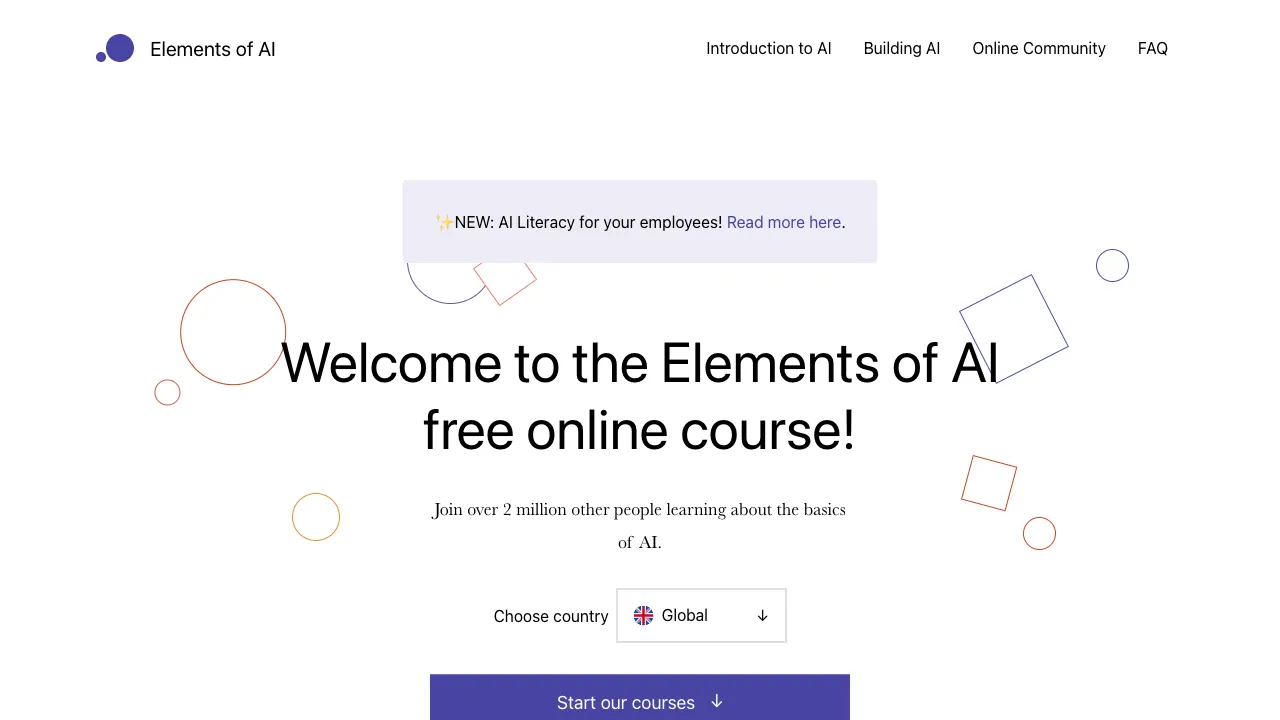
There is a paradox in the barrier to entry for learning AI: online resources are either too shallow (telling you what AI can do without explaining how) or too deep (starting immediately with linear algebra, calculus, and neural network architectures). There are very few truly suitable learning paths for ordinary people starting from zero. Elements of AI is a free course jointly launched by the University of Helsinki and Reaktor, designed specifically to answer this problem—enabling those without a technical background to truly understand what AI is, how it works, and what impact it will have.
What Is Elements of AI?
Elements of AI (elementsofai.com) is a series of free online courses originally launched by the University of Helsinki, with the goal of "making AI basics accessible to as many people as possible without making the course exclusive to experts." The course is completely free, and upon completion, you can receive a certificate from the University of Helsinki.
The background of this course is interesting: it was initially part of Finland’s digitalization strategy, aiming to ensure that a certain proportion of citizens understood AI basics, constituting a "national-level AI literacy education." It has since expanded into multiple languages, including Chinese, reaching a global audience.
Course Content
Elements of AI is divided into two main courses:
Introduction to AI The first part requires no programming or math background. Key topics include:
- What AI is and what it isn’t (dispelling sci-fi misconceptions)
- The history and evolution of AI
- Basic principles of machine learning—how AI "learns"
- How neural networks work (understood through intuition rather than formulas)
- What AI can and cannot do
- The social impact and ethical issues of AI
The course uses numerous analogies and real-life examples to explain concepts, with minimal math content, focusing on conceptual understanding. Each chapter includes quizzes and exercises to test comprehension.
Building AI The second part is slightly easier if you have some programming basics, but it also provides a no-code learning path. Key topics include:
- Implementation of simple machine learning algorithms
- Basic concepts of regression, classification, and clustering
- Building blocks of neural networks
- Writing simple AI programs in Python (includes Python beginner content)
- Further discussion on AI applications and limitations
This part is more hands-on but still controls technical depth. It is not aimed at aspiring AI engineers, but rather at those who want to "understand how AI works."
Course Features
Truly No Math Prerequisites: Many AI courses claim "no background needed" but quickly introduce dense formulas. Elements of AI keeps this promise, explaining concepts through text and diagrams, and explicitly marking math sections as "optional—you can skip them."
Reasonable Time Commitment: The two courses combined take about 30–40 hours, unlike many MOOCs that demand hundreds of hours. The pace is suitable for working professionals to learn in their spare time.
Chinese Version Available: The course content has been translated into Chinese, making it user-friendly for Chinese speakers.
Weighty Certificate: The University of Helsinki is a well-known institution in Northern Europe, and its certificate holds international recognition. Listing "Completed University of Helsinki AI Course" on your resume carries weight.
Community Support: There are forums and discussion areas where you can interact with other learners if you encounter questions.
Comparison with Other AI Learning Resources
vs. Coursera / Andrew Ng’s Machine Learning Course: Andrew Ng’s course is a classic introduction to deep learning but requires some math background (calculus, linear algebra) and suits those who want to seriously study ML. Elements of AI targets beginners with no background who simply want to understand AI; the goals are different.
vs. Andrew Ng’s DeepLearning.AI Courses: These are also more technical, requiring Python basics, and suit those aiming for AI development roles.
vs. Fast.ai: Fast.ai teaches machine learning in a "top-down" manner, starting directly with applications. It is highly practical but requires Python basics; Elements of AI requires no programming background.
vs. YouTube AI Explainer Videos (e.g., 3Blue1Brown): There are many high-quality AI explainer videos on YouTube suitable for fragmented learning, but they lack systematic structure and progress tracking. Elements of AI is a structured, complete course suitable for systematic study.
vs. Domestic AI Courses (e.g., Baidu PaddlePaddle, Alibaba Cloud University): Domestic platforms offer many AI courses, some free, with content tailored to local application scenarios. Elements of AI’s distinguishing feature is its lack of commercial promotion, offering stronger content independence.
Who Should Take Elements of AI?
Those who want to understand AI but don’t want to/can’t learn programming: Professionals, managers, civil servants, teachers… many roles need to understand the impact of AI. Elements of AI is the most suitable entry point.
Non-technical professionals who need to communicate with AI practitioners: Product managers, marketers, and investors need to discuss AI products with engineers. Understanding basic concepts significantly improves communication efficiency.
Students conducting AI-related research: High school or undergraduate students writing papers or giving presentations on AI benefit from the accurate, yet not oversimplified, background knowledge provided by Elements of AI.
Those feeling anxious about AI: Concerns that AI will steal jobs or go out of control often stem from information asymmetry. Understanding what AI can and cannot truly do is more useful than consuming doomsday or utopian predictions.
Corporate AI Training: Many companies use Elements of AI as material for employee AI literacy training, allowing the entire organization to align on basic concepts through a unified curriculum.
After Completion
Elements of AI is just an introduction. After finishing it, you will have a clear conceptual understanding of AI, but you will not become an AI engineer or data scientist. The next steps depend on your goals:
If you simply want to "understand AI," the course has achieved its goal. You will find it much easier to understand AI applications, follow news, and grasp industry trends.
If you want to further study ML/AI technology, consider Andrew Ng’s Machine Learning course, Fast.ai’s practical courses, or start learning Python and math basics.
If you want to transition into an AI-related career, Elements of AI is a starting point, but subsequent learning will be extensive and deep; no single course can accomplish this alone.
Pricing
Completely free; no payment required. You need to register for an account to track your progress and obtain a certificate, which is also free. The certificate itself is provided at no extra cost (unlike many MOOC platforms where learning is free but certificates are paid). Elements of AI is one of the best public welfare projects in AI introductory education: broad coverage, high quality, and completely free. If you want to seriously understand what AI is, spending thirty to forty hours completing this course will be far more effective than randomly watching explainer videos.