

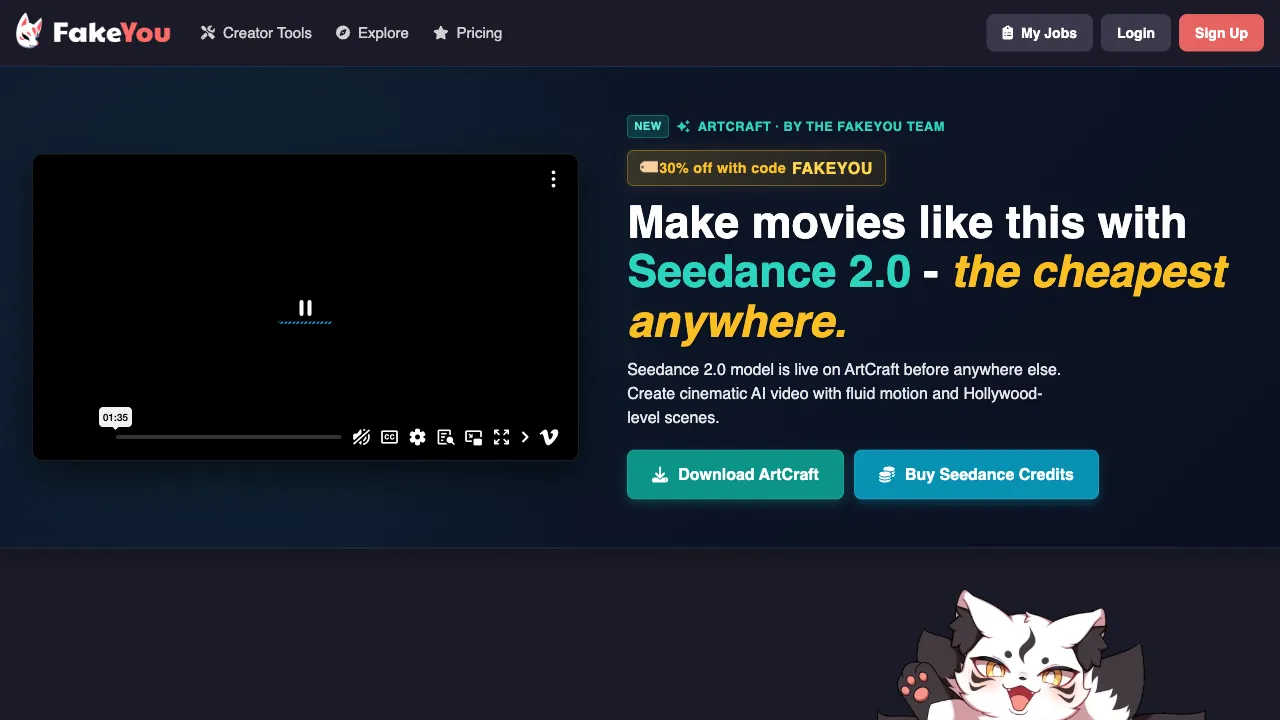
In the AI voice synthesis space, most products compete on the same metric: whose voice sounds most like a real person, is the most natural, and is best suited for commercial voiceover. ElevenLabs competes on cloning quality, Azure on enterprise stability, and domestic players like iFlytek on Chinese language performance. FakeYou takes a completely different path—it doesn’t chase “the most realistic voice,” but rather “the voice of the character you want.”
Imagine having SpongeBob read your jokes, having a video game character deliver your lines, or getting a classic animated character to “say” something they could never say in their original work. This need might seem absurd, but on the internet, where meme culture and fan creations thrive, it corresponds to a massive and active user base. FakeYou exists for this community.
What is FakeYou?
FakeYou (fakeyou.com) is a community-driven text-to-speech (TTS) platform, whose core asset is a library of tens of thousands of voice models trained and uploaded by users. These models cover:
- Classic animated characters (Disney, Pixar, various American and Japanese comic/anime characters)
- Voice styles of celebrities and public figures
- Video game characters (from AAA console titles to indie games)
- Anime voice actor styles
- Various original and stylized synthetic voices
The usage is extremely simple: select a voice model, input text, and the platform generates audio of that voice “speaking” the text. You can play it online or download the WAV file.
“Community-driven” is the key to understanding this platform—the voice models are not uniformly produced by an official team but are trained and shared by users. This determines its breadth of coverage (any character with fans might have a model made for it) and quality distribution (highly variable; popular models are polished, while niche ones may be rough).
Core Features
Text-to-Speech Generation
The basic workflow: search or browse to find your target voice model, input text, and submit for generation. Free users’ requests enter a queue, with wait times potentially long during peak hours; paid users skip the line.
Generation quality depends on two factors: the training quality of the model itself, and how well the text matches that voice style. Having an animated character’s model read lines in its original style usually yields good results; having it read a technical document will feel jarring—the model learns not just timbre, but also the tone and rhythm distribution of its source material.
Massive Voice Model Library
This is FakeYou’s irreplaceable core value. With tens of thousands of voice models, almost any pop culture character you can think of likely has a corresponding voice here. Commercial TTS platforms will never provide such content due to copyright and compliance considerations, while FakeYou’s community model makes it the de facto hub for these needs.
The library continues to grow—when a new character becomes popular, users typically train and upload corresponding models very quickly.
Search, Categorization, and Favorites
Models are categorized by source work, character type, and language, with keyword search support. On each model page, you can see usage heatmaps and generation examples from other users. Listening to a few examples before selecting a model is the fastest way to judge quality. You can favorite frequently used voices.
Voice Cloning and Model Training
The platform provides training tools, allowing users to upload voice samples to train their own models. This is the supply source for the community library and an advanced user feature—training models for characters you like that no one has made yet.
Video Dubbing and Other Features
Beyond pure TTS, FakeYou is expanding into voice-to-voice (replacing your recorded audio with a target voice while preserving tone and rhythm) and singing synthesis features, allowing generated content to go beyond the scope of “machine reading.”
Primary Use Cases
Meme Content and Entertainment Creation: This is where the platform’s users are most concentrated. Having characters deliver lines with strong contrast, creating funny videos, voiceover memes, and audio for reaction images. A vast amount of such content on YouTube and TikTok uses voices from platforms like FakeYou.
Fan Works and Secondary Creations: Dubbing fan animations, comic-to-video adaptations, and game MODs, allowing characters tointerpretation (perform) fan-created plots with their “original voices.”
Independent Content Voiceover: Self-made animations, short films, and indie games often need multiple distinct voices; when budgets can’t afford voice actors, stylized TTS is a viable option.
Technical Research and Learning: Observing the performance differences of models under varying amounts and qualities of training data, FakeYou’s community library serves as a living dataset.
Comparison with Other Voice Tools
vs ElevenLabs: ElevenLabs is the quality benchmark for AI voice cloning, with industry-leading naturalness, clear commercial licensing, and suitability for serious commercial scenarios like audiobooks, podcasts, and video narration; however, it will not provide any copyrighted character voices. The two have almost no competitive overlap—use ElevenLabs for commercial voiceover, and FakeYou for character-based entertainment content.
vs Uberduck: Uberduck was once the closest competitor to FakeYou, also famous for its community character voice library, before pivoting toward music and API services. FakeYou currently has a more active community in the niche of “character voice libraries.”
vs Azure TTS / Google TTS: Big tech TTS providers offer stable, compliant, multilingual standardized voices aimed at enterprise integration; they contain no character-specific or personalized voice content, so their positioning does not overlap with FakeYou at all.
vs Domestic Tools like iFlytek Dubbing: Domestic tools have significantly better Chinese TTS quality, covering announcer tones, customer service voices, and dialects; FakeYou’s model library is overwhelmingly English-centric, with few Chinese models of average quality. For Chinese dubbing needs, do not rely on FakeYou.
Copyright and Ethics: What You Must Know Before Using
Many models on FakeYou are trained on the voices of real people or copyrighted characters, which establishes clear red lines for usage:
- Do not use to impersonate real people: Using a celebrity’s voice to create content that misleads people into thinking they actually said it may constitute defamation or fraud, carrying explicit legal risks in an increasing number of jurisdictions.
- Do not use commercially: Character voices involve rights held by copyright owners and voice actors; using such content in commercial projects is essentially inviting legal disputes.
- Disclose AI generation for entertainment content: Letting the audience know this is a synthetic voice is the basic ethical standard currently accepted by the community.
The platform’s terms also prohibit fraudulent or harassing uses, and violating content will be removed. In short: self-amusement and obvious parody are the safe zones for this platform; the closer you get to “passing as real” and “commercial profit,” the higher the risk.
Limitations
The free version’s queue mechanism offers a poor experience during peak hours, with waits ranging from minutes to much longer.
Model quality varies wildly—premium models for popular characters can be stunning, while niche models may sound mechanical or have broken pronunciation; listening to examples before use is a necessary step.
Chinese support is weak, which is the biggest practical limitation for Chinese users.
The output is “a synthetic voice in the style of this character”; upon close listening, synthetic artifacts are still detectable, making it unsuitable for scenarios requiring professional audio quality.
Pricing
The free tier offers basic TTS functionality, though you’ll need to wait in a queue. Paid subscriptions (available in multiple tiers, ranging from a few dollars to several dozen per month) provide benefits such as skipping the queue, faster generation, support for longer text inputs, and access to private models; see the official website for specific details.
FakeYou is the most purely entertainment-focused AI voice tool out there—it’s not designed to help you work; it’s designed to help you have fun. As long as you stay within the boundaries of copyright and ethics, this playground with tens of thousands of voices truly offers a kind of enjoyment that no other platform can match.