

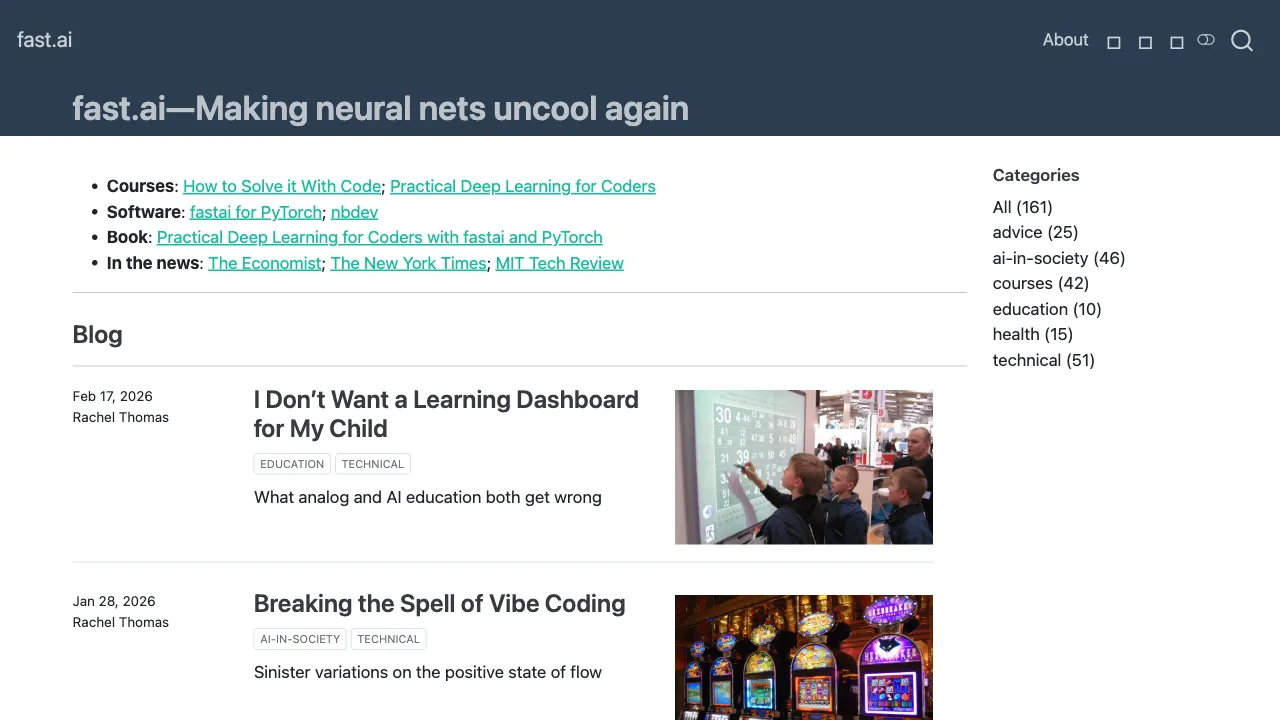
A long-standing myth in the field of deep learning is that you must first master linear algebra, calculus, and statistics, then learn the fundamentals of machine learning, before you can even touch neural networks. This path takes at least one to two years, causing many people to give up midway. Jeremy Howard and Rachel Thomas founded fast.ai in 2016 to break this myth. Their core premise is: most people with programming experience can start building practically valuable deep learning projects within weeks, rather than burning out on mathematical foundations.
New in 2026: alongside the classic Practical Deep Learning for Coders, fast.ai and Answer.AI released a new course, How to Solve it With Code. The site's blog is current through August 2026, so the project remains actively maintained.
What is fast.ai?
fast.ai is a non-profit artificial intelligence research and education institution that offers completely free deep learning courses and the open-source fastai software library. Its most famous product is the course "Practical Deep Learning for Coders." The course is entirely free, with videos publicly available on YouTube, and accompanying Jupyter Notebooks fully open-sourced.
Founder Jeremy Howard is the former CEO of the data science competition platform Kaggle, having ranked world number one in Kaggle competitions for two consecutive years. His partner, Rachel Thomas, holds a PhD in mathematics and is a prominent advocate for AI ethics. Their shared teaching philosophy is to have students run code and build things first, then explain the underlying principles—exactly the opposite of the traditional academic approach of "building foundations before application."
The fastai Library
fast.ai is not just a course; it also includes a Python library of the same name: fastai. Built on top of PyTorch, this library provides numerous high-level abstractions designed to accomplish common deep learning tasks with less code.
The difference between fastai and writing raw PyTorch is clear:
Less boilerplate code: Training an image classifier from scratch in PyTorch requires dozens of lines of code for data loading, model definition, and training loops; fastai can achieve the same result in just a dozen lines, while incorporating best practices (such as learning rate scheduling and mixed-precision training).
Built-in best practices: The fastai library pre-configures numerous techniques validated by research: Learning Rate Finder, One Cycle learning rate policy, progressive image sizing, mixed-precision training, and more. Implementing each of these individually takes time; fastai provides them out of the box.
Coverage of major task types: Image classification, object detection, image segmentation, text classification, recommendation systems, and tabular data—fastai offers specialized high-level APIs for each type of task, eliminating the need to research optimal implementations from scratch for every task.
Working with PyTorch: fastai is a higher-level wrapper around PyTorch. You can call the lower-level PyTorch APIs when you need finer control.
Course Content
The core course offered by fast.ai is "Practical Deep Learning for Coders," which has undergone multiple iterations and updates.
Course Part 1 covers:
- Starting with your first deep learning model (running code in Week 1)
- Image classification and semantic segmentation
- NLP and Transformers
- Collaborative filtering and recommendation systems
- Implementing neural networks from scratch (first using Excel, then Python)
Course Part 2 (more advanced) covers:
- The principles and implementation of diffusion models (Stable Diffusion)
- Implementing every component of Stable Diffusion from scratch
- Low-level principles of deep learning frameworks
Part 2 is unique content—few courses on the market implement Stable Diffusion from scratch. fast.ai’s Part 2 breaks down every component of diffusion models with code, offering high value to learners who want to deeply understand the principles of generative AI.
Additionally, there is the companion textbook for "Practical Deep Learning for Coders," titled Deep Learning for Coders with fastai and PyTorch, published by O'Reilly. An online version is also available for free on the official website.
Comparison with Other Learning Resources
vs Coursera / DeepLearning.AI (Andrew Ng’s courses): Andrew Ng’s curriculum is more systematic, starting from foundational mathematics, making it suitable for learners who want to solidify their theoretical base. fast.ai focuses more on "getting things working," catering to those with programming experience who want to quickly start building projects. The target audiences differ; they are not purely competitive, and many learners study both.
vs PyTorch Official Tutorials: PyTorch’s official tutorials are more fragmented, presented as API documentation plus examples, suitable for those who know what they want to do but need to look up syntax. fast.ai offers a systematic course with a complete learning path.
vs Hugging Face Courses: Hugging Face’s NLP courses focus specifically on Transformers and NLP. fast.ai covers a broader range, including images, tabular data, and recommendation systems. While there is overlap in NLP, fast.ai has greater breadth.
vs Books (Deep Learning by Ian Goodfellow): The book emphasizes theory and serves as a research reference; fast.ai emphasizes coding practice. Start with the course if you prefer learning through code, then use the book to fill in the theory.
Who Should Learn fast.ai?
Programmers with Python experience: fast.ai assumes you can write Python but does not require a deep mathematical background. If you are a backend, frontend, or developer in any field looking to add deep learning to your skill stack, fast.ai is one of the most efficient entry points.
Kaggle competitors: Many techniques in fast.ai come directly from competition practice, and the best practices built into the fastai library are highly practical for Kaggle competitions. Many top-ranking Kaggle competitors have used fastai.
Independent developers looking to build AI side projects/products: If you want to create a small AI product (such as an image classification tool or text analysis service), fast.ai allows you to go from zero to a usable prototype faster than almost any other resource.
Learners exploring generative AI internals: fast.ai Part 2 includes a from-scratch Stable Diffusion implementation for studying diffusion models through code.
Learning Advice
Run the code first, then study the theory: fast.ai’s course design intentionally lets you run code and see results first. This is not a shortcut; it is a pedagogical choice. Gaining an intuitive understanding before studying theory leads to higher absorption rates. Follow this pace and do not try to understand every mathematical detail in your first pass.
Follow along using Jupyter Notebooks: All course code is provided in Jupyter Notebooks, which you can run locally or on Google Colab/Kaggle Notebooks (with free GPUs). Run the code line-by-line alongside the videos, and consult the forums when you encounter issues. This hands-on approach yields far better learning outcomes than just watching videos.
Join the forum: fast.ai has an active learner community forum (forums.fast.ai), where questions are almost always answered. Jeremy Howard himself occasionally answers questions on the forum.
Practice with Kaggle: After completing Part 1, go directly to Kaggle and participate in beginner-level competitions (Getting Started category). Applying course content to real competition data will accelerate your progress significantly.
Limitations
fast.ai’s style is not suitable for everyone. If you need a systematic theoretical foundation (such as preparing for graduate school or publishing papers), fast.ai’s "application before theory" approach may leave you feeling that your basics are weak. Additionally, the course update speed sometimes lags behind the rapid development of the field; the latest technologies may not be covered promptly in fast.ai courses.
For complete beginners with no programming experience, fast.ai assumes a certain level of Python proficiency. If you know no programming at all, you need to learn Python first.
Readers with Python experience who want to learn deep learning through projects can start with fast.ai’s course exercises. It gets a model running before explaining the theory. If you prefer to study the mathematical foundations first, use it alongside another course or textbook.
Pricing
Completely free: the courses, the accompanying book content and the fastai library are all openly available, with no paid tiers and no membership wall.
The only real cost is compute for training — free cloud notebooks are enough to get started, with no need to buy a GPU.
Its teaching stance is worth stating on its own: top-down. It gets a working model running first and unpacks the theory afterwards, rather than opening with three chapters of linear algebra. For people who already write code and want to put deep learning to work quickly, that path is considerably faster than a traditional textbook.