

AI voice synthesis entered a new phase with the emergence of ElevenLabs—not just synthesizing arbitrary text, but cloning specific voices to read any content. The quality of this technology has reached a point where it is sometimes difficult to distinguish between real and synthetic speech.
ElevenLabs’ issues lie in its pricing and Chinese language support: its core features require a paid subscription, and its optimization focus is on English, with Chinese results being merely passable. Fish Audio is a noteworthy alternative, offering similar voice cloning capabilities, better Chinese support, an open voice community, and more friendly pricing.
What Is Fish Audio?
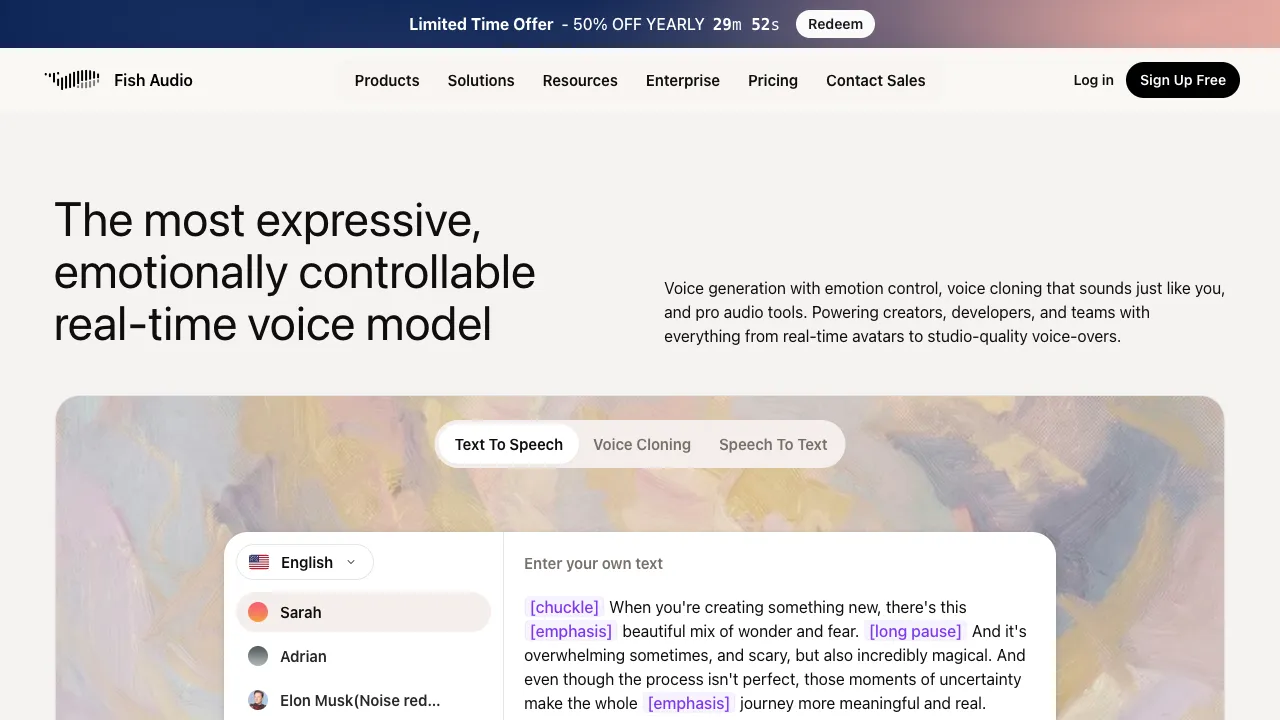
Fish Audio (fish.audio) is an AI voice platform whose core features are text-to-speech (TTS) and voice cloning. The platform hosts an open voice community where users can create their own voice models to share, or use voices uploaded by other community members.
Beyond its web product for general users, Fish Audio also provides API services for developers to integrate into their own applications and workflows.
Developed by a domestic team, Chinese language support is a key differentiator from international competitors, with the entire product better adapted for Chinese-speaking users.
Core Features
Text-to-Speech
Input text, select a voice, and generate an audio file—this is the basic TTS function. Fish Audio enhances this with improved quality:
The generated speech lacks the obvious mechanical feel of traditional TTS. Intonation, pauses, and emotional nuances are handled naturally, making it suitable for video narration without sounding cheap.
Chinese quality is a standout feature of Fish Audio. Many TTS tools perform only adequately in Chinese—accurate pronunciation but flat intonation, sounding like reading from a script rather than speaking. Fish Audio’s handling of Chinese intonation is more natural, with a listening experience closer to real speech, which is crucial for scenarios requiring good audio quality such as video dubbing and audiobooks.
It supports basic adjustments like speed and emotional style, allowing parameter tweaks tailored to specific content needs—for example, using a medium-speed, clear tone for tutorials or a slower, gentler tone for story reading.
Voice Cloning
This is Fish Audio’s core differentiating feature. Upload a recording of the target voice, and the AI analyzes and learns its timbre, intonation, and pronunciation features to generate a voice model. You can then use this model to read any text—theoretically creating an “AI version” of that voice.
The quality of voice cloning is directly related to the reference audio:
Reference Audio Quality: Audio with minimal background noise, clear recording, and no obvious echoes yields significantly better cloning results. Noisy recordings made casually on a mobile phone will result in much poorer quality.
Reference Audio Content: Audio covering different intonations (happy, serious, questioning), pause rhythms, and speeds provides the model with richer “voice samples” to learn from, resulting in higher naturalness. A reading with uniform intonation may produce a cloned voice that lacks emotional variety.
Reference Audio Duration: Typically, tens of seconds to a few minutes of reference audio are sufficient for basic cloning, while longer audio allows the model to learn more vocal details.
With good reference audio paired with Fish Audio’s cloning technology, similarity can reach high levels; in most cases, identifying the speech as AI-generated requires careful listening.
Voice Community
Fish Audio features an open voice community, a unique design that distinguishes it from many TTS tools. Users can publish their created voice models to the community for others to use directly for generating speech.
The community has accumulated a wide variety of voices: simulations of anime and game characters, distinctive timbres (deep magnetic male voices, sweet female voices, raspy elderly voices, etc.), and stylized voices (broadcasting tone, livestreamer style, educational explanation style).
For users who need specific voice effects but do not want to clone themselves, finding a suitable voice in the community is a more convenient option.
The community does host voice models of celebrities and well-known voice actors. The ethical and legal boundaries for this type of content are relatively ambiguous; users must exercise their own judgment, especially regarding commercial use.
API Service
Fish Audio provides a RESTful API, allowing developers to integrate TTS and voice cloning features into their applications, workflows, or automation pipelines. API calls are billed on a pay-as-you-go basis, suitable for users and teams with development capabilities seeking custom integration.
The documentation is comprehensive, supporting interfaces for generating audio, creating voice models, retrieving community voice lists, and more.
Comparison with Competitors
vs ElevenLabs: ElevenLabs is the international benchmark for voice cloning and high-quality TTS, offering extremely natural voices, support for over 30 languages, and professional emotional control; its free tier is limited (approx. 10,000 characters per month), and formal use requires a paid subscription (starting at $5/month); Chinese optimization is not its focus. Fish Audio offers significantly better Chinese quality, more affordable pricing, and a unique voice community advantage, though its English content quality does not quite match ElevenLabs’ extremes.
vs TTSMAKER: TTSMAKER focuses on basic TTS, is completely free, and is simple to use, but lacks voice cloning features; it suits users who only need standard TTS dubbing. Fish Audio’s voice cloning and community voice selection offer capabilities that TTSMAKER lacks, making it better suited for users with custom voice needs.
vs Moyin Gongfang: A long-standing domestic TTS platform with a rich library of voice styles and a mature interface; it leans toward commercial dubbing scenarios with many professional voice actor styles. Fish Audio focuses more on voice cloning and an open community; while their target audiences overlap, their emphases differ.
vs Microsoft Azure TTS: Azure TTS offers top-tier quality, particularly natural Chinese voices, with numerous emotional styles available; however, it is geared toward enterprise-level API calls, has a higher barrier to entry, and is less direct for general users. Fish Audio’s web interface is more user-friendly, and its voice cloning feature is not available in Azure’s standard services.
vs iFlytek Dubbing: iFlytek has deep technical accumulation in Chinese speech synthesis and high dubbing quality; however, the platform leans toward professional dubbing scenarios, and free usage limits are restrictive. Fish Audio’s voice cloning is a differentiator, and its rich voice community is an advantage.
Use Cases
ACG Creators: The voice community hosts numerous anime and game character voices, as well as various stylized options. Combined with Fish Audio’s TTS, it is practical for fan content, secondary creation dubbing, subtitle addition, and other scenarios.
Video Content Creators: For those needing specific style dubbing without hiring voice actors, finding a suitable voice in the community or cloning a desired voice allows for generating audio to import into videos.
Podcasts and Audiobooks: Use cloned voices (even your own cloned version) to batch-generate long-form audio, suitable for audiobooks, paid knowledge courses, and similar content formats.
Developer Integration: If you need to add TTS functionality to an application, Fish Audio API’s Chinese performance is a key reason to choose it, especially for products targeting Chinese-speaking users.
Voice Creation Exploration: For those interested in AI voice technology and exploring the possibilities of voice cloning, Fish Audio’s free tier allows for basic experimentation.
Ethical Usage Considerations
Voice cloning is a technology that requires serious attention to ethical boundaries. A few points to note:
Consent from the Subject: Cloning another person’s voice requires their explicit consent. Unauthorized cloning and publication/use of someone else’s voice involves ethical issues and legal risks, regardless of whether it is for profit.
Celebrity Voices: Celebrity voice models in the community exist in a gray area. Personal entertainment and commercial use carry different implications; commercial use carries higher risks and must be handled with caution.
Commercial Use: When using cloned voice dubbing for commercial projects, ensure you have complete usage authorization to avoid copyright and portrait rights risks.
No Deception: Using another person’s voice to create misleading content is unacceptable behavior, regardless of the purpose.
Fish Audio addresses these issues in its platform terms of service; users should understand and comply with them before use.
Pricing
Fish Audio offers a free tier, allowing new registrants to experience basic TTS and limited voice cloning features. Higher usage requires purchasing credits or subscribing to a membership, with both pay-as-you-go and monthly subscription options available. Specific pricing plans are subject to the official website; pricing is more affordable compared to international competitors like ElevenLabs.
Fish Audio provides a fully functional and reasonably priced option in the Chinese AI voice sector. Combined with rich community voice resources, its voice cloning capabilities offer more creative possibilities beyond standard TTS tools. For content creators with Chinese dubbing needs, Fish Audio is a tool worth serious evaluation.