

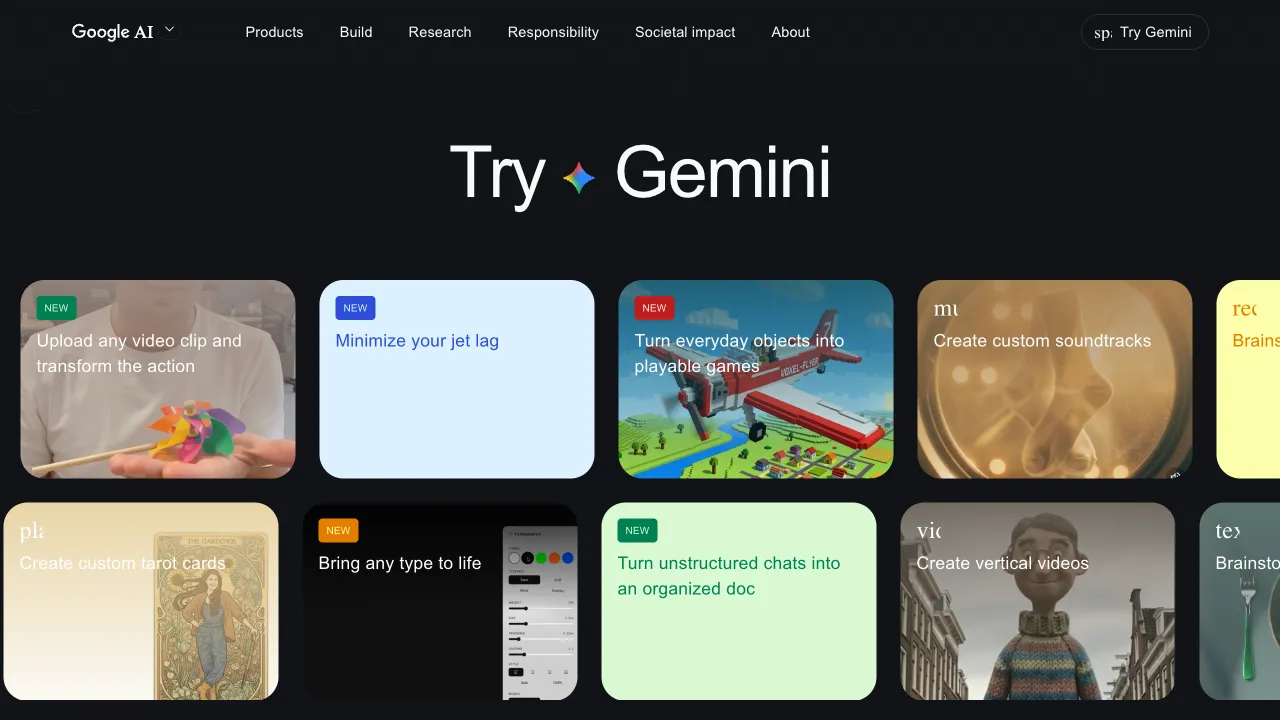
One of the best ways to understand AI is to see directly what those building it have to say. As one of the world’s most important AI research institutions today, Google has consolidated its AI research findings, tool resources, and learning materials into the Google AI platform, making it a key reference source for developers and researchers worldwide to learn about AI.
What Is Google AI?
Google AI (ai.google) is Google’s public-facing portal for artificial intelligence, integrating several key resources across Google’s AI landscape:
- Research Findings: Papers and project overviews from Google DeepMind and Google Research
- Developer Tools: TensorFlow, Keras, Google Colab, Gemini API, and more
- Learning Resources: Courses, tutorials, and documentation
- Product Information: Details on Google’s AI products (Gemini, Bard, NotebookLM, etc.)
It is not a single tool, but rather an information and resource hub for the Google AI ecosystem.
Core Content and Features
Google DeepMind Research
DeepMind is Google’s AI research institute, whose work has had a profound impact on the global AI landscape:
- AlphaGo / AlphaFold: AlphaGo defeated the world Go champion, while AlphaFold solved the decades-old problem of protein structure prediction in life sciences. These are among the most significant milestones in AI history.
- Gemini Models: Google’s series of large language models, competing with Claude and GPT-4.
- AI Safety Research: DeepMind conducts extensive research on AI alignment and safety.
Through the Google AI platform, you can track the latest developments in these areas and gain insight into Google’s thinking and strategic judgments regarding the direction of AI.
Google’s AI Development Tools
For developers, Google offers a rich suite of free AI development tools:
TensorFlow: An open-source deep learning framework by Google, it is one of the most widely used AI frameworks globally. It supports everything from beginner to research levels and boasts extensive tutorials and community support.
Keras: A high-level API for TensorFlow that simplifies writing deep learning code, making it a popular choice for beginners.
Google Colab: A free cloud-based Jupyter Notebook environment providing GPU and TPU resources. You can run Python code directly in your browser without installing any local environment. For students and developers learning AI, this tool significantly lowers the barrier to entry.
Gemini API: The API interface for Google’s latest large language models, allowing developers to integrate Gemini’s capabilities into their own applications. With a free tier available, it is one of the key options for developing AI applications.
Teachable Machine
Google’s Teachable Machine is an excellent tool for AI beginners: no coding is required, and you can train a simple image classification model directly in your browser. By uploading photos for different categories (e.g., "this is a cat," "this is a dog") and clicking train, you can get a working classifier within minutes.
For users with no programming background, this tool provides an intuitive AI training experience, helping to demystify "how AI learns."
Machine Learning Crash Course
This free machine learning course offered by Google covers the full path from basic concepts to practical applications. The content has been refined by Google’s internal engineers and is of high quality, ranking among the best-reviewed free AI introductory courses online. It includes video lectures, coding exercises, and case studies, requiring approximately 15 hours to complete.
The Chinese translation is of good quality and suitable for Chinese-speaking learners.
AI Experiments
A series of AI experiment projects by Google Arts & Culture and Google that turn AI technology into interactive mini-tools. Examples include:
- Identifying your hand-drawn sketches with AI (Quick, Draw!)
- Composing music with AI (Chrome Music Lab)
- Identifying plants, animals, and landmarks in images via AI
These experiments allow everyday users to intuitively experience AI’s capabilities without needing technical knowledge, serving as excellent science communication content.
Responsible AI Practices Guide
Google has established a set of principles and guidelines for the responsible development and use of AI, including best practices for fairness, interpretability, privacy protection, and security.
For teams developing AI products, referencing Google’s framework can help identify potential risks and biases during the design phase.
Who Should Visit Google AI?
AI Beginners: The Machine Learning Crash Course and Teachable Machine provide a zero-to-hero learning path, offering high-quality resources created by Google engineers for free.
Developers and Engineers: TensorFlow, Keras, Google Colab, and the Gemini API are tools used in actual development; their official documentation and tutorials are the most authoritative references.
Researchers: Papers and project overviews from Google DeepMind and Google Research are essential sources for understanding cutting-edge AI advancements.
Product Managers and Business Decision-Makers: To understand the boundaries of AI capabilities and commercial application directions, Google AI’s case studies and product introductions provide rich reference material.
AI Tool Users: Understanding Gemini, NotebookLM, and Google Workspace AI features helps users make better use of Google’s AI products.
Comparison with Other AI Learning Platforms
vs. OpenAI Developer Documentation: OpenAI’s documentation focuses more narrowly on GPT-4 and API usage, targeting developers as its core audience. Google AI covers a broader scope, offering more foundational educational content for general users and students.
vs. Coursera / deeplearning.ai: These platforms offer more systematic AI courses with certificates and complete curricula, suitable for those seeking structured learning. Google AI’s resources are more fragmented but closer to the practical application of Google’s technical ecosystem.
vs. Kaggle: Kaggle is a data science competition platform under Google, offering rich datasets, competitions, tutorials, and community support. It is highly valuable for learners looking to improve skills through practice. Google AI and Kaggle have a complementary relationship.
The Google AI platform aggregates public resources accumulated from years of Google’s AI research and engineering efforts. Whether you want to learn AI, develop AI applications, or stay updated on the latest advancements, it is an important source worth checking regularly.