
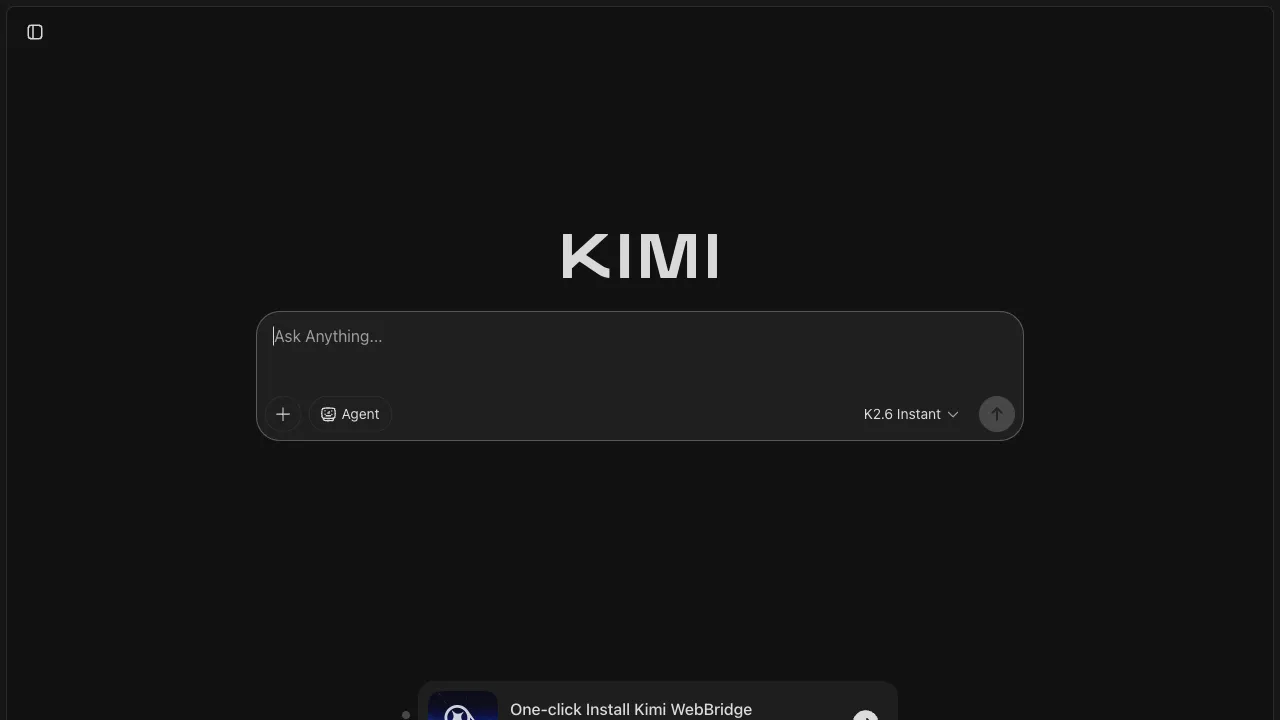
In this wave of AI product explosions in China, Kimi is one of the few products that has truly built a strong reputation among everyday users. It didn’t rely on backing from tech giants; it succeeded through its product itself—specifically two features: the ability to read ultra-long documents and perform web searches. These capabilities allowed it to stand out among numerous AI assistants, becoming a daily tool for many people.
What is Kimi?
Kimi AI (kimi.moonshot.cn) is an AI conversational assistant launched by Moonshot AI, a Beijing-based company, built on its proprietary Moonshot large language model. Founded in 2023, Moonshot AI was established by Yang Zhilin, a Tsinghua University graduate who previously participated in AI research projects at Google Brain and Microsoft. It represents the new generation of domestic LLM startups.
Kimi officially opened to the public in late 2023, with its key differentiator being long-context processing. At that time, most AI products were still operating within 4K–8K token windows. Kimi directly launched a version supporting contexts of up to 200,000 Chinese characters—roughly equivalent to a medium-thickness book. This differentiation allowed it to spread rapidly among content creators, researchers, and students.
Core Capabilities
Ultra-Long Document Processing
Kimi’s long-context processing is its most frequently cited capability. It supports uploading documents for direct parsing; PDFs, Word files, and TXT files are all supported. After uploading, you can ask questions about the document content, request summaries, abstracts, or comparisons.
In actual use, feedback has been particularly positive in several scenarios:
Academic Paper Processing: Upload a PDF of an English paper and ask Kimi to summarize its core contributions, research methods, and experimental conclusions in Chinese, saving significant reading time. For papers requiring close reading, you can follow up with questions about specific paragraphs, and it will answer based on the original context.
Contracts and Legal Documents: Paste the full contract text and ask, “Which clauses in this contract are unfavorable to Party B?” or “What are the specific conditions for third-party breach of liability?” It can directly locate and answer these questions without you needing to flip through clause by clause.
Long Report Summaries: For annual reports, industry research reports, or policy documents, upload them and ask Kimi to extract key data and conclusions, yielding a structured summary in minutes.
Web Search
Kimi supports real-time web search, addressing one of the most common pain points for AI assistants: knowledge cutoff dates.
The practical effect of this feature is that when answering questions, Kimi proactively fetches relevant web content, synthesizes information from multiple sources to provide an answer, and cites source links. This makes it more trustworthy than simple knowledge Q&A, especially when asking about the latest information, current events, or product reviews.
Useful Scenarios:
- Asking about the latest policy or regulatory changes
- Checking recent reviews and prices for a specific product
- Understanding recent developments in an industry
- Looking up the latest version updates for a technical framework
Multi-Document Comparison
You can upload multiple documents simultaneously and ask Kimi to compare and analyze them. For example, upload two different versions of a contract and ask, “What are the main differences between these two versions?” or upload several related papers and ask it to summarize the similarities and differences among the studies.
Code Understanding and Generation
Kimi’s coding ability is above average; it handles writing basic code, explaining code logic, and debugging without issue. You can paste code files for review or describe requirements for it to write the corresponding implementation. It is not a specialized programming assistant, but it is sufficient for daily development support.
Chinese Writing Assistance
For writing articles, revising drafts, polishing text, or expanding content, Kimi’s Chinese expression is relatively natural and lacks the typical “AI flavor.” It is suitable for writing WeChat Official Account articles, work reports, emails, and proposal drafts.
Comparison with Other Tools
vs ERNIE Bot (Baidu): Backed by Baidu with abundant resources; its product features are more comprehensive, including image generation and plugins. However, its conversational quality has not been as stable in the eyes of everyday users as Kimi’s, sometimes producing formulaic answers. Kimi’s conversations are more “direct” and less verbose.
vs Tongyi Qianwen (Alibaba): Part of the Alibaba ecosystem with comprehensive features and good coding capabilities; Tongyi is better suited for enterprise API usage scenarios, while Kimi offers a lighter personal user experience.
vs Zhipu Qingyan (Zhipu AI): Zhipu comes from Tsinghua University with solid technology and advantages in its open-source ecosystem; in terms of daily user experience, Kimi’s interface is more user-friendly, and its web search is more practical.
vs ChatGPT: ChatGPT has stronger comprehensive capabilities, especially in reasoning and Agent functions; it requires scientific internet access (and payment for GPT-4). Kimi connects directly within China and is free to use. In long-document scenarios, it is basically comparable to ChatGPT, and its web search capability is no worse.
vs Claude (Anthropic): Claude is very strong in coding and English writing with a 200K context window; it requires scientific internet access. Both have similar long-document processing capabilities, but Kimi is more user-friendly for Chinese scenarios and sometimes has better Chinese linguistic intuition.
vs Domestic Competitors: Among domestic AI assistants, Kimi is currently considered one of the products with conversational quality closest to ChatGPT, and its web search is more stable than most competitors.
Who Should Use Kimi?
Researchers and Students: For processing papers, literature, and reports, the ability to ask questions and summarize after uploading long documents greatly aids academic work.
Content Creators: Those who need to gather material for writing can save significant time on research using web search; Kimi’s Chinese expression is also stable for drafting and revising.
Office Workers: It can handle daily tasks such as processing work files, drafting reports, organizing meeting notes, and replying to emails.
Those Who Need to Analyze Long Contracts and Documents: Professionals in law, finance, and HR often need to process large blocks of text; Kimi’s document analysis capabilities can significantly speed up this process.
Users Who Don’t Want to Deal with Scientific Internet Access: If you want a high-quality AI assistant but find it inconvenient to use ChatGPT or Claude, Kimi is currently the domestic option closest to that experience.
Limitations
Kimi’s comprehensive capabilities still lag behind GPT-4, particularly in complex reasoning, multi-step tasks, and processing English content.
The quality of information sources from web search varies; sometimes it cites low-quality web content, requiring users to judge credibility themselves.
The free version has daily usage limits, and high-frequency users may encounter quota shortages.
It does not support image generation and is less comprehensive in multimodal features compared to competitors like ERNIE Bot.
Pricing
Kimi offers a free version with a certain number of daily conversations and file upload quotas, which is sufficient for ordinary users. The Kimi+ paid version costs ¥99 per month, removing usage limits and supporting longer contexts, making it suitable for heavy users or those with professional needs. Please refer to the official website for specifics.
Overall, Kimi is one of the domestic AI assistants with an experience closest to ChatGPT. Its long-document processing and web search capabilities are genuine differentiators, not gimmicks. For users who do not have access to overseas AI tools, Kimi is currently the most recommended domestic alternative.