

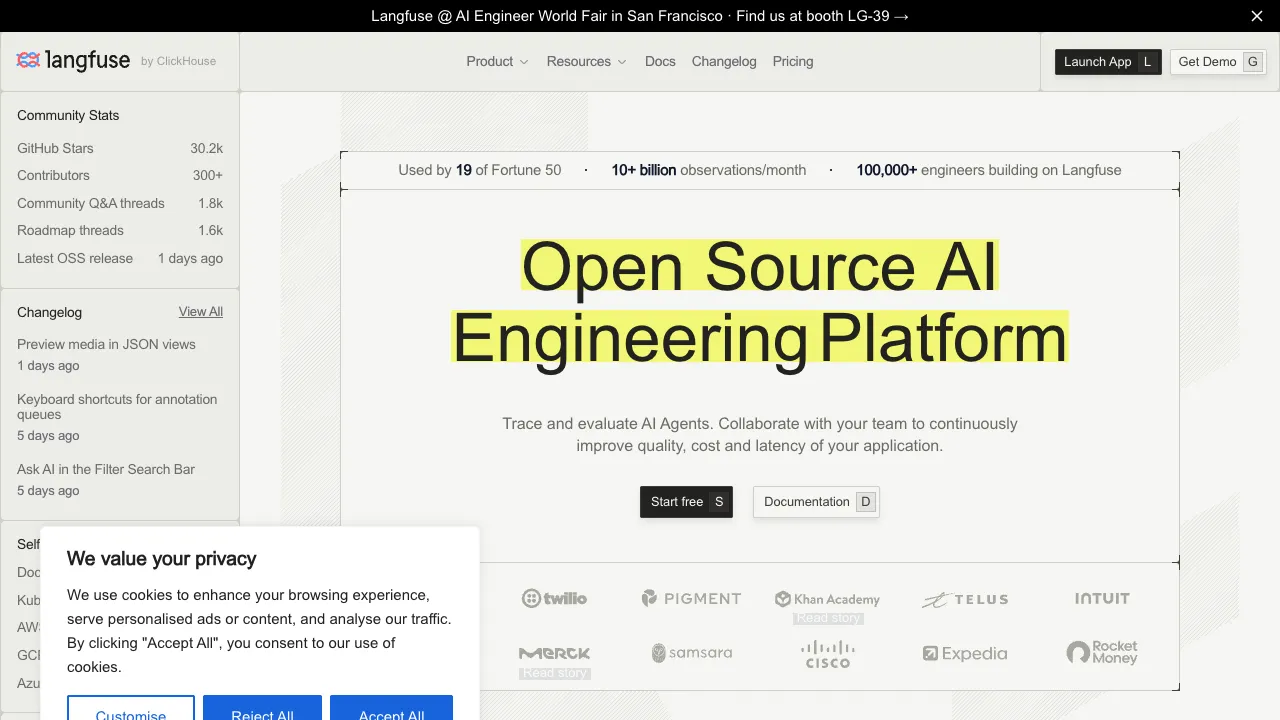
There is a significant difference between developing LLM applications and traditional software: it is difficult to verify an LLM’s behavior using conventional unit tests and assertions. Change a single character in a prompt, and the output might change; switch to a different model version, and scenarios that previously worked well may suddenly break. This uncertainty complicates the engineering of LLM applications. Langfuse was born to solve this problem: it is an open-source LLM observability platform that helps developers track, analyze, evaluate, and improve their AI applications.
What is Langfuse?
Langfuse (langfuse.com) is an open-source LLM engineering platform with core features including tracing and logging of LLM calls (Tracing), prompt version management (Prompt Management), quality evaluation (Evaluation), and dataset management.
In simple terms: every time your LLM application calls a model, Langfuse records it, analyzes the results, and identifies issues, allowing you to systematically improve application quality rather than relying on guesswork.
The project is fully open-source, with code publicly available on GitHub. It supports self-hosting and also offers a managed cloud service version (with a free tier). In the field of LLM observability, Langfuse is currently one of the most popular open-source solutions.
Core Features
LLM Tracing
This is Langfuse’s core feature. By integrating the Langfuse SDK into your application code, every LLM call is recorded:
- Input prompts and model parameters
- The model’s output content
- Call latency
- Token usage and costs
- Error messages
For complex LLM applications (multi-step chains, RAG pipelines, agent workflows), Langfuse supports nested tracing—each sub-step has its own record, allowing you to see the execution of the entire call chain and pinpoint exactly where issues occur.
Prompt Management
Prompts are the core configuration of LLM applications, but hardcoding them in your code makes management cumbersome—modifying one requires a redeployment, and tracking or comparing multiple versions becomes difficult.
Langfuse provides a dedicated prompt management interface featuring version control (every modification is recorded and can be rolled back), A/B testing (running two prompt versions simultaneously to compare performance), and integration with tracing data (so you know how each prompt version performs in real-world usage).
Evaluation
This is the most challenging part of LLM application engineering—how do you determine if a model’s output is “good”? Langfuse supports multiple evaluation methods:
- Manual Annotation: Score model outputs directly within the Langfuse interface to build high-quality evaluation datasets.
- LLM Automated Evaluation: Use another LLM to score the output of the original LLM, enabling large-scale automated evaluation.
- User Feedback: Integrate user feedback data such as likes/dislikes into Langfuse to understand how real users judge output quality.
These evaluation data points can be used to track changes in application quality over time and make data-driven decisions during iterations.
Datasets and Testing
Langfuse can organize tracked real-world data into test datasets for regression testing—ensuring that new versions of prompts or models do not regress on known scenarios. This is a critical quality assurance mechanism for LLM applications entering production.
Integration Methods
Langfuse offers various integration methods compatible with common LLM development stacks:
- OpenAI SDK: Integrate with just a few lines of code to automatically trace all OpenAI API calls.
- LangChain: Native support for LangChain callbacks, tracing the full execution process of chains and agents.
- LlamaIndex: Supports tracing for LlamaIndex RAG pipelines.
- Direct HTTP API: Record data by calling the HTTP API directly without relying on any SDK.
- Python and JavaScript/TypeScript SDKs: Officially maintained client libraries.
Integration typically requires only initializing the Langfuse client and passing an API key. Most tracing can be handled automatically via decorators or callbacks, without modifying core business logic.
Comparison with Other Tools
vs. LangSmith (LangChain’s Official Tool): LangSmith is an LLM observability platform launched by the LangChain team. Its features are highly similar to Langfuse’s, making it the most direct competitor. LangSmith is a commercial product, whereas Langfuse is open-source and self-hostable, offering better data privacy guarantees.
vs. Helicone: Helicone is another LLM tracing tool with a similar positioning. Helicone focuses on cost analysis and caching features, while Langfuse offers more comprehensive evaluation and prompt management capabilities.
vs. Weights & Biases (W&B): W&B is an established tool for machine learning experiment tracking that has recently added LLM features. W&B leans more toward model training and experiment management, whereas Langfuse focuses on observability for LLM applications in production environments.
vs. Datadog / Traditional Monitoring Tools: Traditional application monitoring tools can track API calls but lack native support for LLM-specific needs (such as prompt versions and output quality evaluation). Langfuse is designed specifically for LLM applications.
Who Should Use Langfuse?
Developers Building LLM Applications: Whether you are building a RAG system, an AI customer service bot, or a smart assistant, if you use LLM APIs, Langfuse helps you better understand your application’s runtime behavior.
Teams Needing Systematic Prompt Improvement: Stop guessing when modifying prompts. Instead, rely on data—know which version performs best in which scenarios to make iterations more directed.
Teams with Strict Data Privacy Requirements: Langfuse is fully open-source and can be deployed on your own servers, avoiding the need to send user data to third-party platforms.
Teams Moving LLM Applications from Prototype to Production: Once an application goes live, continuous quality monitoring is essential. Langfuse provides the observability infrastructure for LLM applications in production environments.
Self-Hosting and Cloud Services
Langfuse can be deployed on your own servers via Docker, with official documentation and Docker Compose configurations provided. Self-hosting is completely free and suits teams with strict data privacy requirements or high usage volumes.
The cloud service version (cloud.langfuse.com) offers a free Hobby tier with limited event counts, suitable for personal projects and small-scale application evaluation; higher usage requires a paid subscription.
Limitations
As an observability tool, Langfuse cannot directly improve the quality of LLM outputs; it simply helps you see and understand output quality better. Actual improvements still require decision-making and execution by engineering and product teams.
Self-hosting requires certain server operations capabilities. For small teams without technical ops resources, using the cloud service version is more realistic, though data transmission concerns must be considered.
Langfuse is critical infrastructure for LLM application engineering. If you are seriously building an LLM application rather than just playing with a demo, establishing observability from the start will make later iterations and maintenance much smoother. Langfuse is open-source and free, has comprehensive documentation, and boasts an active community, making it the top choice in this space currently.