
In the early hours of March 6, 2025, a product that almost no one had heard of suddenly went viral across the Chinese internet and X. In its demo video, Manus received tasks such as “screen these résumés,” “research real estate,” and “analyze stocks,” then opened a browser, navigated web pages, took notes, wrote code, and delivered complete reports—all without human intervention. Within hours, “Manus” was trending, invitation codes were being resold for tens of thousands of yuan, and the international AI community was debating whether a Chinese team had built the first truly general-purpose agent.
The frenzy reflected an expectation that had been building across the industry. Large language models had been able to “talk” for two years; what people wanted was for them to genuinely “do.” Manus captured that shared sentiment. Whatever controversies followed, it moved the idea of an “AI agent” out of papers and demos and into mainstream discussion.
What Is Manus?
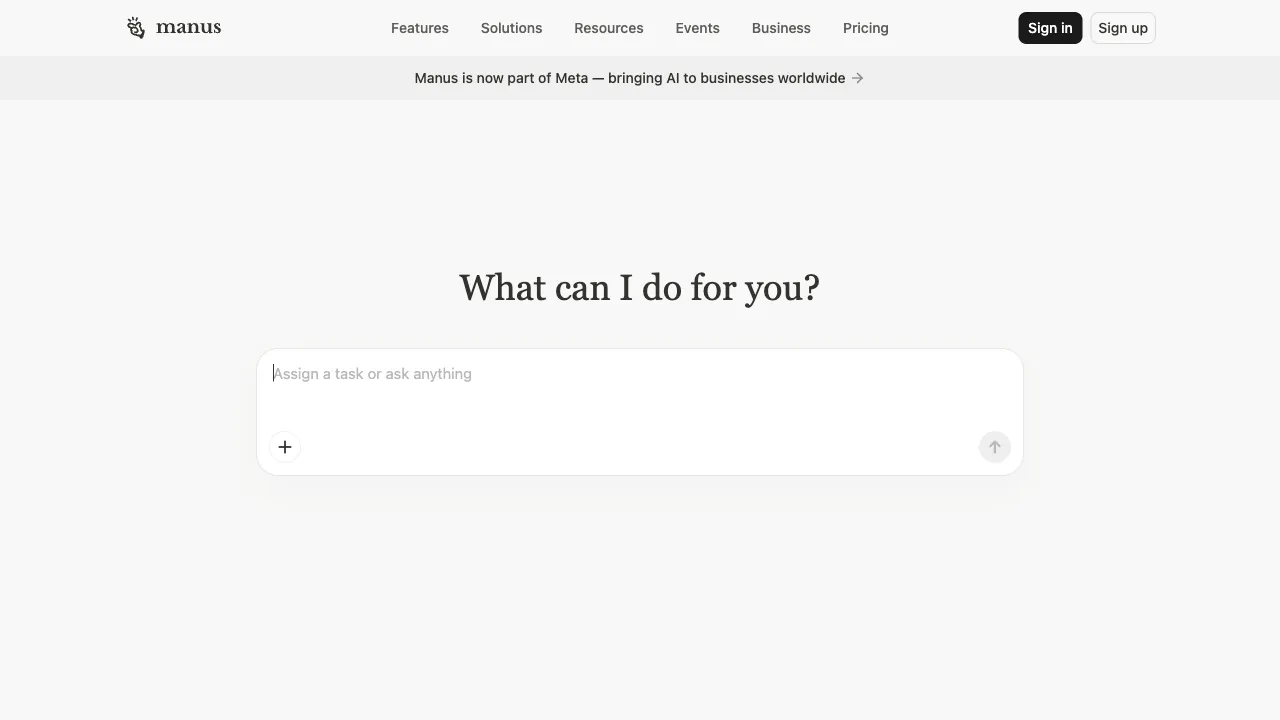
Manus (manus.im) is a general-purpose AI agent built by the Chinese team Butterfly Effect, the developer of Monica.im. Its name comes from the Latin word for “hand,” a straightforward metaphor for giving AI the ability to act.
Its essential difference from conversational AI lies in how it works. A chatbot follows a question-and-answer pattern, while Manus can plan and execute autonomously after receiving a goal. It breaks the goal into tasks, operates a cloud browser, searches and reads information, runs code, processes files, and completes the work step by step in its own virtual-machine environment. It then delivers a finished output, such as a report, spreadsheet, website, or data file. You can watch a replay of its actions or close the page and do something else while it continues running asynchronously in the cloud.
How It Works
Consider a typical request: “Research the competitive landscape for AI coding tools in China and produce a report.”
- Planning: Manus breaks the goal into subtasks, such as identifying tools, checking pricing, gathering user feedback, and compiling the final report.
- Execution: It opens a browser in a cloud virtual machine, searches the web, reads pages, and records key points. When data processing is needed, it writes and runs a Python script on the spot.
- Self-correction: If one approach fails—for example, a page will not open or information is missing—it changes strategy and tries again.
- Delivery: It combines the collected material into a structured report and includes an activity record for review.
The combination of asynchronous cloud execution and replayable actions is a thoughtful product decision. Agent tasks can take dozens of minutes, so expecting users to stare at the screen is unrealistic. Manus instead feels like sending out an intern who lets you know when the work is finished.
Its Real Capabilities and Limits
After the initial excitement, large-scale hands-on testing provided a more measured picture. Anyone considering Manus should understand where it performs reliably and where it does not.
Reliable use cases: moderately complex online research and information synthesis, structured data collection and organization, and focused multi-step tasks with a single clear objective. For this kind of work, Manus can genuinely save several hours.
Failure-prone use cases: tasks that require nuanced judgment or aesthetic taste, very long chains of dependent steps where errors compound, websites that require login or human verification, and situations where factual accuracy must be flawless. Information synthesized by Manus can still contain errors or omissions.
The industry gradually reached a clearer consensus: Manus offers strong engineering and integration, but its underlying capabilities remain constrained by the limits of existing large language models. Agent reliability is an unresolved industry-wide problem, not a flaw unique to one product. Expectations are more realistic if you treat Manus as an efficient intern whose work still needs review.
Comparison with Competing Products
vs. OpenAI Deep Research: Deep Research specializes in in-depth research and has a strong reputation for rigorous reports. Manus covers a broader range of actions, including browser operation, code execution, and file creation. The two are competitive for pure research tasks, while Manus covers more operational workflows.
vs. Claude Computer Use and agent capabilities: Anthropic focuses more on exposing foundational capabilities to developers. Manus packages similar capabilities into a consumer product that works out of the box, and its level of productization is a genuine strength.
vs. Devin: Devin specializes in software engineering and goes deeper on coding tasks. Manus is more general-purpose and covers non-programming scenarios such as research, documents, and data work.
vs. early open-source agents such as AutoGPT: These projects pioneered the concept but offered rough reliability and user experience. Manus can be viewed as a more mature productization of the same agent idea, with the main difference lying in engineering rather than concept.
vs. newer agent products: After Manus went viral, major companies in China and elsewhere rapidly introduced similar features, making the market crowded. Manus retains the visibility of an early mover, but its period of being uniquely positioned has passed. It is worth comparing alternatives before choosing a product.
Tasks That Suit Manus
Market and competitor research: Systematically collect products, pricing, and user sentiment in a field, then turn the findings into a report. This is one of the most mature agent use cases: let it run while you attend a meeting.
Bulk information organization: Give it a collection of links or files and ask it to extract information into a specified structure or table.
Repetitive data collection: Look up figures across multiple sources, record them, and consolidate the results—mechanical but time-consuming work.
Preliminary research for content creation: Gather source material and organize references, effectively outsourcing the research phase of writing.
One principle matters above all: the more specific the task, the higher the success rate. “Take a look at my competitors” is a poor request. “List the top ten products in category X, compare their pricing and core features, summarize recurring user complaints, and output a comparison table” is much more suitable for an agent.
Access and Pricing
Manus initially used an invitation-only system, which led to the period when codes were extremely difficult to obtain. Registration was later opened gradually. The service uses a credit-based pricing model: users receive a free allowance, tasks consume credits, and heavier use requires a paid subscription. Each agent task consumes real computing resources, so limited free usage is common across this category. Check the official website for current pricing.
How to Think About Manus
Manus may ultimately be more historically significant than any particular version of its capabilities. Its explosive launch demonstrated how much demand exists for AI that can take action, and it accelerated the entire industry’s race to build agents. The product, like its competitors, is still confronting the reliability problems inherent to agents, but the direction is clear: AI is moving from “talking” toward “doing,” and Manus was one of the memorable products that opened this chapter. If you have a large amount of research or organizational work that is mechanical yet still requires some reasoning, it is worth using the free allowance to see how this digital intern performs.