

In the autumn of 2023, a wave of videos swept through global social networks: Taylor Swift "spoke" fluent Chinese, and Guo Degang "performed" English crosstalk—lip movements were perfectly synchronized, voices were eerily authentic, and the realism was so chillingly impressive that it left viewers both spine-tingled and applauding. Behind this viral content was a single tool: HeyGen’s video translation feature. Overnight, the company leaped from industry fame to mainstream spotlight, driving the category of "AI digital humans" into the public consciousness for the first time.
Even more dramatic is its origin: HeyGen was founded by former Snap engineer Joshua Xu (Xu Zhuo) and others. The team has deep Chinese roots; originally named Movio, it started in Shenzhen before shifting its focus to the global market. Today, it is one of the most highly valued star companies in the AI video sector and a benchmark case for "Chinese teams building global SaaS."
What is HeyGen?
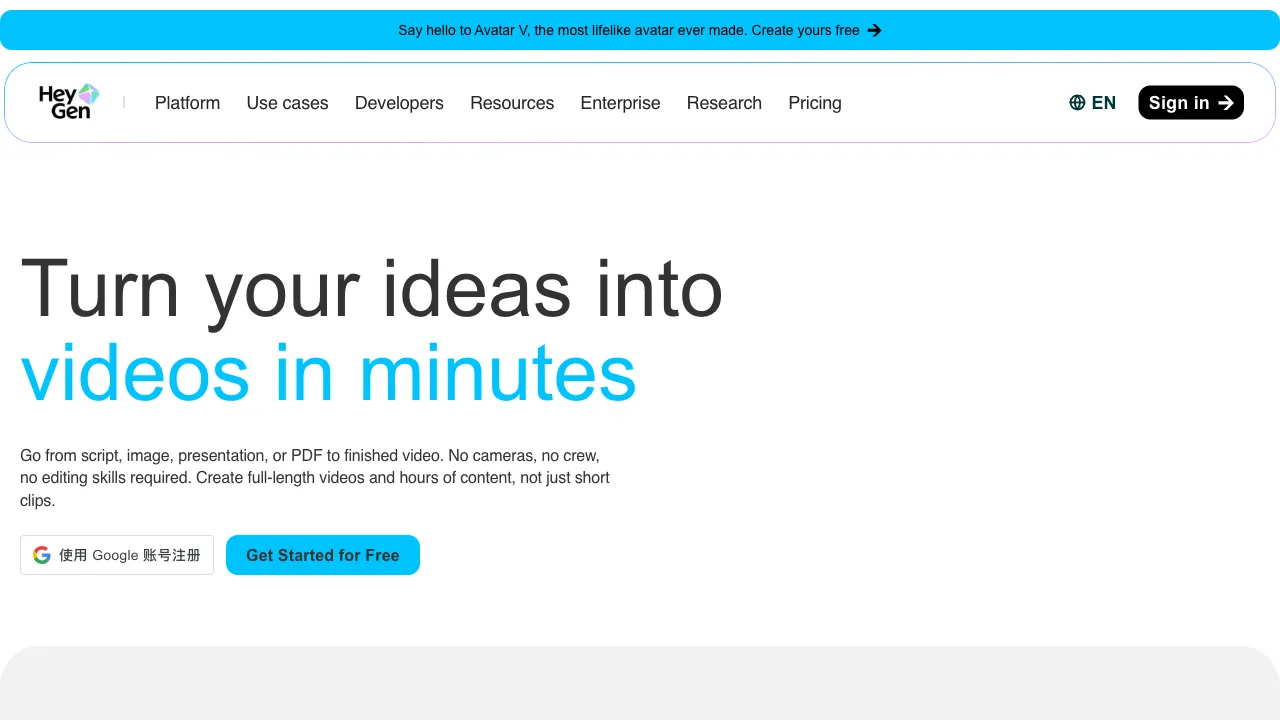
HeyGen (heygen.com) is the most representative AI digital human video platform in the international market: select or customize an AI avatar, input a text script, and generate a video of that avatar speaking—with synchronized lip movements, natural expressions, and multi-language support. Its core capabilities fall into four areas: digital human video generation, personal avatar cloning, video translation, and multi-language dubbing.
Its industry status can be summarized in one sentence: it is the "quality benchmark + feature definer" of the digital human video category—the feature lists of later entrants are largely copied from it.
Core Features
Digital Human Video Generation
The foundation: choose from hundreds of public digital human avatars (covering different races, ages, and styles), input a script, select a voice, and generate a broadcast video. HeyGen’s digital humans have long been in the industry’s top tier for naturalness—the coordination of micro-expressions, head posture, and gestures leaves the "uncanny valley stiffness" of early digital humans far behind.
Personal Avatar Cloning (Avatar)
Record a few minutes of real-person video footage to train a "digital twin"—your appearance, voice, and speaking mannerisms are all preserved. Then, for any script input, your "AI self" appears on screen.
This feature changes the fundamental constraints of content production: real-person presence is a bottleneck resource that cannot be parallelized or replicated; digital twins turn it into an infinitely callable asset. For knowledge bloggers and corporate spokespeople who appear on camera frequently, the efficiency revolution of "record once, use for a year" is well-deserved.
Video Translation: The Masterpiece
The signature feature that went viral globally. Upload a video of a real person speaking, select the target language, and AI handles the entire pipeline: speech recognition → translation → synthesizing new-language dubbing using the original voice → adjusting lip movements to match the new language. The result is an illusion-level experience of "the same person speaking a different native language."
The commercial value is straightforward: one piece of content covers the global market with zero additional shooting costs. For overseas brands’ marketing videos, multinational corporations’ internal communications, and creators’ multi-language channels, the budget for local production teams is compressed into a single button. This feature remains HeyGen’s sharpest differentiator against all competitors to date.
Multi-Language TTS and Template Library
High-quality dubbing in dozens of languages and a rich library of commercial video templates (product introductions, marketing, training scenarios), closing the loop from script to final cut within the platform.
Interactive Digital Human (Interactive Avatar)
The advanced direction: real-time conversational digital humans powered by large language models—video customer service agents and sales assistants that can "listen" and "respond," representing the next stop for this category as it moves from "pre-recorded" to "live/interactive."
Comparison with Similar Tools
vs. Synthesia: The veteran rival in enterprise digital humans, focusing on large corporate training and internal content with deep compliance and enterprise service capabilities; HeyGen’s product is more creator- and SMB-focused, with more aggressive feature iteration, and video translation is a trump card Synthesia lacks. Enterprise procurement looks to Synthesia; creators and growth teams look to HeyGen.
vs. D-ID: An early player in photo-driven talking videos, lightweight and API-friendly; but its naturalness has been surpassed by HeyGen’s generational leap.
vs. Hedra: A newcomer in creative character videos, excelling in the flexibility of driving any image; HeyGen is more comprehensive in commercial scenario maturity, real-person cloning, and translation capabilities. For virtual characters, look to Hedra; for serious commercial content, look to HeyGen.
vs. Tencent Zhiying / iFlytek Zhizuo: Domestic digital human solutions with optimized access within China, RMB pricing, and Chinese scenario optimization; they are smoother for purely domestic business. HeyGen wins on the upper limit of digital human naturalness and irreplaceable video translation, making the choice easy for overseas teams.
vs. Wondershare Virbo: Another domestic tool aimed at overseas marketing, with more affordable pricing; but the upper limit of effect and breadth of features still sets HeyGen as the benchmark.
Who Should Use HeyGen?
Overseas Brands and Cross-Border E-commerce: Video translation + multi-language digital humans cut content localization costs by an order of magnitude—HeyGen’s core paying audience, with the clearest ROI.
High-Frequency On-Camera Creators: Digital twins free up real-person schedules, serving as a mass-production engine for talking-head content.
Corporate Training and Marketing Departments: Batch production of standardized video content; just modify the script and regenerate, saying goodbye to reshoots.
Sales and Customer Success Teams: A new touchpoint method using personalized video messages ("your AI self" presenting proposals to clients), a popular tactic in the overseas B2B circle.
Boundaries and Ethics
HeyGen’s effects are so good that misuse must be discussed seriously; the platform itself draws clear red lines: cloning an avatar requires the subject’s authorized verification (recording a confirmation video), prohibiting cloning others without consent and prohibiting creating impersonation content. User-side responsibilities are equally clear: digital twin videos should be labeled as AI-generated, and authorization must be obtained for any third-party likeness—legal risks surrounding deepfakes are tightening rapidly worldwide; this line must not be crossed.
An honest reminder on effects: digital humans can pass for real in "information-delivery" content (broadcasts, explanations, training), but for content requiring strong emotion and charisma, human performance remains irreplaceable. Additionally, direct access within China faces network barriers; for purely domestic business, evaluating domestic alternatives is recommended.
Pricing
Offers a free tier (generating watermarked trial videos); paid subscriptions unlock more duration, avatar cloning, video translation, and HD export by tier. Creator plans start at tens of dollars per month, with enterprise features negotiated separately. Refer to the official website for specifics.
HeyGen’s story condenses the best script of this wave of AI applications: piercing public awareness with a stunning single-point feature (video translation), then catching that traffic with a solid product matrix. For any team with video content going global, it is a name you cannot bypass—take one of your real videos, translate it into another language for free to see the effect, and in that moment, you will naturally understand why it is worth its valuation.