

The live-streaming world is rife with "copyright tragedies": a streamer casually plays a popular song as background music, only to have their stream cut off by the platform, their VOD muted, or worse, face heftyclaim from rights holders. The copyright landmines lurking in background audio are a shared memory for every streamer and video creator, stepped on by all. Yet the demand here is exceptionally picky: it’s not about "one song," but a continuous audio stream that can play for hours without repeating, without breaking immersion, and absolutely clean of copyright issues—the traditional music library model of "per-track licensing" simply cannot meet this need in form.
Mubert’s solution differs at its core: music isn’t selected; it’s streamed. AI generates audio in real time based on your specified scene and mood, theoretically continuing indefinitely without repetition, with every generation being original and naturally copyright-free. This team, with Russian roots, is one of the earliest practitioners of the "generative streaming music" concept, having run this path for years before the current AI music boom.
What is Mubert?
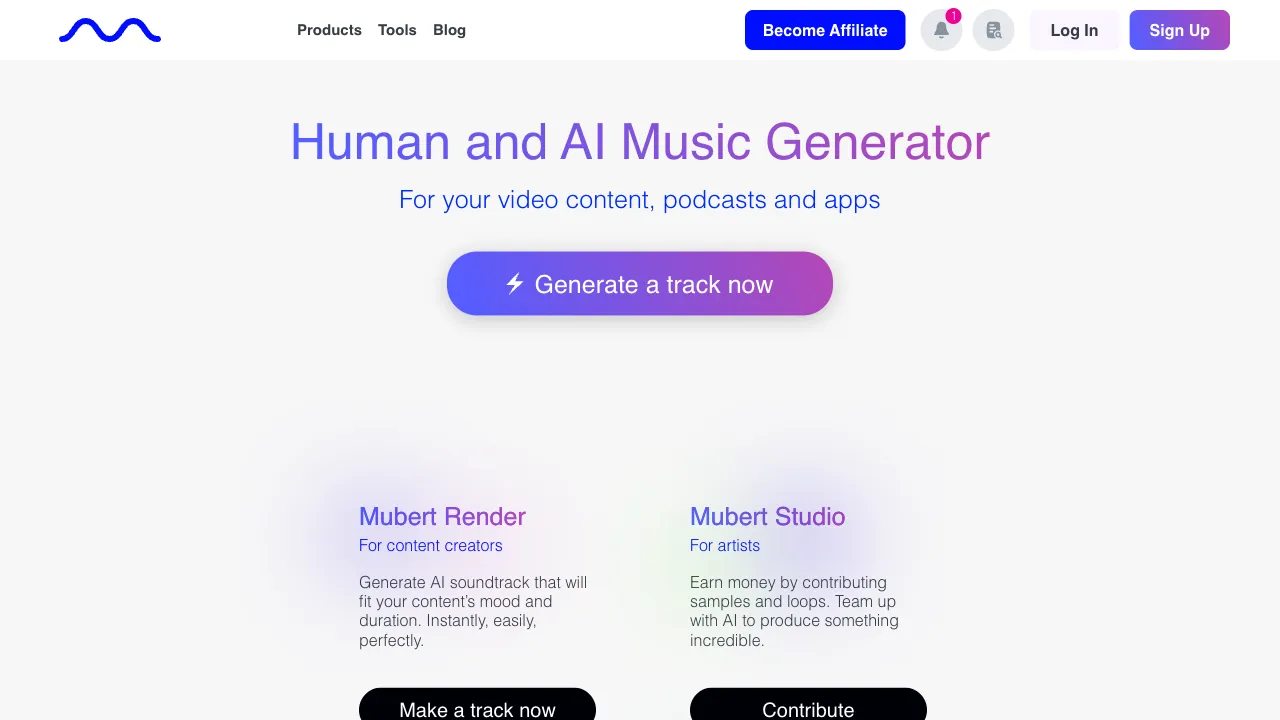
Mubert (mubert.com) is an AI music generation platform specializing in functional background music in two forms: infinite streams (real-time generated and continuously played for live streaming, focus, or relaxation scenarios) and custom tracks (background music generated based on descriptions and precise duration for video creation). Its product lineup is comprehensive: an app for listeners, Render for creators (text-to-music), and an API for developers—it provides an outlet for every consumption form of the "background music" need.
Its technical approach is also distinctive: rather than pure end-to-end generation, it uses AI to real-time arrange and combine materials contributed by a vast number of musicians (loops/samples). This hybrid architecture of "human material + AI arrangement" is why its streams sound stable and free of glitches, while also allowing contributing musicians to share in the revenue, keeping the copyright chain clean and traceable.
Core Features
Scene-Based Infinite Streams
Select a scene, start streaming, and forget about it:
- Focus Work: Endless streams of lo-fi, ambient, and deep focus music—an "AI version of a study companion radio." The lack of repetition means you won’t be distracted by familiarity.
- Live Streaming: Background streams customized for gaming, chatting, or creative live streams, which will not trigger platform copyright detection—this single feature is the sole reason countless streamers have migrated here.
- Fitness/Relaxation/Meditation: Functional streams customized by BPM and mood.
Mood (calm/vibrant/mysterious), tempo, and style are all adjustable; music flows out like a tap on demand.
Video Background Music Generation (Render)
The main tool for creators: input a style description plus precise duration to generate a track that exactly matches your video length. The simple need of "57 seconds of video requires 57 seconds of music" can only be forced by editing in traditional libraries, but Mubert solves this natively. The combination of copyright-free, fixed-length, and style-controllable features hits the workflow of YouTube/short-video creators right on the head.
Commercial Licensing and API
Licensing terms are clearly tiered (personal free tier / creator commercial tier / enterprise tier); "peace of mind" is the lifeline of functional music products. The API is aimed at application developers—personalized soundscapes for meditation apps, dynamic emotional scoring for games, background audio systems for commercial spaces—the integration form of "music as a service."
Comparison with Similar Tools
vs Suno/Udio: Those two generate "songs"—with vocals, structure, and complete works lasting three to five minutes; you listen to the work itself. Mubert generates "soundscapes"—no vocals, no clear structure, infinitely extendable; you listen to the atmosphere. For a lead vocalist, choose Suno; for background, choose Mubert. This boundary is so clear it’s not even a choice.
vs Stable Audio: Both generate instrumental music. Stable Audio produces structured, fixed-length clips (with a higher quality ceiling), while Mubert excels in the "stream" format and scene-based products. For single-track scoring, both work; for continuous streams, Mubert has an exclusive niche.
vs Epidemic Sound/Artlist Libraries: Libraries recorded by human musicians still have the upper limit in musicality and production quality, offering full-library access for an annual fee. Mubert’s cards are infinity, customization, fixed length, and lower entry costs. Use libraries for polished final productions; use Mubert for massive daily needs and live streaming scenarios. It’s common for creators to hedge their bets with both.
vs Spotify Playlists as Background: Fine for personal listening, but using them in live streams or videos is a copyright disaster site—this is the negative example that justifies the existence of products like Mubert.
Who Should Use Mubert?
Streamers: Infinite background streams that don’t trigger copyright detection; this category was practically invented for live rooms—the core beneficiary group, without exception.
Video Creators and Podcasters: A pipeline supply of fixed-length, copyright-free scoring; the daily ammunition for intros, bed tracks, and ambient sounds.
Focus Work Individuals: Use it as an "infinite lo-fi radio," a casual but genuine mass-market use case.
App and Game Developers: API integration for dynamic soundscapes; audio layer solutions for meditation, fitness, and gaming products.
Commercial Spaces: Compliant background music solutions for shops and showrooms—public performance rights are a blind spot often ignored by physical retail; generative streams offer a clean alternative.
Limitations
Functionality is both its ceiling and its positioning: Mubert’s music "competently stays in the background," but lacks the emotional narrative and memorable hooks of human composition—it cannot provide theme melodies that audiences need to remember or scoring for emotional passages. For such needs, return to libraries or hire a composer.
No vocals, no song structure; it does not replace Suno-style tools. The free tier has obvious limitations (audio quality, licensing scope); commercial use basically requires the paid tier.
Pricing
- Free / Ambassador: 25 tracks a month, attribution required and watermarked, personal use only, with 5 fixed-duration MP3 downloads
- Creator, $14/month ($11.69/month annually): 500 tracks, no attribution required
- Pro, $39/month ($32.49/month annually): unlocks full digital commercial licensing
- Business, $199/month ($149.29/month annually): adds in-app music and agency use, a dedicated account manager, advanced licensing options and digital ad campaigns at scale
- Enterprise API: on request; single-track purchases start at $19 for a Standard track
Verify the licensing yourself, because sources disagree. One says the Creator plan allows royalty-free downloads without attribution and permits monetised content but not advertising or paid media placements; another says Creator does not include commercial rights and that monetisation requires Pro. Take the prices as a guide, but read the official licence page for scope.
Clear limits worth knowing: tracks are royalty-free for video and content use but cannot be registered with Content ID, released as standalone streaming singles, or listed on stock music sites. Mubert Render and the newer Mubert.ai creation platform run different plans and distribution rules, and the streaming release rights in Mubert.ai's paid terms do not automatically extend to tracks downloaded through Mubert Render.
One negative signal, stated plainly: Trustpilot reviewers report the terms saying you do not own your creations or hold commercial rights even on paid plans — though with only 20 reviews and a 1.7 score, that page is a small sample and a caution rather than a conclusion.