

Content creators have all been burned by the copyright issues surrounding background music: you finish your video, and the soundtrack is either expensive (annual subscriptions for commercial music libraries are no joke), poor (free libraries offer the same handful of tracks until you’re sick of hearing them), or risky (using a popular song casually means waiting for takedown notices and copyright claims). The simple desire to “have a two-minute lo-fi background track that won’t cause trouble” has long lacked a decent solution.
AI music generation pulls this problem out by the roots: describe the music you want, and in a few dozen seconds, receive a brand-new, copyright-clean audio file. Stable Audio is a key player in this space—the creator, Stability AI, is the same company that ignited the image generation revolution with Stable Diffusion. Stable Audio is their product of applying the “diffusion model + open strategy” approach to the audio domain.
What is Stable Audio?
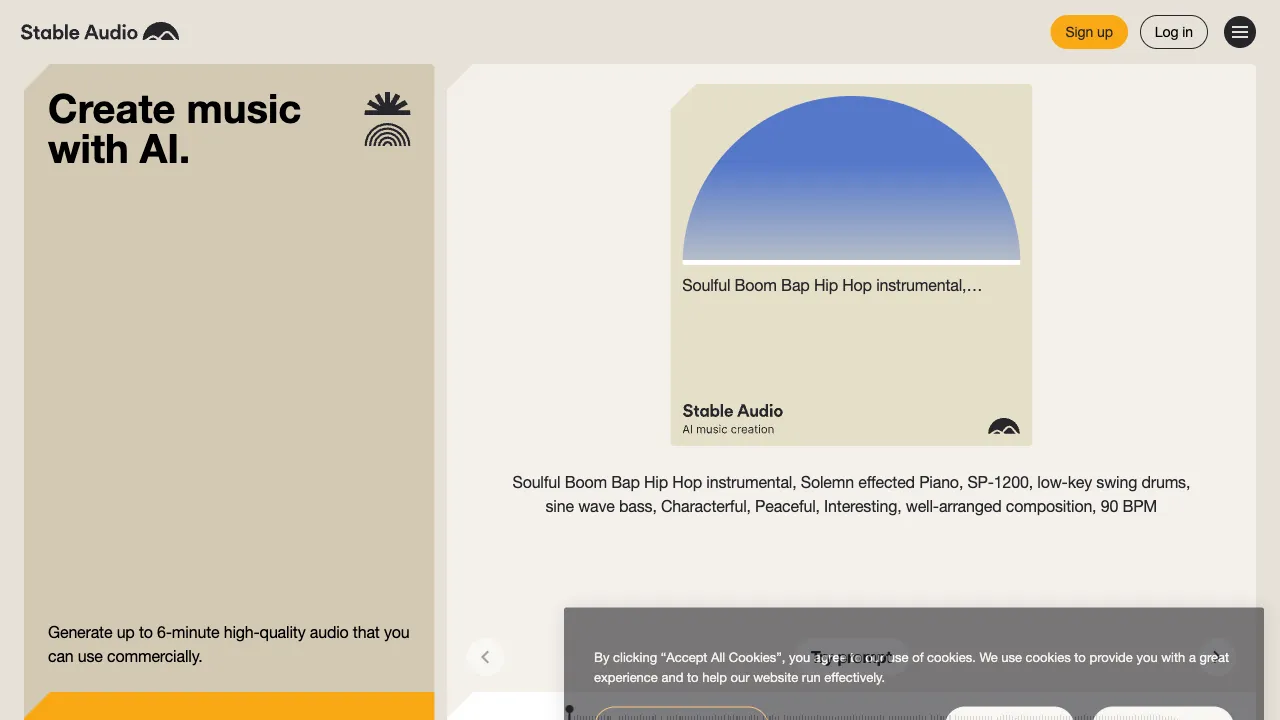
Stable Audio (stableaudio.com) is Stability AI’s AI audio generation platform: input a text description (style, mood, instruments, rhythm), and it generates corresponding music or sound effects, with a maximum duration of about 3 minutes per generation and usable audio quality at 44.1kHz stereo.
Technically, it is a latent diffusion model designed natively for audio, not a simple port of an image model—this ensures a solid foundation for audio quality. Continuing Stability’s consistent style, the team has also open-sourced the Stable Audio Open version for community research and local deployment. This is a rare stance among commercial AI music products and is the source of its good reputation among developers.
Core Features
Text-to-Music Generation
Prompts can combine multiple dimensions; the more specific, the more accurate:
- Genre: ambient, synthwave, jazz, lo-fi hip hop, cinematic orchestral…
- Mood: relaxing, tense, uplifting, melancholic…
- Instruments: piano solo, strings and brass, analog synth, acoustic guitar…
- Rhythm and Structure: BPM values, slow build, driving beat…
- Use Case: for a podcast intro, meditation background…
A decent prompt looks like this: “cinematic orchestral, tense strings building to dramatic climax, 100 BPM, movie trailer style”—the specific multi-dimensional description yields significantly more controllable output.
Precise Duration Control
You can specify the generation duration—this is highly significant for practical scenarios: if a video needs 47 seconds of background music, it generates exactly 47 seconds; if an intro needs a 10-second jingle, it gets 10 seconds. There’s no need to hard-cut a full song to fit.
Sound Effect Generation
In addition to music, it can generate ambient sounds and sound effects: rain, crowd noise, mechanical operation, transition effects—the sound design needs for video and game development are solved conveniently with one tool.
Audio-to-Audio and Style Transfer
Upload an audio clip as a reference to transform its style or extend it—this gives creators more direct control than text alone, making workflows like humming a melody and having the AI arrange it feasible.
Copyright and Commercial Licensing
Commercial rights for generated content are unlocked according to subscription tiers, and Stability emphasizes that its training data comes from licensed music libraries (in partnership with AudioSparx)—against the backdrop of major copyright controversies in AI music, “clean training data” is a key selling point for its commercial users.
Comparison with Similar Tools
vs Suno / Udio: The two biggest names in AI music right now, with core capabilities focused on complete songs with vocals—lyrics, composition, and singing all in one go. If you want to make “songs,” go to them. Stable Audio’s home turf is instrumental music and sound effects: background scores, ambient sounds, and SFX assets. Its pure music audio quality and controllability (duration, BPM) are more professional-oriented. A one-sentence division of labor: choose Suno/Udio for songs, choose Stable Audio for background scores.
vs Mubert: Mubert takes the “infinite stream of background music” route, suitable for live streaming and long-duration playback; Stable Audio generates defined musical clips, suitable for precise matching with content needs.
vs Meta AudioCraft/MusicGen: Meta’s open-source solution is the choice for researchers and self-deployment enthusiasts; Stable Audio’s online product experience is more mature, while also offering an open-source version to cater to both sides—this smart positioning is exactly what sets it apart.
vs Commercial Music Libraries (Epidemic Sound, etc.): Libraries feature human-composed tracks with stable quality and ready-to-use search, operating on annual subscriptions; AI generation wins in infinite customization and exclusivity (no one else will have the same track). If you have a sufficient budget and need reliable selection, choose a library; if you want flexibility and uniqueness, choose AI. Using both is the current norm for creators.
vs Domestic Music AI (SkyMusic, etc.): Domestic tools have advantages in Chinese lyric support and accessibility; Stable Audio still holds an edge in the professional depth of instrumental generation.
Who Should Use Stable Audio?
Video Creators and Podcasters: Those with batch needs for copyright-free background music can solve intro tracks, bed music, and transition SFX in one place, no longer needing to dig through free libraries until they despair.
Indie Game Developers: Low-cost customization of scene BGM and sound effects—describe the scene’s atmosphere and generate directly. It’s more flexible than buying SFX packs and orders of magnitude cheaper than hiring a composer.
Advertising and Marketing Content Production: Custom scores for brand videos, with styles adjustable according to briefs; the cost of revising ten versions is approximately zero.
Musicians: Use it as an inspiration engine—quickly generate dozens of style drafts to explore directions, or generate material samples to import into a DAW for secondary creation; the open-source version also allows for local tinkering.
Producers of Functional Audio (Meditation/Sleep Aid): Ambient content is exactly the comfort zone of diffusion models, making batch production highly efficient.
Limitations
It is not good at vocal songs—this is the core distinction from Suno/Udio. Users who want “songs” should not go to the wrong door.
The common ceiling of AI music still exists: long-term structural development, nuanced emotional layers, and “memorable melodic hooks” still lag behind excellent human composition—it generates “professionally usable backgrounds,” not “moving works.” This is exactly sufficient for scoring scenarios but only auxiliary for serious music creation.
The single-segment duration limit (about 3 minutes) requires stitching together clips for long-form content; the quality of output from the same prompt fluctuates, so generating multiple times and selecting the best is standard practice.
Pricing
The free tier provides a certain amount of generation credits per month (non-commercial use only); paid subscriptions unlock more generations, longer durations, and commercial licensing according to tiers. Check the official website for specifics.
For creators who struggle with background music every month, the evaluation method is straightforward: write down the background music needs for your next video as a single prompt, and generate it three times using the free credits—if one of them can be used directly, your background music workflow needs an update. Clean copyright, infinite customization, and on-demand duration—these three combined are exactly what the content industry’s scoring segment has been waiting for years.