

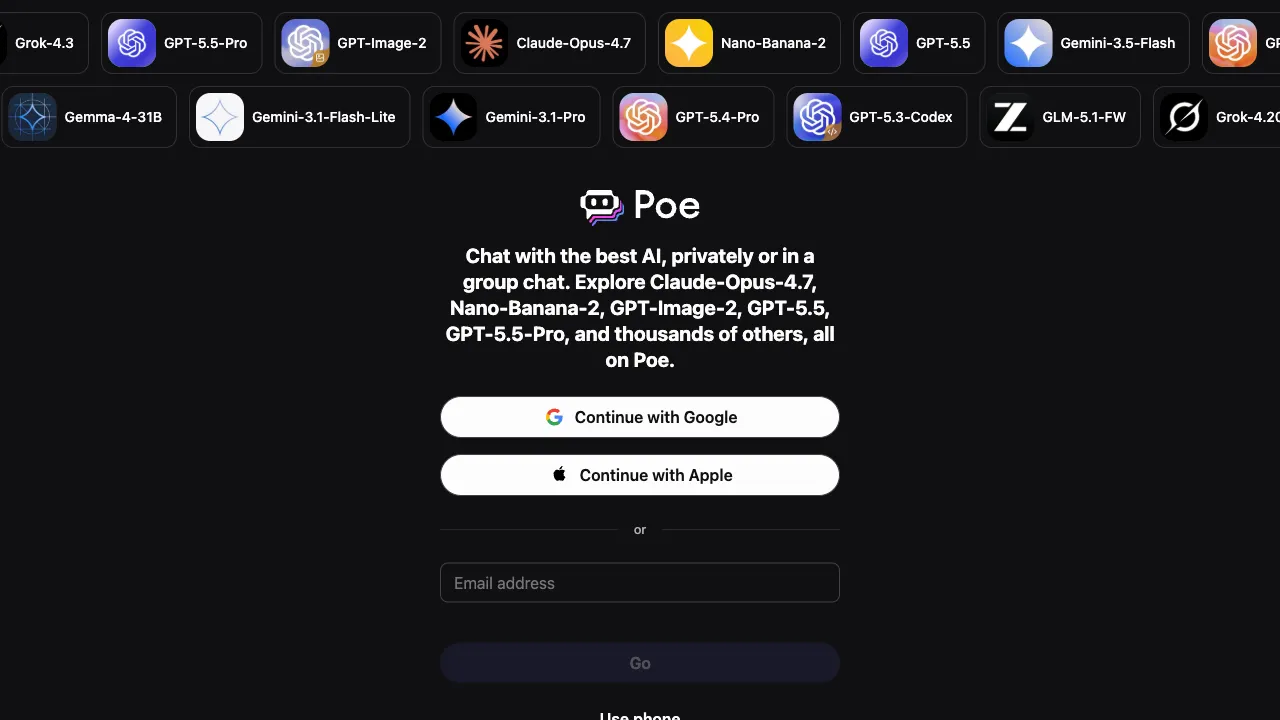
The arms race among AI models has fattened up an unexpected species: aggregators. As OpenAI, Anthropic, and Google each carve out their own paid territories, users find themselves in a predicament: "I want to subscribe to GPT for one task, Claude for another, and now that a new model is out, I have to register on yet another platform." Subscription fatigue and the burden of account management have become pain points in themselves. Poe’s business is built precisely on this pain point: one account, one subscription, access to all major models, much like a cable TV package bundling every channel. The identity of its creator is also telling—Quora, the American equivalent of Zhihu, is led by former Facebook CTO Adam D’Angelo (who was also a former board member of OpenAI and an eyewitness to that 2023 corporate drama). It’s no surprise that Quora is well-positioned to become an AI aggregator.
What Poe Is
Poe (poe.com, Platform for Open Exploration) is a multi-model AI chat platform launched by Quora: GPT-series, Claude-series, Gemini, Llama, Grok, DeepSeek, and various open-source models can all be switched between in the same interface like changing TV channels. Above the models lies a Bot ecosystem—millions of user-created specialized bots (characters, tools, domain experts), akin to a cross-model "GPTs Store." Creators can also earn revenue shares based on their Bot’s usage.
In one sentence: An aggregated subscription platform for AI models + a Bot application marketplace.
Core Features
One-Stop Multi-Model Switching
The lineup of models on the shelf updates continuously with industry trends: OpenAI’s full suite, Claude’s full suite, Gemini, Llama, Mistral, Grok, DeepSeek… Poe is famously fast at listing new models, meaning early adopters don’t need to register on new platforms every time a model launches. Poe serves as the "first-stop experience store" for new models.
Horizontal Comparison: A Unique Feature of Aggregators
Throw the same question at three models and view their answers side by side—write an email with versions from both GPT and Claude to pick the best parts, or analyze a problem to see how different models approach it differently. This "shopping around" isn’t possible within a single platform, yet it’s the most needed capability for those selecting models, conducting research, or crafting prompts. Poe also supports @-ing different Bots within a single conversation to take turns, taking this functionality even further.
Bot Ecosystem and Creator Revenue Sharing
Create custom Bots based on any underlying model: set prompts, attach knowledge bases, publish to the marketplace—functional (code, SEO, writing), character-based, and domain-specific options are all available. There are two key differences from GPTs: cross-model compatibility (your Bot can use Claude as its base) and real monetary revenue sharing (creators earn income based on usage). The latter has attracted a dedicated group of serious Bot developers to Poe.
Multimodality and Multi-Platform Support
Image understanding, file upload analysis (capabilities depend on the underlying model), and image generation Bots (FLUX, DALL·E series can be invoked); full synchronization across web, iOS, and Android with unified management of conversation history—keeping cross-model histories under one roof offers a simple convenience that adds up significantly over time.
How Subscriptions Work
Free Tier: Daily point system, sufficient for light exploration of various models (a few uses per day for advanced models).
Subscription (~$19.99/month): A large monthly pool of points, consumed according to model tiers (flagship models consume points quickly, while lightweight models can be used almost freely).
The math here is clear: If you only heavily use one model, subscribing directly to that provider’s official service is more cost-effective (fuller features, faster access to new capabilities). For those who need to use multiple models, love trying new things, and want to compare capabilities, Poe’s single subscription covers what would otherwise require three separate ones. Its target customers have never been "loyalists of a single model," but rather "nomads of the model world."
Comparison with Alternatives
vs. Official Providers (ChatGPT/Claude.ai): Exclusive features of official interfaces (ChatGPT’s advanced voice/Canvas, Claude’s full Projects/Artifacts) may not all be available on Poe—the cost of aggregation is "compromised experience outside the core conversation capabilities." Users deeply bound to a specific provider’s workflow should stay with the official service; those with broad needs should come to Poe.
vs. OpenRouter/API Aggregators: Developer-focused aggregation (unified API, pay-per-use), flexible and often cheaper, but requires you to build your own client; Poe is a consumer-grade, out-of-the-box product, targeting different audiences.
vs. HuggingChat: Free aggregation of open-source models, purely open-source lineup; Poe’s card is the legitimate bundling of closed-source flagship models. The two complement each other.
vs. Domestic Aggregators: Poe requires scientific internet access (GFW bypass) and international payment methods, which are real barriers for domestic users—but conversely, it consolidates "multiple services that previously all required GFW bypass" into a single entry point, which is actually a simplification for those with the means to access it.
Who Should Use Poe
Multi-Model Nomads: Those who switch between GPT, Claude, and Gemini in their work—one subscription ends subscription fatigue; this is the core customer base.
Model Researchers and Prompt Engineers: Horizontal comparison is a daily necessity; Poe is the most convenient arena for such comparisons.
Early Adopters: For those who want to try every new model as soon as it drops, Poe’s listing speed is made for you.
Bot Creators: Those with prompt-crafting skills looking to monetize; Poe’s revenue-sharing mechanism is one of the few genuinely viable channels for a "prompt business."
Those Seeking Simplicity: For those tired of managing five different AI accounts, the cleanliness of a single entry point is value in itself.
Limitations
The lag and absence of official exclusive features are structural (aggregators will never have full access to first-class services); the rapid consumption of points for flagship models can be fast for heavy users, making "point anxiety" at month-end a shared experience for subscribers; domestic access barriers remain.
Pricing
Poe bills as a subscription plus a compute-point meter: you pick a monthly tier, that tier grants a point allowance, and every message, image, video or audio generation spends points at the chosen model's rate. The same prompt might cost a few points on a light model and over a hundred on a frontier one. Every bot publishes a rate or estimated cost, and you can set a per-message budget.
The tiers (six including Free, about 17% cheaper billed annually):
- Free: around 300 points per day, lighter models only
- $4.99/mo: 10,000 points per day
- $19.99/mo: 660,000 points per month
- $49.99/mo, $99.99/mo, $249.99/mo: successively larger allowances
Add-on points run about $30 per million and expire after a year.
Two cautions. The free allowance tightened noticeably around March 2026 and the help center no longer states an exact number, so what you see signed in is what you have. And third-party trackers contradict each other on tier names and grants — whether the $19.99 tier carries 660,000 or 1,000,000 points, for instance — so check the signed-in purchase page before paying.