

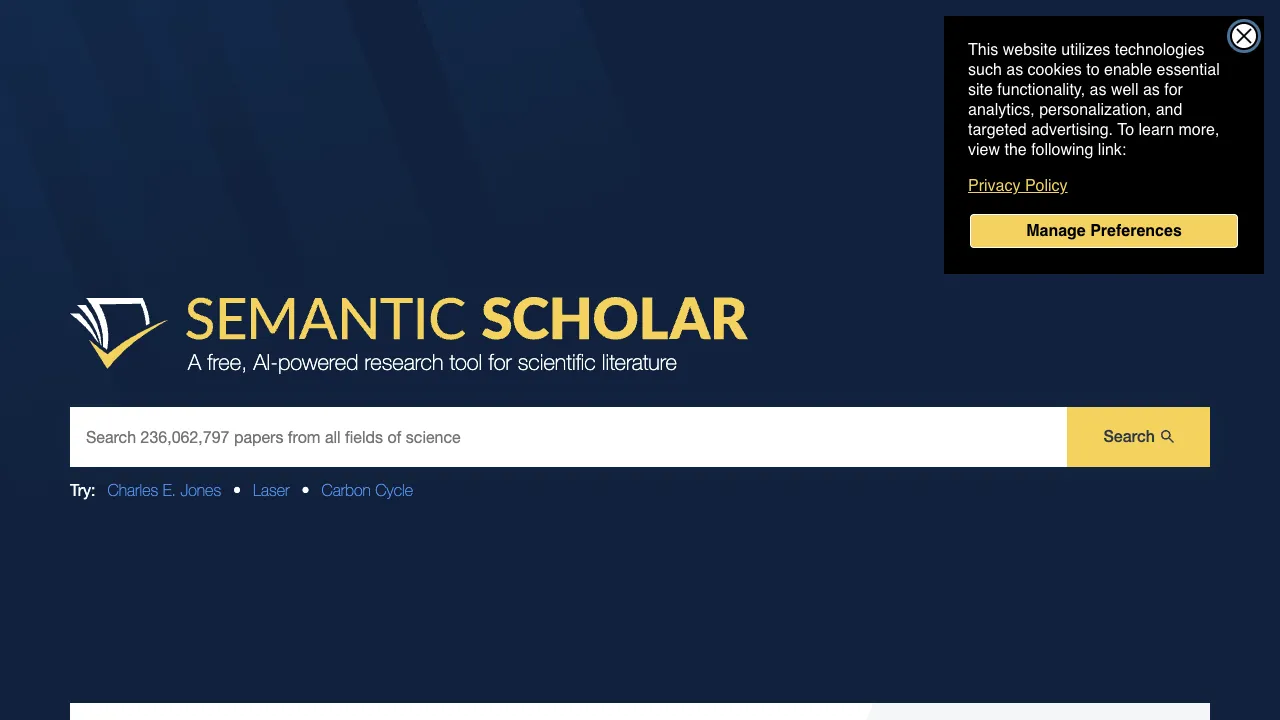
Semantic Scholar is a free academic search engine built by the Allen Institute for AI (AI2). Unlike plain keyword search, it uses AI to "understand" paper content, helping researchers find, filter and make sense of literature faster — a common tool for literature reviews and research surveys.
What Semantic Scholar Is
According to its official API page, Semantic Scholar indexes about 214 million papers, 2.49 billion citations and 79 million authors across fields from computer science to biomedicine and physics. Its core strength is in the word "semantic":
- Semantic search: rather than only matching keywords, it interprets the intent of a query to surface genuinely relevant research.
- TLDR summaries: AI-generated one-sentence summaries help you decide quickly whether a paper deserves a close read.
- Citation context: shows what a paper cites and what cites it, and distinguishes the nature of each citation, so you can trace a line of research.
- Highly influential citations: flags influential citations and papers to help judge importance.
- Author and topic pages: gather related work by a researcher or on a topic.
Reading and Tracking Tools
- Semantic Reader: an enhanced paper reader that shows details of cited works right inside the PDF, so you don't have to flip back and forth to the references.
- Research Feeds: recommends newly published related research based on papers you've saved — useful for following a field over time.
- Library: save papers to your own library and organize them.
Getting Started: A Round of Literature Review
- Search by describing the question in plain language rather than juggling keyword combinations; filter by year, field or PDF availability.
- Skim each result's TLDR first and save the ones worth a close read to your library.
- Open a core paper and follow its "cited by" list forward to the latest work, and its "references" list back to the theoretical sources.
- Turn your saved papers into a Research Feed so new papers are pushed to you automatically.
For Developers: API and Datasets
- API: it can be called without a key, but all unauthenticated users share one rate-limit pool (the official page says 1,000 requests per second shared); with an API key, the introductory limit is 1 request per second, with more predictable availability.
- Open datasets: including the S2AG academic graph and the S2ORC corpus for NLP and text mining, useful for building your own research tools. Check the API license agreement before any commercial use.
Who It's For
- Researchers and graduate students: literature reviews, tracking a field, finding related work.
- Students: researching papers and understanding where concepts came from.
- Anyone who reads academic papers: quickly locating key research in a large body of literature.
Strengths
- Completely free: built by a nonprofit, with no subscription wall.
- AI that reads content: TLDR summaries and semantic search cut the cost of screening literature.
- Citation analysis: citation networks and influence signals help judge a paper's value.
- Open data: an API and public datasets.
Tips
Screen quickly with TLDRs, then read the key papers closely — it makes literature surveys much faster. Following the "cited by" chain often leads to the newest work in a direction. TLDRs are AI-generated, so always go back to the original before citing. Coverage is strongest for English-language literature and more limited for Chinese and some niche fields, so combine it with databases such as CNKI or Google Scholar when needed.
How It Compares
- For the widest coverage and citation counts: Google Scholar covers more.
- If you want AI to read several papers and answer questions directly: pair it with AI search such as Perplexity or a dedicated paper Q&A tool.
Pricing
Semantic Scholar is completely free, and the API is open to researchers and developers.