

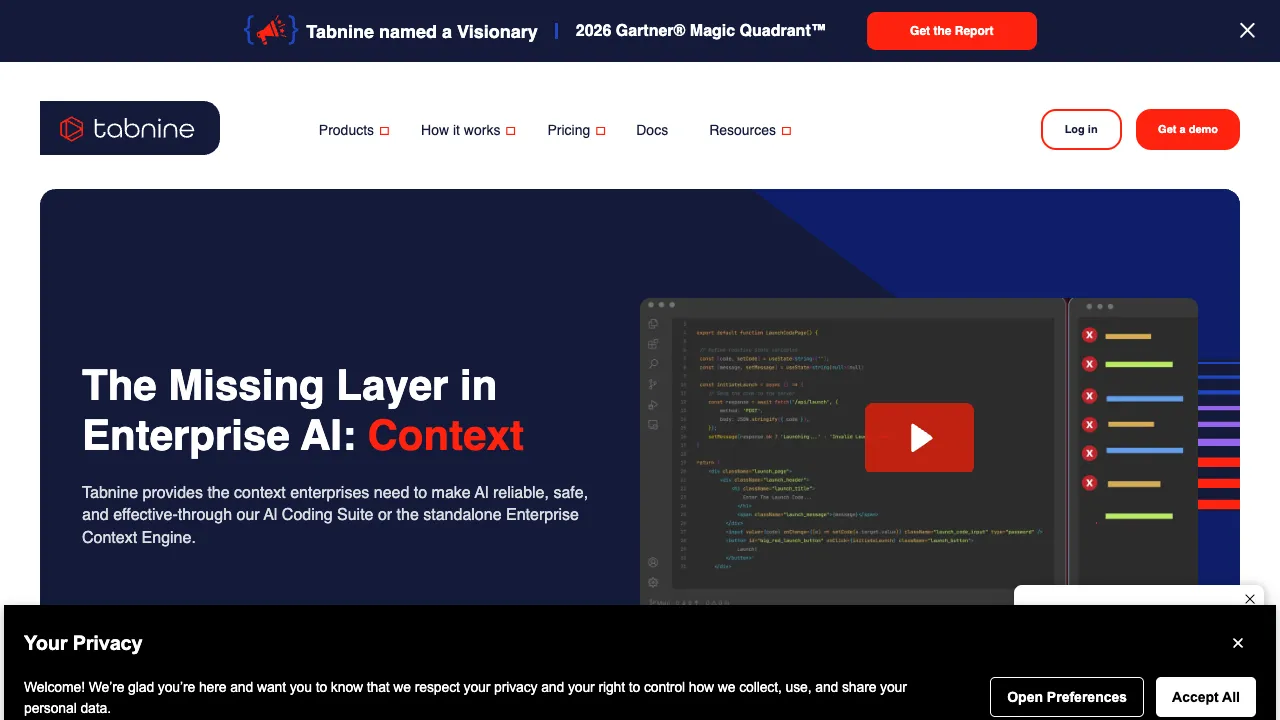
There is no free plan and no individual plan any more. Tabnine retired the free Basic tier on April 2, 2025 and then discontinued the $9–12/month Dev plan. By mid-2026 only two options remain — Code Assistant at $39/user/month and Agentic Platform at $59/user/month — both annual billing only. Many pricing guides dated 2026 still list a $12/month Dev plan; that information is roughly a year stale.
Before GitHub Copilot, Tabnine was already the most widely used AI code completion tool. As a pioneer in this space, Tabnine started as a simple code completion plugin and has evolved into a more comprehensive AI programming assistant, carving out a differentiated enterprise-focused path distinct from Copilot.
What is Tabnine?
Tabnine is an AI-powered code completion and programming assistance tool launched in 2018 under the name Codota (later rebranded to Tabnine). It analyzes code context to predict and complete code for developers in real time, supporting almost all major programming languages (Python, JavaScript, TypeScript, Java, Go, Rust, C++, etc.) and nearly all mainstream IDEs (VS Code, the entire JetBrains suite, Vim, Emacs, etc.).
While Tabnine competes directly with GitHub Copilot in market positioning, it has one core differentiator: Tabnine offers a fully private, on-premises enterprise version where code is never uploaded to third-party servers and runs entirely within the enterprise’s own infrastructure. This feature is critical for enterprises with strict code security requirements, such as those in finance, healthcare, defense, and government sectors.
Core Features
Real-time Code Completion
This is Tabnine’s core capability. As you type, Tabnine analyzes context (what you are writing, other code in the current file, and related files in the project) to predict what you might write next. Suggestions appear inline, and you can accept them by pressing the Tab key.
This completion goes beyond simple keyword matching; it performs semantic-level code prediction:
- Predicts function implementations based on your function names and parameter types
- Generates corresponding code from comments
- Continues writing patterns based on similar code structures
Full-line and Multi-line Completion
Tabnine doesn’t just complete the current word or line; it can complete entire lines or multiple lines of code at once. For repetitive code patterns (CRUD operations, configuration files, standard test case structures), this capability generates several lines simultaneously, significantly boosting typing efficiency.
AI Chat Assistant (Chat)
Interact directly with Tabnine within your IDE to ask it to explain code, refactor code, find bugs, generate documentation comments, or write test cases. Similar to GitHub Copilot Chat, this feature integrates code Q&A directly into the development workflow.
Codebase-aware Context Understanding
Tabnine can analyze an entire project’s codebase, not just the current file. For large projects, the AI understands the overall architectural patterns, naming conventions, and interface designs of the project, generating code that aligns with the project’s holistic style rather than isolated "best practices."
On-premises Deployment (Enterprise Core Feature)
This is Tabnine’s primary differentiator: the Enterprise edition supports deploying Tabnine on your own servers, processing all code internally within the intranet so that code never leaves the enterprise network. For enterprises with intellectual property protection needs and compliance requirements, this feature provides a capability that Copilot and other cloud-based tools cannot offer.
Comparison with GitHub Copilot
Tabnine and GitHub Copilot are the most direct competitors in the market, each with its own strengths:
GitHub Copilot’s Advantages: Backed by OpenAI and Microsoft’s technical accumulation, it boasts strong model capabilities, deep integration with the GitHub and VS Code ecosystems, higher brand recognition, and a larger base of individual users.
Tabnine’s Advantages: On-premises deployment (a key factor for enterprises); clearer commitments to code security and privacy; support for a wider variety of IDEs (including the entire JetBrains suite, Vim, etc., which Copilot does not cover); and more flexible team-customized model features.
For individual developers, the differences are minimal, with similar functional experiences. For enterprises with security and compliance requirements, Tabnine’s on-premises deployment is a distinct advantage.
vs Amazon CodeWhisperer: Amazon’s AI programming assistant offers excellent code completion for AWS SDKs and provides specialized optimizations for teams using the AWS tech stack. Tabnine is more general-purpose and not tied to any specific cloud platform.
vs Codeium: Codeium is a free AI code completion tool with features similar to Tabnine, but it is completely free (including for commercial use). For individual developers with limited budgets, Codeium is a viable option; for enterprise users, Tabnine’s on-premises deployment feature offers greater value.
Who Should Use Tabnine?
Enterprises with strict code security requirements: For industries like finance, healthcare, and government that must comply with data regulations where code cannot be uploaded to third-party servers, Tabnine’s on-premises deployment is the preferred choice.
JetBrains Users: Users of JetBrains IDEs such as PyCharm, IntelliJ IDEA, and WebStorm will find Tabnine’s support more mature than Copilot’s.
Multi-language Developers: Those who switch between multiple programming languages will appreciate Tabnine’s comprehensive support for 30+ languages.
Individual Developers and Students: The free version provides basic code completion features suitable for personal projects and learning, allowing users to experience AI code completion without paying.
Pricing
Two plans, annual billing only:
- Code Assistant, $39/user/month: AI code completion, in-IDE chat across major editors, IP protection and flexible deployment
- Agentic Platform, $59/user/month
No free plan and no individual plan. Free Basic was retired on April 2, 2025 and the $9–12/month Dev plan discontinued shortly after. When the enterprise context engine launched in March 2026 the message became explicit: entry is $39/user/month, annual billing only, with no monthly option and no individual licence.
The cost people miss: if you self-host, you also pay for the compute to run the models — the per-seat licence does not include infrastructure, and third-party analyses estimate this can add hundreds to thousands of dollars a month. On procurement, Vendr deal data puts the median contract at about $23K a year across seven deals.
Why teams still choose it: zero code retention, IP protection, and deployment across SaaS, VPC, on-premises and fully air-gapped setups. For organisations whose compliance teams would reject Copilot outright over data residency, air-gapped on-premise deployment is one of the few production-ready options in the category. It was also named a Visionary in Gartner's May 2026 enterprise AI coding agents evaluation.
Check tabnine.com/pricing for current rates.
Limitations
Code generation quality is not the strongest: Compared to GitHub Copilot and Claude (within Cursor), Tabnine’s model capabilities are not top-tier, particularly when generating complex functional code.
Free version features are limited: The free tier restricts both completion quality and request volume, preventing users from experiencing the full product capabilities.
Lower awareness and community support than Copilot: GitHub Copilot has a larger user community, making it easier to find help when issues arise.
Tabnine is a product with a clear differentiated positioning in the AI programming assistant space—on-premises deployment and code security are its core competitive advantages. For enterprises with these specific needs, it is a more suitable choice than Copilot.