

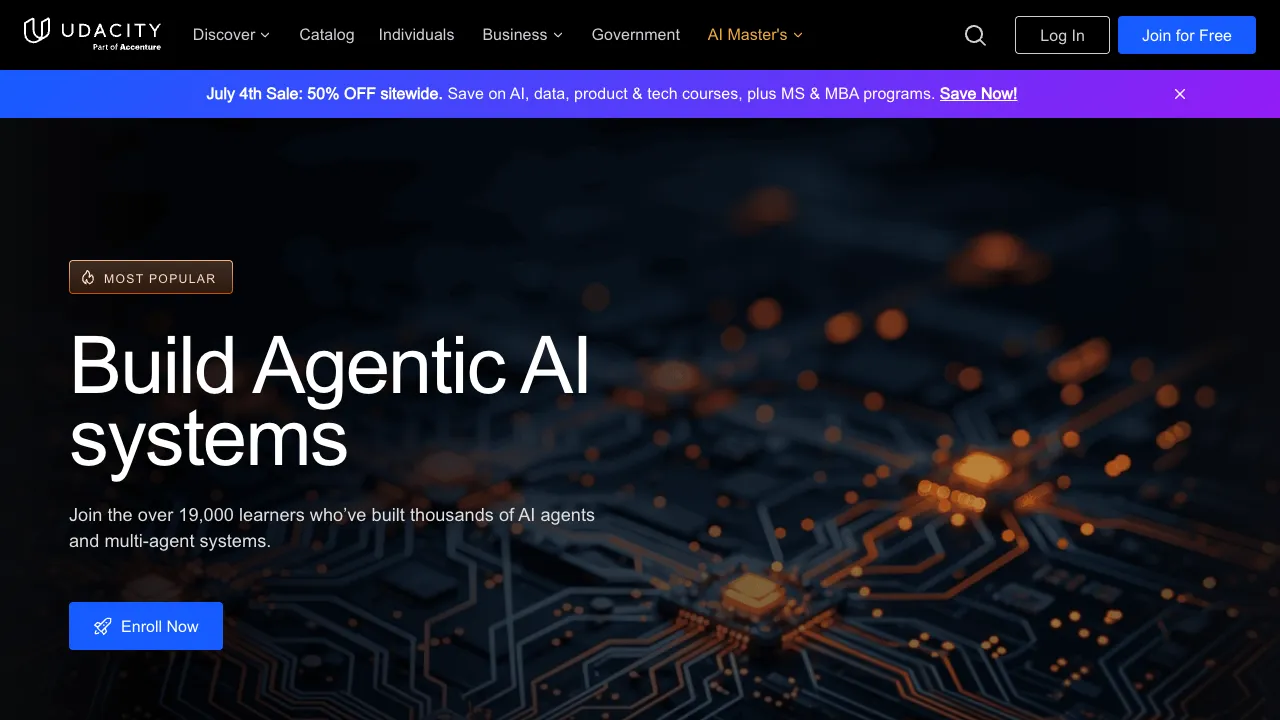
With so many online learning platforms available, few truly deliver on the promise of "getting a job after completing the course." Udacity has long held a unique position in this space—it doesn’t compete on the volume of courses offered but instead focuses on career transitions, designing curricula specifically tailored for tech industry hiring. Its AI Academy (School of AI) is Udacity’s core content pillar for artificial intelligence, covering a complete learning path from foundational concepts to professional engineering roles.
What Is the Udacity AI Academy?
The Udacity AI Academy (udacity.com/school/school-of-ai) is a curriculumsystem specifically established by Udacity for AI/ML tracks, offering "Nanodegree" courses ranging from AI programming fundamentals to deep learning, computer vision, natural language processing, and machine learning operations.
Udacity was founded by Stanford University professor Sebastian Thrun, who is also the founder of Google’s self-driving car project. Many courses in the School of AI are co-developed with tech companies such as Google, NVIDIA, IBM, and Kaggle, resulting in content that aligns more closely with real-world industry needs than purely academic university courses.
The core feature of a Nanodegree is not just video lectures, but a comprehensive learning experience that includes project assignments, mentor feedback, and career coaching.
Main Course Tracks
AI Programming with Python
An entry-level course covering the fundamentals needed to build AI applications with Python: Python programming, NumPy, Pandas for data processing, Matplotlib for visualization, and the application of linear algebra and calculus in machine learning. This serves as the starting point for entering the AI field and is suitable for beginners without a relevant background.
Machine Learning Engineer Nanodegree
A comprehensive machine learning course covering supervised learning, unsupervised learning, deep learning fundamentals, model evaluation, and hyperparameter tuning. The curriculum includes numerous practical projects, such as predicting housing prices using machine learning and image classification, providing students with substantial project experience upon completion.
Deep Learning Nanodegree
An advanced course specifically focused on deep learning, designed with the involvement of Andrew Trask, a key figure in the field and author of Grokking Deep Learning. Content includes neural network fundamentals, convolutional networks, recurrent networks (RNN/LSTM), generative adversarial networks (GANs), and more.
Computer Vision Nanodegree
Co-developed with NVIDIA, this track focuses on computer vision areas such as image recognition, object detection, and image segmentation. The course uses PyTorch and includes practical projects like robotic vision and autonomous driving vision systems.
Natural Language Processing Nanodegree (NLP)
Covers NLP directions including text processing, sentiment analysis, machine translation, and speech recognition. Developed in collaboration with companies such as IBM, the curriculum features hands-on projects like building speech recognition systems and translation models.
Machine Learning Operations (MLOps)
A relatively new track covering ML model deployment, monitoring, and automated training pipelines, addressing the engineering challenge of "how to deploy and maintain a model after it has been trained." This direction sees high demand in enterprises, though teaching resources are less abundant than those for pure ML algorithms.
Generative AI Nanodegree
A new track launched after 2023, covering core GenAI technologies such as large language models, prompt engineering, fine-tuning, and retrieval-augmented generation (RAG), aligning with the hottest trends in the current industry.
Learning Model Features
Project-Driven
Each Nanodegree is centered around projects, going beyond watching videos and taking multiple-choice questions. Students must complete actual coding projects and submit them for review, receiving written feedback from Udacity mentors (who are mostly industry practitioners). The resulting project portfolio can be used directly for job applications.
Mentor Support
Dedicated technical mentors provide code reviews and project guidance, while learning coaches monitor your progress. This is a core differentiator between Udacity and pure video course platforms (such as certain Coursera courses or YouTube).
Career Coaching
Nanodegrees include career services—resume reviews, LinkedIn optimization, and interview preparation. Udacity has hiring partnerships with numerous tech companies, occasionally facilitating direct connections with employers.
Flexible Schedule
All courses are self-paced with no fixed class times. The official recommendation is to invest about 10 hours per week, with a suggested completion time of 3–6 months for most Nanodegrees.
Comparisons with Other Learning Platforms
vs Coursera + DeepLearning.AI: Andrew Ng’s Deep Learning Specialization is a classic path for AI learning, featuring rigorous content and an option to audit for free; it is relatively more affordable and has a higher proportion of academic content. Udacity focuses more on engineering practice and employment, offering higher-quality project assignments with mentor feedback.
vs fast.ai: fast.ai offers completely free, practice-oriented deep learning courses with a unique "top-down" learning approach and an active community; however, it does not provide certificates or career coaching. Udacity is better suited for learners who need a systematic learning path and job-seeking support.
vs edX Professional Certificates: edX hosts AI courses from prestigious universities like MIT and Columbia University, backed by strong academic reputations; Udacity’s industry partnerships and hands-on projects may offer greater direct help for employment.
vs Domestic AI Courses (Geek Time, MOOCs, etc.): Domestic platforms offer Chinese-language content at lower prices; Udacity is entirely in English, featuring more international projects and career connections, making it suitable for learners aiming to work in the global market.
Who Is Udacity’s AI Academy For?
Professionals looking to transition into AI/ML engineering roles: If you have some programming foundation (Python) and want to systematically learn ML knowledge while accumulating project experience to change jobs, Udacity’s system and career coaching are most valuable for this group.
Engineers looking to enhance their AI skills: If you are already a software engineer wanting to add ML capabilities to your skill set, the depth of the Nanodegree is sufficient to support a role transition or skill upgrade.
Learners with strong English proficiency: The courses are entirely in English and require good reading and listening skills; those with barriers to English are advised to consider domestic platforms first.
Serious learners willing to invest time and money: Udacity’s pricing is not low, and the courses require project submissions. It is suitable for serious learners with clear goals, not for casual browsing or superficial learning.
Limitations
Price is the biggest barrier: Nanodegrees typically cost around $300–$400 per month. Completing one requires 3–4 months, resulting in a high total investment. For learners who feel the content is unsatisfactory after studying, the refund policy should be understood clearly in advance.
The industry recognition of certificates is higher in the US market than in China; domestic companies’ familiarity with Udacity Nanodegrees varies significantly.
The pace of course content updates sometimes fails to keep up with the rapid development of the AI field, and some technical details may lag behind the latest industrial practices.
Pricing
Nanodegrees are subscription-based, costing approximately $299–$399 per month, depending on the course and discounts. Udacity frequently runs promotions, sometimes with significant discounts. Occasionally, there are sponsored free spots, particularly for specific courses launched in partnership with companies like Google or NVIDIA. Specific prices are subject to the official website.
If you have clear AI/ML employment or career transition goals and no language barriers, the systematic and practical nature of Udacity’s AI Academy is worth the investment. If you simply want to understand what AI is, try the free content on Coursera or fast.ai first; confirming your interest before considering Udacity’s paid courses is more cost-effective.