

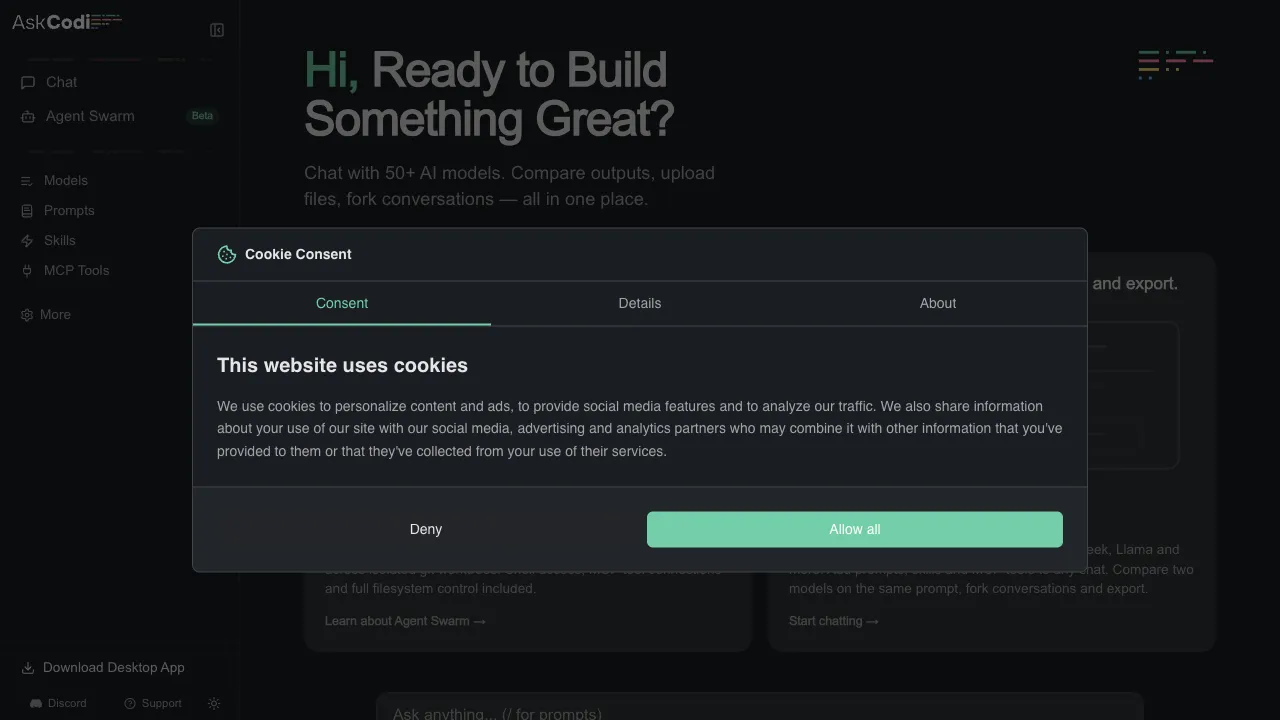
AskCodi now describes itself as a "coding cofounder": it turns ideas into tested code in a GitHub repository you own and keeps maintaining it within boundaries you set. It also offers an OpenAI-compatible AI Gateway for calling models from multiple providers through one endpoint.
A Product That Changes Quickly
This product has changed shape several times in a year. It started as an IDE plugin for code completion and unit test generation; when we checked it in August 2026 it was a local-first desktop multi-agent platform; by late September the official site had moved to the "coding cofounder + AI Gateway" pitch described here. Everything below reflects the official site as of September 29, 2026 — check again before committing to it.
How It Works
- Two starting points: describe what you want in plain language, or connect an existing GitHub repository.
- Work runs as "plays": the site calls each piece of work a play — a defined outcome with a visible execution pipeline that can run on a schedule, which is how it takes on routine maintenance.
- Autonomous within limits, key decisions come back to you: it moves forward on its own inside the boundaries you set, and hands decisions about money, scope changes and irreversible actions back to you.
- Goes through GitHub review: code passes code review and CI checks before it deploys, and every change stays in your own repository.
- Entry points: a web app (app.askcodi.com), plus a downloadable desktop app.
AI Gateway
AI Gateway is an OpenAI-compatible endpoint that, according to the vendor, gives access to more than 200 models including Claude, GPT and Gemini; you connect with standard SDKs by changing the base URL and key. It shares one token balance with the coding cofounder: the more the cofounder runs, the less is left for the Gateway, so budget for both together.
Pricing
- Free: 300,000 tokens a day, reset at midnight UTC; one app, one seat.
- Pro: $29, $99 or $199 a month, with the full price returned as that month's credit. All three tiers have the same features and differ only in credit — up to 5 apps, 3 seats and 3 concurrent agent sessions.
- Enterprise: custom pricing, up to 500 seats, with invoicing.
- Top-ups: $10 for 8M tokens, $25 for 20M and $100 for 80M, which works out to $1.25 per million tokens.
This reflects the official pricing page as of September 29, 2026; check the site for current terms.
Who It's For
- Solo developers or small teams who want to build a small application from scratch and keep it maintained without dedicated engineering staff;
- People with an existing GitHub repository who want to hand routine maintenance to scheduled jobs;
- Developers who need one endpoint for switching between model providers — the AI Gateway can be used on its own.
Before You Start
- Start small. The product changes shape often, so don't hand over an important project all at once.
- Set clear boundaries and keep review in place. It commits and deploys on its own within those boundaries, so keep code review and CI switched on. Irreversible actions come back to you for confirmation, but read what changed before you approve.
- Your code needs to live on GitHub. It works around GitHub repositories, so projects that can't be hosted on GitHub or must be developed offline aren't a fit.
- The token balance is shared. Heavy automation drains it faster than you might expect; watch your real usage on the free tier for a while first.
How It Compares
- If you want to control changes line by line in your own editor, AI editors such as Cursor and Windsurf are a better fit.
- If you prefer letting an agent edit code from the terminal: Claude Code, the CLI in Google Antigravity or OpenCode.
- To generate a runnable web app straight from a one-line description: Bolt.new or Replit Agent.
- If you only need a unified multi-model endpoint, OpenRouter is the more established choice.