

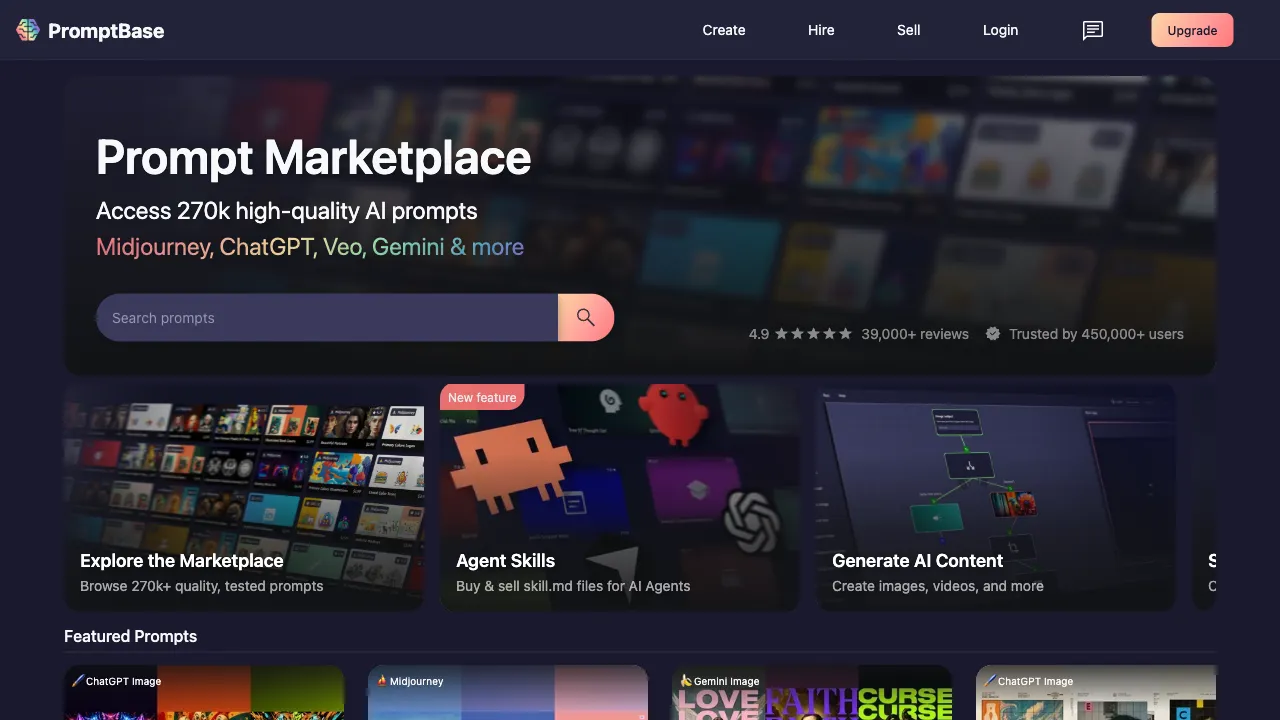
In 2022, a new profession briefly became a buzzword in the AI wave: "Prompt Engineer," with rumored annual salaries reaching $200,000–$300,000. The logic behind this was that in the era when Midjourney image generation still heavily relied on "spells," writing prompts itself was a scarce skill. The gap in output quality between good and bad spells was so vast that it could determine the success or failure of a project. PromptBase was born riding this wave—it did something fresh at the time: selling prompts as commodities. As the first platform to commercialize "prompts," it allowed those who could write them to monetize their skills, while letting users save the time spent on repeated trial and error for just a few dollars.
The rise and fall of this business model is itself a condensed history of AI tool evolution.
What is PromptBase?
PromptBase (promptbase.com, launched in 2022) is an AI prompt marketplace: sellers (prompt engineers) upload fine-tuned prompts for sale, while buyers spend a small amount (typically $1.99–$9.99) to purchase verified high-quality prompts for use with tools like Midjourney, SD, DALL·E, and ChatGPT. The platform takes a 20% commission, leaving sellers with 80%. Its core premise is: good prompts are valuable intellectual property worthy of pricing and trading.
Core Features
Prompt Marketplace
A searchable catalog of prompt products, categorized by tool (MJ/DALL·E/ChatGPT/SD) and use case (product photography, portraits, commercial illustration, copywriting, code). Each product includes example outputs (showing the effect), scenario descriptions, and upon purchase, the full prompt text along with usage instructions—the e-commerce logic of "see the effect first, buy only if satisfied," which reduces the risk of blind purchases.
Seller Monetization
Register to upload and sell, which gave rise to the first generation of "professional prompt engineers"—people who specialize in researching and producing various prompts for monetization. In an era when prompt-writing skills were scarce, this was a real small business; its rise and fall also served as a barometer for the proposition of "prompt value."
Integrated Generation (FLUX, etc.)
Later added in-platform generation capabilities, allowing users to generate images directly after purchasing prompts, integrating new models like FLUX—extending from "selling recipes" to "recipes + kitchens," attempting to retain users.
Review System
Buyer ratings filter for high-quality content; commercial incentives drive quality control—good creators are seen, while low-quality prompts are eliminated.
The Reality It Must Face: This Market Is Being Impacted by the Times
What is most worth telling about PromptBase’s story is the structural challenges it faces—which is also key to deciding whether to use it:
Overwhelming free resources: Platforms like Civitai, OpenArt, PromptHero, and Midlibrary provide massive amounts of free prompts; there is simply no need to pay for general needs.
Large models can now optimize prompts themselves: Having ChatGPT/Claude help you write and revise prompts is both free and customized, greatly reducing the necessity of "paying for ready-made" solutions.
Models are becoming more "human-understanding": Midjourney V6+, DALL·E 3, and new-generation models have significantly improved their understanding of natural language; the technical barrier of "prompt jargon" has been leveled by the models themselves—you can describe things in plain language and still get good results.
The combined result of these three forces is: the halo of "Prompt Engineer" as an independent profession is fading, with prompts shifting from a "scarce skill" to "common knowledge." The foundation of "prompt scarcity" that PromptBase relied upon has been continuously eroded by technological progress.
Does It Still Have Value?
Yes, but it has narrowed to high-end professional scenarios: prompts that have undergone extensive testing and tuning for specific professional styles—precise product photography styles, specific cinematic rendering, stable and reproducible commercial styles—these "competitive assets" still have people willing to pay for them because what they save is not minutes, but days of professional debugging. For daily general needs, free resources are sufficient; for commercial-grade precise reproduction needs, PromptBase’s high-end offerings remain a shortcut.
Comparison with Peers
vs Civitai/OpenArt/PromptHero: Free sharing communities, the main source of general prompts; PromptBase uses a paid threshold to filter out "more serious creators," theoretically offering higher quality, but you have to pay for it.
vs Letting Large Models Optimize Prompts: Free, customized, instant—this is PromptBase’s strongest invisible competitor and the fundamental force impacting its business model.
vs Researching Yourself: Investing time allows you to create prompts that fit your needs perfectly, with accumulating capabilities; PromptBase is a shortcut of "spending small money to save time," suitable for those who don’t want to delve into it.
Who Is It For?
AI art users with commercial-grade quality requirements: People who need to stably reproduce specific professional styles (product images, commercial illustrations) can buy verified high-end prompts, which is faster than tuning them themselves—the core audience for its residual value.
Prompt experts attempting monetization: For those who have deeply studied prompts and want to try monetizing them, PromptBase remains one of the few viable channels (although the cake is shrinking).
Those wanting to deconstruct and learn specific styles: Buy a prompt for a target style as a template to deconstruct, understanding the structure of high-quality prompts—use it as paid teaching material.
Pricing
Purchase individual prompts, typically $1.99–$9.99, with perpetual usage rights upon purchase; no subscription model; sellers receive an 80% revenue share. Specifics are subject to the official website.
PromptBase is a vivid slice of AI tool evolution history: it precisely captured the window period of "prompt scarcity" to become a pioneer, and then watched as this window was gradually closed by free resources and smarter models. Today, its reasonable positioning is a boutique store for high-end professional prompts, rather than a mass necessity. For ordinary users, asking whether free resources and large model optimization are sufficient—likely yes; only when you need "professional-grade precise styles that might take days to tune" does its boutique shelf become worth browsing.