

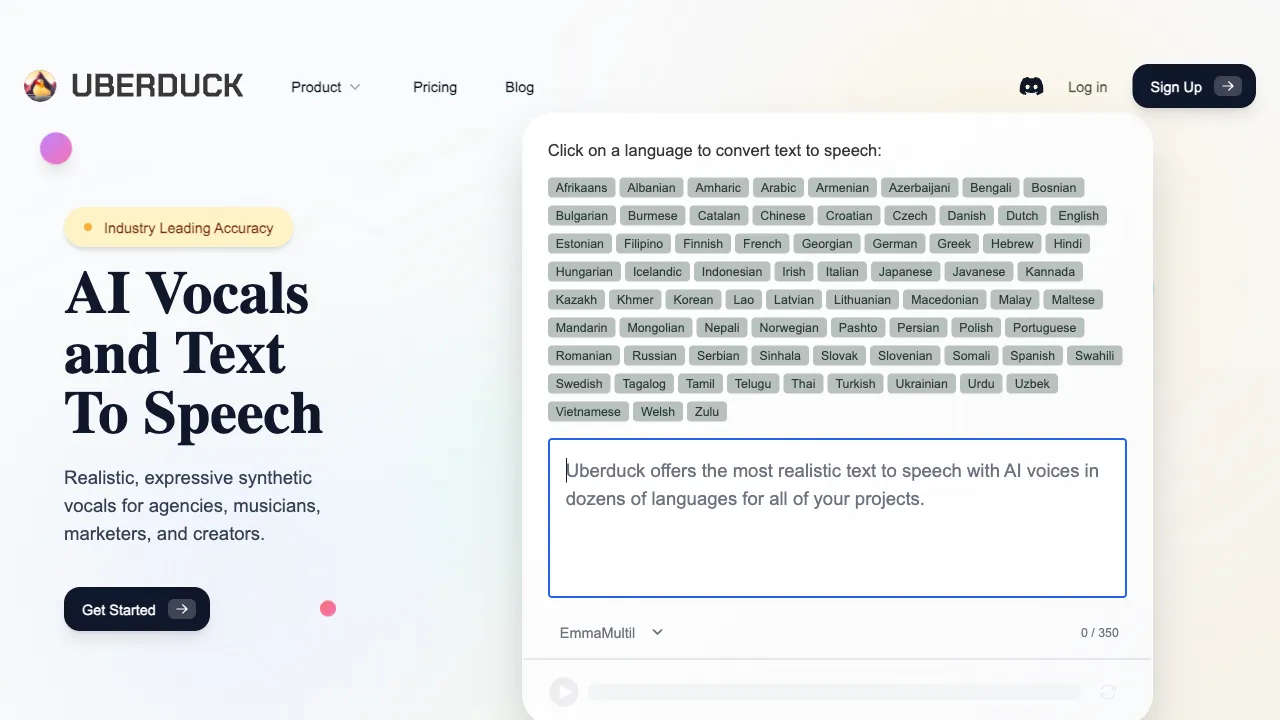
The product is much diminished — understand its state before using it. In July 2023, following the SAG-AFTRA and WGA strikes, the platform removed all user-created voices to avoid further lawsuits, having already lost a legal dispute with Universal Music Group. The catalogue shrank from over a hundred voices to roughly 30, the site is kept largely for archival purposes, and the company has acknowledged it may shut down. It offers no SLAs or uptime guarantees, and lacks enterprise features such as SOC 2 compliance, data residency options and audit logs. Most of its user base has moved to other AI voice platforms.
Around 2021, a specific type of video suddenly went viral on TikTok: classic animated characters "singing" pop songs in their own voices or delivering absurd lines. Much of the technology behind this meme wave came from Uberduck—whose community voice library at the time contained thousands of character voice models available for free use, briefly becoming an arsenal for internet meme culture. Later, even musician Yung Gravy incorporated its technology into his song production, marking the first large-scale entry of "AI voices" into the pop culture production chain.
This history is the key to understanding Uberduck: from the start, it was never aimed at "commercial voiceover," but rather at "creative play with voices," and in its subsequent development, it increasingly tilted toward AI music.
What is Uberduck?
Uberduck (uberduck.ai) is an AI voice and music generation platform, with core capabilities including text-to-speech (TTS), AI rap generation, voice cloning, and a speech synthesis API for developers. Its two signature assets are:
Community Voice Library: A vast collection of voice models trained and shared by the community, covering animated characters, game characters, celebrity styles, and original synthetic voices—this was the foundation of its early viral success.
AI Music Capabilities: Speech synthesis that can "sing," represented by Rap generation. You input lyrics, select a beat style (Flow), and the platform outputs rhythmic rap audio. This line has gradually become the platform's development focus.
The platform open-sourced parts of its toolchain early on, and developer community participation is part of its ecosystem.
Core Features
Characterized Text-to-Speech
Select a voice model, input text, and generate audio. The difference from standard TTS tools lies entirely in the composition of the voice library—here, voices are not "professional male voice #3," but have specific character identities and personality traits. Giving a mundane piece of text the tone of a particular character is itself the source of humor and creativity for content.
Voice models are contributed by the community, with a wide quality distribution: models for popular characters are trained on extensive material and can be indistinguishable from reality; less popular models may sound noticeably mechanical. Listening to a model's example output before use is basic practice.
AI Rap Generation
Uberduck’s most recognizable feature. The workflow: write (or have AI help you write) lyrics, choose a Flow (which determines rhythm and rhyme style), and the platform generates rap vocals that hit the beat, which can then be paired with backing tracks to export a complete song.
The audience for this feature is broader than expected: people making entertainment content who can’t rap, musicians quickly producing demos to verify lyrical rhythm, and video creators adding custom rap to their works. The fun of the "input text, output rap" experience is the core reason for Uberduck’s viral spread.
Voice Cloning
Upload voice material to train a custom voice model. Individual creators can clone their own voices for content voiceovers, while developers can create exclusive voice personas for products. Cloning quality depends on the duration and cleanliness of the source material.
Developer API
Provides API access for speech synthesis and music generation, with application scenarios including game NPC voiceovers, character voices for interactive apps, and automated content production pipelines. The supply of characterized voice APIs is relatively scarce in the market, which is Uberduck API’s differentiating selling point.
Comparison with Similar Tools
vs ElevenLabs: ElevenLabs is the benchmark for AI voice quality, leading comprehensively in realism, emotional expressiveness, and multilingual support, with clear commercial licensing; it is the top choice for audiobooks, video narration, and professional voiceover. However, it does not provide character entertainment voices, and its pricing targets professional users. The relationship between the two is division of labor, not competition: use ElevenLabs for serious voiceover, and Uberduck for creative play and music.
vs FakeYou: FakeYou is a community character voice platform with similar origins to Uberduck; currently, it stands out more in the number and activity of community models for "character TTS." Uberduck’s focus leans more toward AI music and rap generation. If you want characters to "speak," check FakeYou first; if you want AI to "sing," Uberduck is a better fit.
vs Suno / Udio: These two are leading products in current AI music generation, capable of generating complete songs (vocals + arrangement) directly from text descriptions. Their capability dimension is more complete than Uberduck’s Rap generation. Uberduck’s advantage lies in finer control over the voice itself (specifying voice models, writing your own lyrics, choosing Flow), making it suitable for users who want to control creative details.
vs Azure / Google Cloud TTS: Enterprise-grade TTS services are stable, compliant, and multilingual, suitable for scaled applications like customer service and announcements; they completely lack character and musical play. The needs they address do not overlap.
vs Domestic Tools (e.g., iFlytek Voiceover): Chinese TTS quality is significantly better with domestic tools; Uberduck’s voice library is overwhelmingly English-based, with weak Chinese support, making it unsuitable for Chinese voiceover needs.
Who Should Use Uberduck?
Meme Content and Entertainment Video Creators: For funny voiceovers, character parodies, and AI cover songs on YouTube and TikTok, Uberduck’s voice library and Rap generation are ready-made creative toolboxes.
Music Enthusiasts and Producers: Those wanting to quickly test the rhythmic effect of lyrics, create a demo, or simply experience the fun of "AI rapping for me."
Indie Game Developers: Who can’t afford voice actors but need NPCs to have voices; API integration of characterized TTS is a low-cost solution (note: choose voice models with clear licensing).
Learners of AI Voice Technology: The community model library serves as a living sample of observing speech synthesis effects under different training qualities, and the platform’s open-source parts also have research value.
Legal and Ethical Boundaries
This section is not boilerplate disclaimers for platforms like Uberduck; it represents actual usage boundaries:
- Character voices involve copyright holders’ and voice actors’ rights; commercial use basically equals legal risk, and entertainment creation should remain within the obvious context of parody
- Do not use celebrity voices to impersonate them—producing content that misleads people into thinking it’s real has clear legal consequences in most jurisdictions, and legislation regarding AI voices is tightening continuously
- Labeling AI-generated voice content as such is currently the basic ethical consensus within the community
- Platform terms prohibit fraudulent or harassing uses; violating content will be handled
The safe zone is clear: self-amusement, obvious parody, using your own cloned voice for serious content. The closer you get to "indistinguishable from reality" and "commercial profit," the more dangerous it becomes.
Pricing
The site is still reachable, but the product is much diminished, and no current tiers or allowances appear on publicly readable pages.
The risk to weigh before paying: the company offers no SLAs or uptime guarantees and has acknowledged it may shut down. If it does, custom voice clones disappear and content libraries become inaccessible. Status monitors currently disagree about whether the site is up.
If you need AI voice capability you can rely on long-term, choose a platform that is actively operating with explicit service commitments.